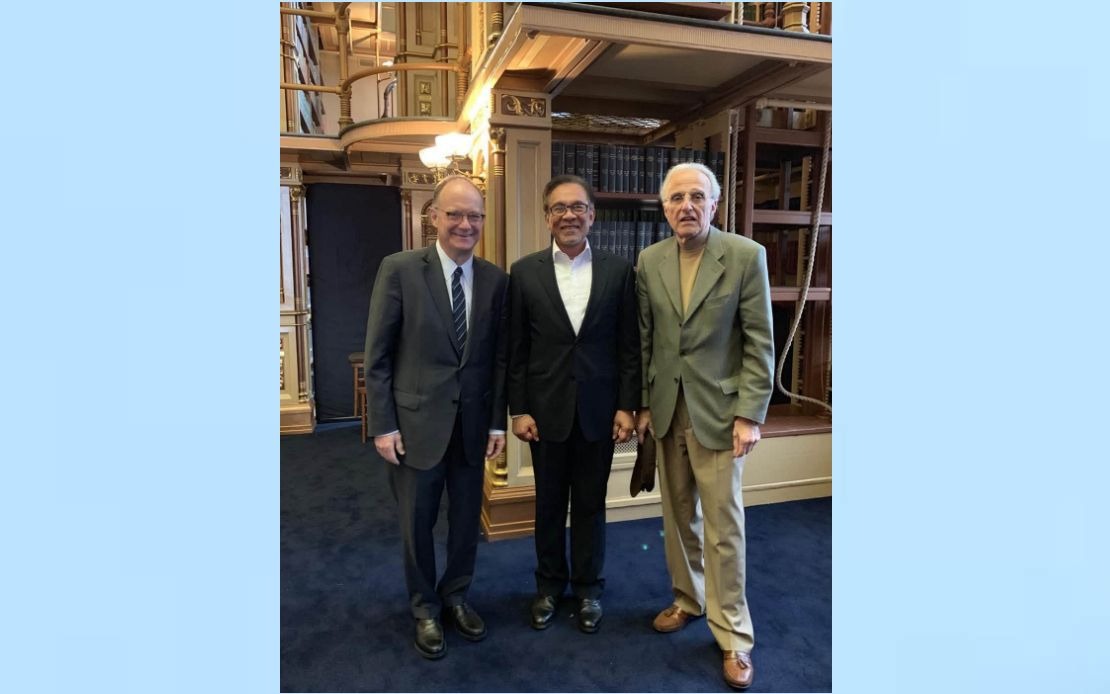
Prime Minister Datuk Seri Anwar Ibrahim has mourned the passing of Professor John L. Esposito, one of the world's foremost authorities on Islamic studies and interfaith relations. Through a statement posted on social media, Anwar expressed his profound sorrow at the loss of a scholar whose intellectual contributions reshaped how millions in the West perceive and understand Islam as a religion and civilization.
The Prime Minister's tribute underscores a remarkable personal connection spanning more than five decades, originating from their first encounter during the early 1970s. This enduring relationship between Malaysia's leader and the Georgetown-based academic speaks to the depth of Esposito's influence within Muslim political and intellectual circles globally, and the particular respect he commanded among progressive Muslim leaders who sought to bridge divides rather than entrench them.
Esposito's most significant institutional legacy rests with his founding of Georgetown University's Centre for Muslim-Christian Understanding, a pioneering establishment that positioned interfaith scholarship at the heart of American academia during a period of considerable tension between Muslim and Western societies. This centre became instrumental in fostering dialogue when mutual understanding was desperately needed, particularly as geopolitical complexities threatened to reduce religious communities to monolithic stereotypes and adversarial positions.
Among his most impactful scholarly endeavours, Esposito co-authored Makers of Contemporary Islam, a work that traced the intellectual genealogies and trajectories of influential Muslim thinkers and leaders across the modern period. This contribution proved invaluable for readers seeking nuanced perspectives on how Islamic thought evolved through the twentieth century and into the contemporary era, grounding discussion in historical reality rather than polemical assertion.
Anwar specifically highlighted how Esposito's more populist publications democratised complex academic material for general audiences. Books such as What Everyone Needs to Know About Islam and Who Speaks for Islam? exemplified his commitment to accessibility without sacrificing scholarly rigour. These works gained particular salience in the post-9/11 environment, when global anxiety about Islam had reached fever pitch and authoritative, balanced voices became essential to counter misinformation and restore productive conversation across religious boundaries.
The Prime Minister employed evocative language in characterising Esposito's contribution to contemporary discourse, observing that he constructed intellectual and diplomatic bridges in contexts where others preferred to reinforce civilisational divisions. This framing situates Esposito within a broader tradition of bridge-builders whose work counters the deterministic narratives of inevitable civilisational conflict that gained prominence in early twenty-first century geopolitical analysis.
Anwar's personal recollections reveal dimensions of Esposito beyond his published output and institutional positions. The Prime Minister spoke of valuing the scholar's counsel and guidance throughout their long association, and characterised him as a devoted confidant who demonstrated unwavering loyalty across changing political circumstances and global upheavals. This intimate dimension humanises the academic and demonstrates how Esposito's influence extended beyond classroom and publication into the realm of personal mentorship and honest counsel.
In public discourse, Anwar emphasised that Esposito possessed an unusual capacity to combine intellectual precision with generous personal engagement. The scholar proved as thoughtful and generous in private conversation as he was demanding and meticulous in his published scholarship, a combination that often separates merely brilliant thinkers from those who genuinely reshape their fields through both intellectual and interpersonal influence.
The Prime Minister extended Malaysia's official condolences to Esposito's widow Jean and to his extended family, professional colleagues, and the numerous students whose intellectual formation he guided throughout his career. This formal gesture reflects the significance that Malaysia's government attaches to scholarly contributions to interfaith understanding, a priority that aligns with Malaysia's own constitutional commitments to religious pluralism and harmonious coexistence among diverse faith communities.
Anwar concluded his tribute by expressing confidence that Esposito's scholarly legacy and the foundation of dialogue he constructed would continue generating positive consequences long after his death. The Prime Minister characterised the late scholar as an authentic friend to the Muslim world, a designation that captures both Esposito's intellectual alignment with Muslim interests and his consistent advocacy for Muslim voices within Western academic and policy environments.
Esposito's passing represents a significant loss for scholars and practitioners of interfaith relations across Southeast Asia and beyond. In Malaysia specifically, where religious coexistence remains a foundational national principle but faces periodic strain, Esposito's body of work continues offering intellectual resources for those committed to building mutual understanding. His emphasis on listening to diverse Muslim voices and resisting reductive characterisations of Islam remains pertinent to contemporary Malaysian debates about religious identity, pluralism, and social cohesion.

