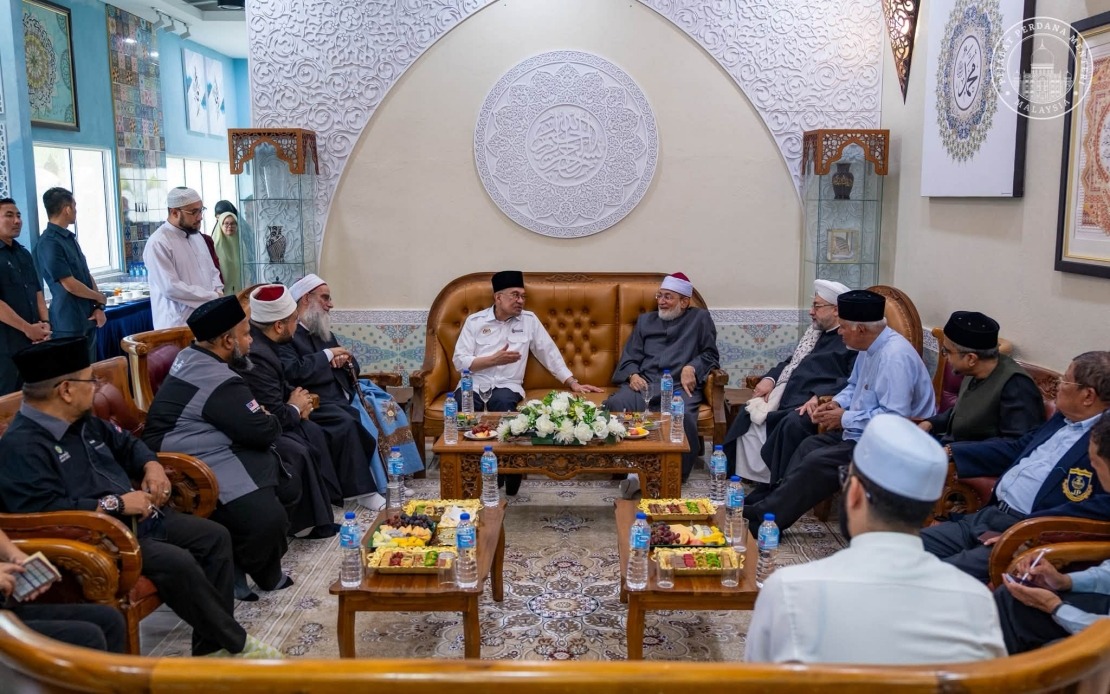
Prime Minister Datuk Seri Anwar Ibrahim made time in his packed schedule to meet with three prominent Islamic scholars who are currently visiting Malaysia, reflecting his administration's emphasis on engaging with leading figures in Islamic thought and scholarship. The visit underscores the government's efforts to strengthen religious knowledge and promote Islamic teachings within the country while maintaining inclusive and harmonious social values.
The three scholars visiting Malaysia represent different specializations within Islamic learning. Al-Fadhil Al-Allamah Al-Muhaddith Syeikh Dr Mustafa al-Nadwi Al-Hasani brings expertise in hadith studies, a foundational discipline in Islamic jurisprudence and theology. Al-Fadhil Al-Allamah Al-Muqri' Syeikh Dr Ahmad Isa Al-Ma'sarawy is recognized globally for his mastery of Quranic recitation, an art form that bridges spiritual devotion with linguistic precision. The third visitor, Al-Fadhil Al-Syeikh Maulana Al-Sayyid Afeefuddin Al-Jailani, serves as custodian of the waqf properties, mosques, and sacred sites associated with Syeikh Abdul Qadir Al-Jailani, the venerated 12th-century Islamic figure whose influence extends across Muslim communities worldwide.
Through his Facebook statement, Anwar conveyed that the meeting encompassed multiple objectives beyond ceremonial courtesy. He sought their counsel and prayers, recognizing the spiritual authority and wisdom these scholars carry within Islamic circles. This engagement reflects a broader pattern where Malaysia's political leadership acknowledges the importance of consulting with internationally respected Islamic figures on matters affecting the nation's religious and social direction.
The location chosen for the meeting, Nasyrul Quran, carries significance as an institution dedicated to Quranic studies and dissemination. This setting reinforces the thematic focus on knowledge-sharing and religious education, suggesting that discussions likely centered on collaborative initiatives to elevate Islamic scholarship in Malaysia and strengthen the populace's understanding of their faith.
For Malaysia's diverse society, such initiatives carry particular weight. The country's constitutional framework establishes Islam as the federation's official religion while guaranteeing freedom of worship for other faiths. High-level engagement with international Islamic scholars demonstrates the government's commitment to deepening Islamic knowledge and practice among the Muslim majority while maintaining the secular governance structures that protect religious pluralism. This balance represents an ongoing challenge in Malaysian politics, where religious discourse intersects with national identity and social cohesion.
Anwar's emphasis on building "a society that is virtuous, knowledgeable and lives in harmony" signals his administration's vision for religious development alongside social stability. By framing Islamic scholarship as a vehicle for strengthening both individual piety and communal peace, the Prime Minister positions religious learning as complementary to rather than at odds with Malaysia's multicultural foundations. This framing becomes increasingly important as Southeast Asia navigates demographic changes, generational shifts in religious expression, and evolving interpretations of Islamic teaching among younger Muslims.
The visit also reflects Malaysia's ongoing cultural diplomacy within the Islamic world. By hosting respected international Islamic scholars and engaging them at the highest political levels, the country reinforces its position as a center for Islamic learning and interfaith dialogue. Such positioning has implications for Malaysia's regional influence and soft power, particularly as competition intensifies among Muslim-majority nations to become hubs for contemporary Islamic thought and education.
International scholars visiting Malaysia contribute to a broader ecosystem of Islamic institutions, including universities, research centers, and established schools of Islamic jurisprudence. These visitors bring fresh perspectives, contemporary scholarly approaches, and networks connecting Malaysian Islamic communities to global centers of Islamic learning from Al-Azhar University in Egypt to institutions across the Middle East and beyond. Such connections can elevate the quality of religious education and ensure that Malaysian Islamic scholarship remains engaged with international developments in theological and jurisprudential discourse.
The timing and public nature of Anwar's visit carry political implications as well. By publicly demonstrating engagement with respected Islamic figures, the Prime Minister strengthens his credibility within conservative Islamic constituencies while signaling to secular-minded citizens and non-Muslim communities that religious leadership remains embedded within constitutional governance. This symbolic dimension proves crucial in Malaysian politics, where religious authenticity and demonstrated piety contribute to political legitimacy among significant voter blocs.
Looking forward, such engagements may establish frameworks for ongoing intellectual exchange and collaboration. International scholars visiting Malaysia often participate in public lectures, seminars, and workshops that ripple through Islamic institutions and educational networks far beyond the initial meeting with government leadership. These broader dissemination efforts can influence how Islamic teachings are understood and practiced at grassroots levels, potentially shaping religious discourse in Malaysia for years beyond the visiting scholars' time in the country.
The initiative also positions Malaysia as a destination for serious Islamic scholarship rather than merely a market for religious tourism or superficial cultural exchanges. By engaging with scholars of the caliber of hadith experts and Quranic reciters recognized worldwide, the government signals investment in intellectual rigor and authentic engagement with Islamic knowledge traditions. For a nation balancing multiple religious communities and modernization pressures, such intellectual anchoring proves valuable in maintaining Islamic identity while advancing development objectives.

