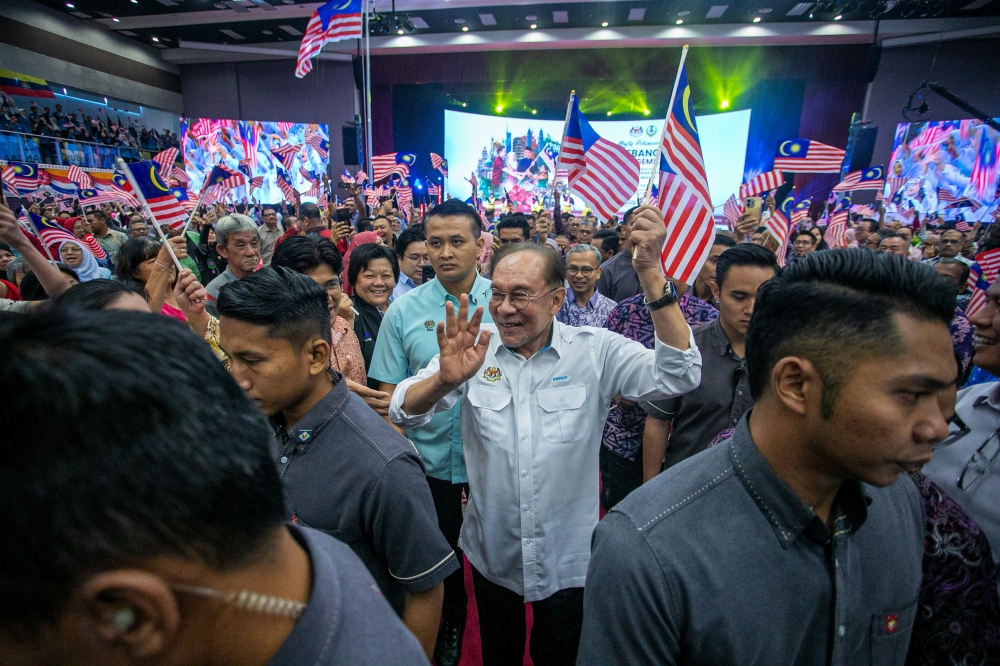
Prime Minister Datuk Seri Anwar Ibrahim delivered a measured message to Cabinet members and senior government officials in Ipoh on July 19, emphasising the importance of maintaining standards while engaging in political activities. Speaking at what appears to be an internal government gathering, the Prime Minister acknowledged that individuals in office retain their right to participate in campaign work, yet underscored that this freedom comes with significant responsibility and clear constraints.
The remarks reflect an ongoing tension within Malaysian governance between the political activities of elected officials and their administrative duties. Government ministers occupy a unique position where they serve simultaneously as political actors and as custodians of public resources and institutional integrity. Anwar's guidance sought to navigate this complexity by affirming both the legitimate political participation of office-holders and the non-negotiable boundaries that protect the public interest.
Central to the Prime Minister's message was an implicit warning against the misuse of government machinery for partisan purposes. Malaysia's history of political controversies has frequently involved allegations that sitting ministers or officials deployed state resources, personnel, or information to advantage their political movements. By directly addressing this concern, Anwar signalled that his administration intends to maintain clearer distinctions between governmental and political functions than have sometimes been observed in Malaysian politics.
The timing of these remarks carries significance given the ongoing political dynamics in Malaysia. With various state and federal elections either recently concluded or anticipated, the line between legitimate campaign activity and improper use of office becomes particularly relevant. Senior officials must understand that their conduct during campaign periods is subject to scrutiny from both the public and oversight bodies, and that lapses in judgment can undermine public confidence in institutions.
Anwar's dual messaging—permitting campaign involvement while enforcing boundaries—suggests an administration attempting to establish clearer governance standards without entirely removing politicians from the democratic process. This represents a departure from approaches that either completely restrict official involvement in campaigns or, conversely, provide little oversight of officials' political activities. The middle path requires active management and clear communication from leadership, which the Prime Minister's statement provided.
For Malaysian governance, such clarity serves important functions. When officials understand precisely where boundaries lie, they can make better decisions about their conduct. Ambiguity, by contrast, encourages rationalisations and breaches. By explicitly linking the right to campaign with obligations of restraint, Anwar created a framework that senior officials can reference when making decisions about their political involvement.
The implications extend to broader institutional health. Government ministries and agencies function most effectively when public confidence in their impartiality remains intact. Citizens and businesses interact with government expecting fair treatment regardless of their political affiliations. When officials visibly campaign using state resources or in ways that blur institutional boundaries, this confidence erodes. Ministers who understand and respect these limits help preserve the credibility that government institutions require to function properly.
Regionally, Malaysia's approach to managing official involvement in politics draws attention from other Southeast Asian democracies grappling with similar challenges. The question of how to permit democratic participation by officials while preventing institutional corruption concerns governments across the region. Anwar's explicit framework-setting may offer insights to policymakers elsewhere on how to establish workable standards.
The challenge ahead lies in implementation and consistency. Clear directives from leadership matter only if enforced through demonstrated consequences and institutional mechanisms. Whether specific cases of alleged boundary-crossing receive appropriate scrutiny will signal whether the Prime Minister's statement represents genuine commitment to reform or merely aspirational rhetoric. Malaysian political observers will likely monitor forthcoming campaign periods closely to assess whether government behaviour reflects these stated principles.
For public servants within government, these remarks carry practical weight. Career officials can point to the Prime Minister's statement when resisting pressures from political masters to deploy resources or information inappropriately. The clearer and more publicly stated the boundaries, the easier it becomes for conscientious officials to maintain them. This protection of institutional capacity serves broader public interests beyond the immediate political moment.
Anwar's message also reflects recognition that sustained governance requires maintaining a distinction between the ruling party or coalition and the state apparatus itself. Even in single-party or dominant-party systems, successful administration depends on citizens and investors perceiving that state institutions serve public purposes rather than narrow partisan interests. By drawing attention to these boundaries and framing them as essential to good governance, the Prime Minister positioned restraint as a professional and institutional value, not merely a legal obligation.
Moving forward, the effectiveness of these guidelines will depend on whether they become embedded in ministerial culture and enforced through institutional mechanisms. Training programmes, ethics guidelines, and clear consequences for violations can translate general principles into specific practices. The question for Malaysia's government remains whether this moment represents a genuine pivot toward tighter governance standards or simply an attempt to manage immediate political sensitivities.

