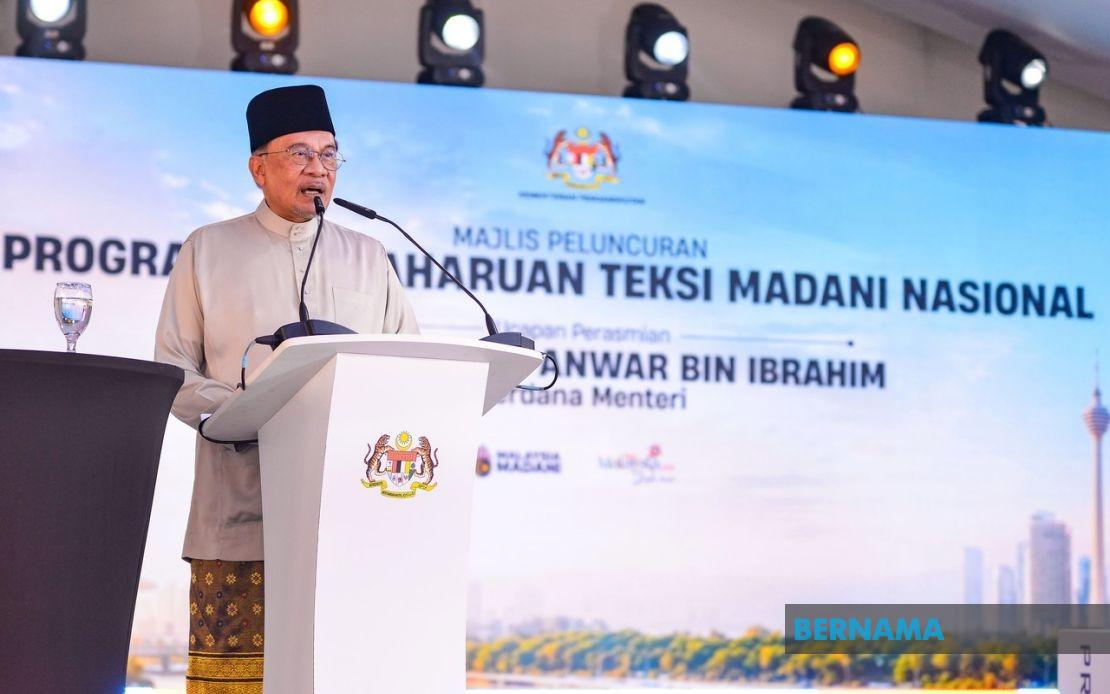
Prime Minister Datuk Seri Anwar Ibrahim has moved swiftly to expand government support for Malaysia's taxi industry, announcing an additional RM10 million injection into the Vehicle Replacement Matching Grant Programme during the launch of the National MADANI Taxi Reform Programme at Dataran Merdeka on July 3. The decision reflects both the administration's commitment to modernising ground transportation and the unexpectedly robust demand from drivers seeking to retire older vehicles from active service.
The supplementary funding comes hot on the heels of an initial RM10 million allocation unveiled in Budget 2026, which Anwar credited with generating considerable enthusiasm across the taxi operator community. Speaking in his dual capacity as Prime Minister and Finance Minister, Anwar indicated that the encouraging response to the first tranche of support warranted immediate action to sustain momentum for the reform initiative. The decision demonstrates the government's willingness to flex its fiscal levers when policy interventions prove effective on the ground, a signal that may influence how future transport-sector initiatives are resourced.
Crucially, the government has secured a strategic partnership with automaker Proton and the Transport Ministry to establish a bespoke financing arrangement facilitating taxi driver ownership of the Proton S70 model. This collaboration tackles one of the structural barriers preventing drivers from upgrading their vehicles: access to affordable credit. By tailoring a financing scheme specifically for taxi operators, the administration addresses the catch-22 that many drivers face when seeking loans for commercial vehicles without substantial collateral. The S70, as a domestically manufactured option, also supports Malaysia's automotive sector and keeps currency within the local economy.
The presence of Transport Minister Anthony Loke, Minister in the Prime Minister's Department Hannah Yeoh, and Chief Secretary to the Government Tan Sri Shamsul Azri Abu Bakar at the programme launch underscores the cross-governmental coordination underpinning this initiative. Such high-level attendance signals that taxi reform is not a peripheral concern but a priority spanning finance, transport, and executive oversight, suggesting the government intends to maintain political pressure on implementing agencies to deliver results efficiently.
For Malaysian taxi drivers, many of whom operate single vehicles as sole proprietors, the combination of grant support and preferential financing represents a meaningful opportunity to modernise their businesses. Ageing vehicle fleets not only reduce driver income—through higher maintenance costs and reduced competitiveness against ride-hailing services—but also pose road safety and environmental concerns. A younger, more reliable taxi fleet enhances service quality and passenger confidence, potentially reversing years of decline in the sector's appeal to consumers.
The timing of this announcement carries strategic weight in Malaysia's transport policy landscape. The rise of platform-based ride-hailing services has eroded the traditional taxi industry's market share, placing severe financial pressure on conventional operators. Government intervention through grants and financing schemes attempts to level the playing field by reducing the capital burden on taxi drivers, allowing them to invest in newer vehicles that compete more effectively on reliability and comfort. This approach acknowledges market reality while using public resources to prop up a constituency—independent taxi operators—that lacks the economies of scale available to larger transport companies.
The National MADANI Taxi Reform Programme represents a broader philosophical commitment to inclusive economic policy, ensuring that modernisation benefits are distributed beyond corporate entities to individual workers and small business operators. MADANI's emphasis on inclusivity aligns with the government's stated priority of raising living standards across income groups. By enabling taxi drivers to own vehicles outright rather than leasing or operating under exploitative owner-operator arrangements, the scheme potentially improves worker autonomy and earnings stability.
Industry observers will watch closely whether the RM20 million total allocation proves sufficient to achieve meaningful fleet renewal, or whether demand will outpace available funding. The initial positive response suggests that uptake could exceed supply, potentially necessitating further tranches of support. Moreover, the success of the Proton financing scheme will depend on whether loan terms remain attractive and whether dealers and financial institutions implement the programme smoothly without creating bureaucratic friction for applicants.
The Proton partnership carries additional significance given the company's recent performance challenges and the government's long-standing role as a stakeholder. A successful taxi financing scheme could serve as a proof-of-concept for broader vehicle financing initiatives and provide Proton with steady demand, creating symbiosis between industrial policy and transport reform. If the S70 gains traction among taxi operators, it may contribute to improving Proton's market position and domestic sales volumes.
From a regional perspective, Malaysia's taxi reform efforts may offer lessons for neighbouring countries wrestling with similar tensions between traditional transport operators and digital-era mobility services. Thailand, Indonesia, and the Philippines face comparable pressures on taxi industries, and how Malaysia manages this transition could influence policy-making elsewhere in Southeast Asia. A successful outcome validates interventionist approaches to protecting incumbent industries while modernising them; failure might suggest that market forces should determine sector evolution regardless of social consequences.
Anwar's personal involvement in approving the supplementary allocation—despite other pressing fiscal demands on government—reflects recognition that transport policy carries political weight. Taxi drivers represent a visible, organised constituency that directly interacts with the public daily, making their welfare a legitimate concern for administrations seeking to maintain social stability and economic dynamism. The announcement thus serves multiple audiences: drivers receive tangible support, the government demonstrates responsiveness to sectoral concerns, and domestic automotive interests gain a boost.

