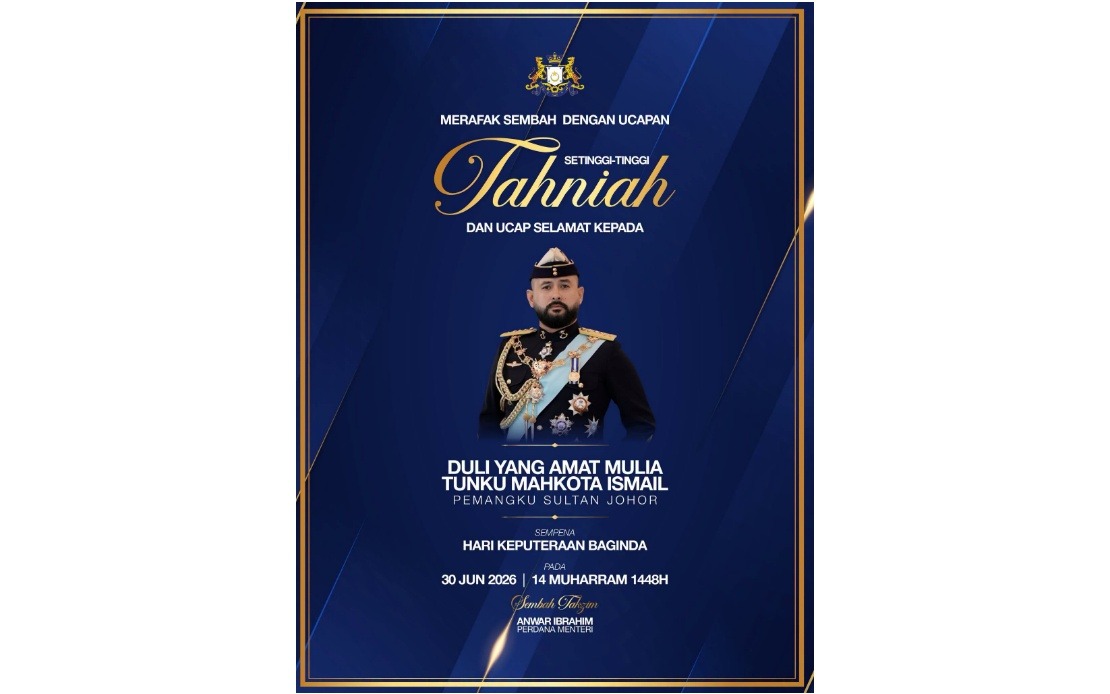
Prime Minister Datuk Seri Anwar Ibrahim marked the birthday of Johor's Regent, Tunku Mahkota Ismail, with heartfelt congratulations shared on social media platforms on June 30. The gesture reflects the longstanding protocol observed by senior government figures when acknowledging milestone occasions for members of Malaysia's royal institutions, particularly those holding significant constitutional roles within their respective states.
In his public message, Anwar conveyed more than simple salutations, incorporating spiritual well-wishes into his remarks. He invoked blessings for the Regent's sustained vitality and robustness, alongside prayers for continued divine favour. Such expressions carry particular weight in Malaysia's political culture, where acknowledgment of royalty traditionally blends formal courtesy with religious sentiment reflective of the nation's Islamic foundations.
Deputy Prime Minister Datuk Seri Dr Ahmad Zahid Hamidi similarly marked the occasion through a Facebook post, adding his voice to the chorus of well-wishers. Zahid's message extended beyond generic birthday pleasantries, incorporating specific references to the Regent's governmental responsibilities. He entreated divine protection and mercy upon Tunku Mahkota Ismail whilst emphasising the spiritual dimension of leadership within Johor Darul Ta'zim.
The Deputy PM's statement specifically referenced the Regent's role in governing both the state of Johor and its people, the Bangsa Johor. This framing underscores the constitutional importance placed upon Johor's monarchy within Malaysia's federal structure. The state holds particular significance within the Malaysian federation, and its royal household commands considerable influence across peninsular politics and governance. Recognition of the Regent's authority and the prayers for wisdom in exercising his responsibilities demonstrate the respect accorded to this position by federal leadership.
Tunku Mahkota Ismail occupies a unique and strategically important position within Malaysia's complex constitutional monarchy system. As the Regent, he serves as a crucial figurehead for one of the nation's largest and most economically significant states. His continued health and capacity to fulfil his duties remains a matter of broader national interest, particularly given the intertwined relationships between state and federal government functions.
The public nature of these birthday acknowledgments reflects established practice within Malaysian political circles, where maintaining positive relationships with state-level royalty remains essential for federal stability and policy implementation. Such courtesies, though apparently ceremonial, serve as tangible reminders of the constitutional hierarchy and the importance placed upon collaborative governance between federal and state authorities.
For Malaysian observers, these exchanges illustrate how contemporary political communication often occurs through social media platforms, where traditional gestures of respect find new expression. Facebook posts have become the primary vehicle through which senior officials acknowledge royal occasions, replacing or supplementing older methods of formal written correspondence. This shift demonstrates the adaptation of Malaysia's political traditions to modern digital communication practices.
The emphasis within both messages on health and blessing reflects broader concerns regarding continuity in governance. In Malaysia's system, the health and stability of key constitutional figures hold implications extending far beyond ceremonial considerations. The focus on divine protection and wisdom in Zahid's statement particularly resonates with Johor's citizens, for whom the Regent's wellbeing directly affects the state's political and administrative direction.
These birthday wishes, whilst appearing straightforward, operate within a sophisticated framework of Malaysian political protocol. The participation of both the Prime Minister and Deputy Prime Minister signals the federal government's acknowledgment of the Regent's standing and the importance attributed to harmonious centre-state relations. For international observers and regional analysts, such moments reveal how Malaysia's federal system maintains cohesion through carefully observed ceremonial conventions and public displays of respect towards royal institutions.
The timing and content of these messages also underscore continuity within Malaysia's government during what remains a period of significant political transition and reform. By publicly honouring the Regent's birthday with expressions of respect and goodwill, Anwar and Zahid reinforce the legitimacy of constitutional monarchy within the contemporary Malaysian context whilst simultaneously demonstrating their commitment to established protocols that bind the nation's political institutions together.

