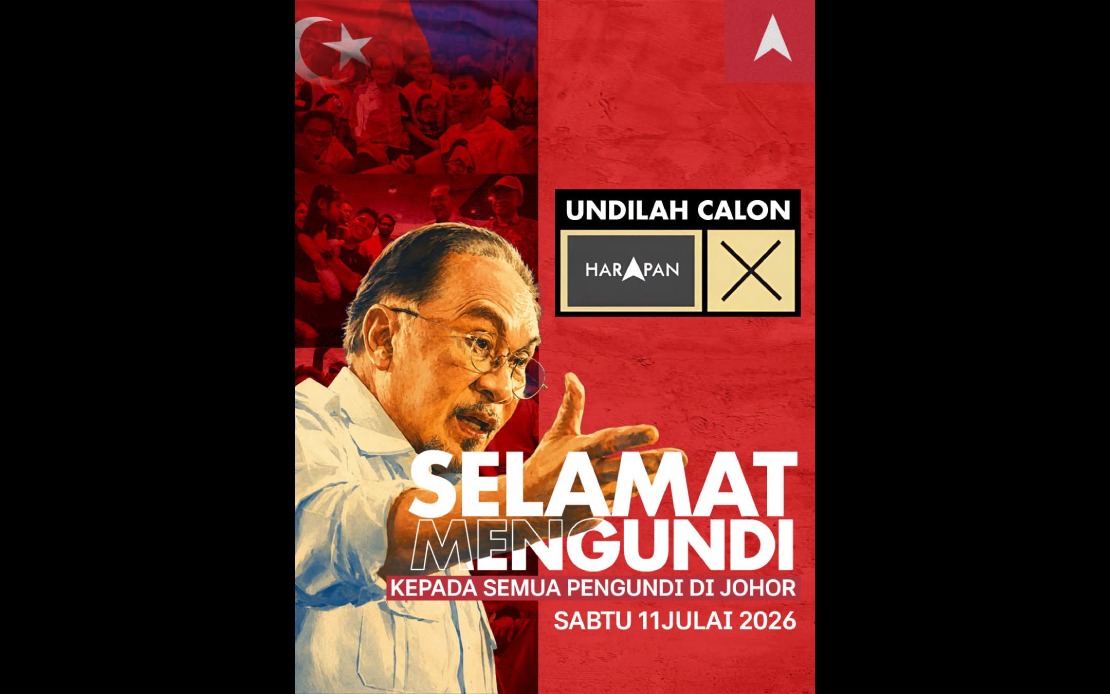
Prime Minister Datuk Seri Anwar Ibrahim has made an emphatic appeal to Johoreans to return to the state and exercise their electoral franchise in the upcoming 16th Johor state election, emphasizing the critical nature of the ballot in shaping the region's trajectory. In a statement released ahead of the voting scheduled for tomorrow, Anwar stressed that Johoreans living away from home have a particular responsibility to come back and participate in determining which coalition will steer the state over the next five years. The appeal reflects growing awareness among political leadership that voter turnout, particularly among the working-age population who may have migrated for employment, could prove decisive in a closely contested contest.
As chairman of Pakatan Harapan, Anwar positioned the election as a referendum on the coalition's governance model and its track record since assuming federal office. He articulated a core argument centred on the notion that PH has substantively transformed Malaysia's political and economic landscape through institutional reforms, foreign direct investment inflows, and improvements in wage structures. The messaging strategy appears designed to frame the state election not merely as a local contest but as an extension of the federal government's reform agenda, suggesting that voting for PH at the state level represents continuity with the broader MADANI Government agenda that has ostensibly restored international confidence in Malaysian institutions.
Anwar highlighted what he characterizes as tangible achievements under PH's federal administration, pointing to economic stabilization, salary enhancements across sectors, and the resolution of long-standing infrastructure and development bottlenecks. These claims resonate particularly within Johor's context, given the state's economic significance as Malaysia's second-largest economy and its traditional role as a barometer for broader electoral trends. By connecting state-level voting decisions to national economic performance, Anwar attempted to elevate the discourse beyond parochial state politics and ground it in material concerns about employment, wages, and infrastructure that affect voters' daily lives.
The Prime Minister also made an explicit moral appeal, framing the election as fundamentally a choice between integrity-based governance and what he characterized as corrupt and divisive political alternatives. He urged Johoreans to reject what he termed as defending public fund theft and politics devoid of substantive policy ideas, instead relying on racial and religious mobilization. This rhetorical positioning effectively characterizes opposition approaches as intellectually bankrupt and morally compromised, attempting to shift the narrative away from specific policy comparisons toward a binary choice between ethical and unethical governance frameworks.
Anwar's invocation of religious blessing and his composition of traditional Malay poetry in support of his electoral appeal demonstrates an attempt to connect with cultural and spiritual sensibilities within the Johor electorate. This approach acknowledges that political persuasion in Malaysia operates simultaneously across rational policy discourse and cultural-emotional dimensions. The poetic appeal serves to ground political arguments within historically significant Malay literary traditions, suggesting that voting for PH represents not merely a pragmatic choice but an alignment with deeper values of communal prosperity and equitable governance.
The 16th Johor state election represents a significant contest within Malaysia's broader electoral calculus, with 172 candidates competing across 56 seats. The distribution and competitiveness of these seats will largely determine which coalition secures the mandate to govern the state. Johor's political complexion has historically reflected national trends, making its outcome potentially indicative of broader voter sentiment heading into any future federal elections. The state's economic importance, combined with its substantial population and geographic proximity to Singapore, magnifies the symbolic and practical significance of the result.
For voters, particularly the working-age population scattered across Malaysia and beyond, returning to vote requires significant logistical effort and time commitment. Anwar's specific appeal to diaspora voters acknowledges these practical barriers while implicitly arguing that the stakes justify the inconvenience. This messaging recognizes that electoral engagement requires not only political persuasion but also practical facilitation and emotional appeal that motivates voters to overcome practical obstacles.
The election occurs within a broader context of Malaysian politics characterized by coalition fragmentation and volatility. Pakatan Harapan's messaging emphasizes stability, reform continuity, and international economic credibility as counterbalancing factors against opposition narratives that may emphasize alternative visions of governance or communal representation. Anwar's framing attempts to position PH as the custodian of genuine reform rather than mere political window-dressing, a distinction he evidently views as crucial to persuading centrist and reform-oriented voters.
The appeal to voters reflects deeper anxieties within the coalition about whether the electoral base mobilizes effectively in state-level contests, where national figures may have less salience than state-specific issues and personalities. By leading the charge personally as Prime Minister, Anwar signals that PH views the Johor election as consequential to its broader political legitimacy and future trajectory. The outcome will substantially shape perceptions of the coalition's electoral strength and the durability of its 2022 Sheraton Move-enabled federal administration heading toward the next national polls.

