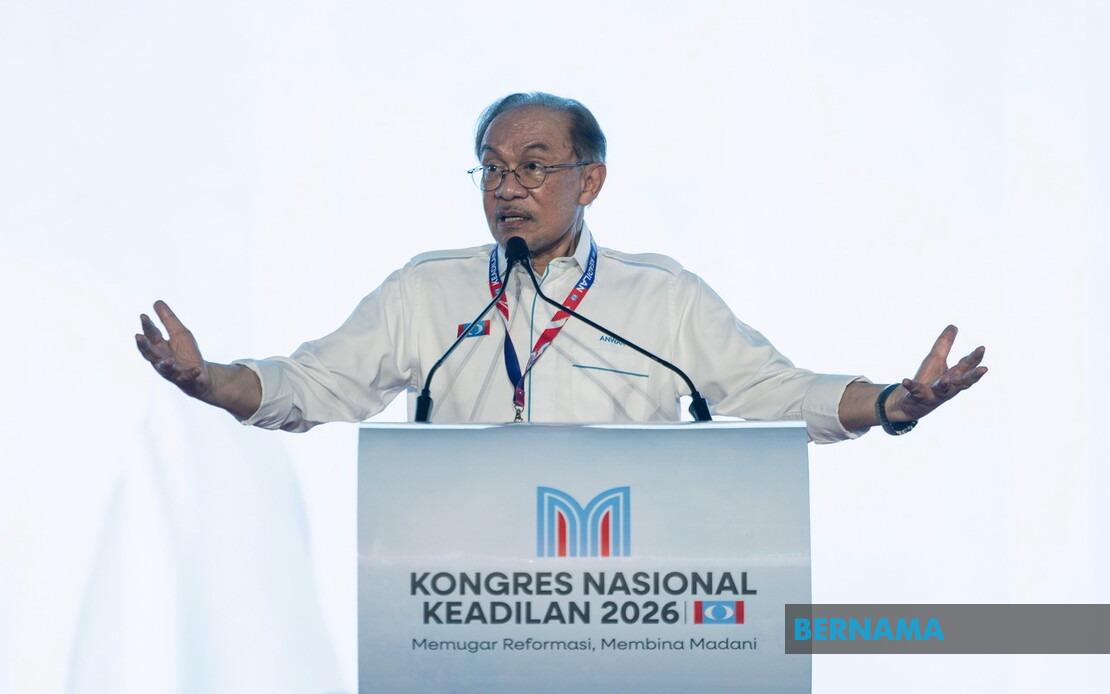
Prime Minister Datuk Seri Anwar Ibrahim has unveiled a significant financial commitment to Malaysia's grassroots communities, announcing an additional RM1 million allocation directed to each of the nation's parliamentary constituencies. The initiative, revealed during his closing address at the 2026 PKR National Congress in Melaka, underscores the government's stated objective to streamline assistance delivery and circumvent administrative obstacles that traditionally slow resource distribution at the local level.
The fresh allocation targets immediate welfare requirements, basic infrastructure improvements, and other community-focused interventions that require rapid resolution. By channelling funds directly to constituencies rather than routing them through conventional bureaucratic pathways, the government aims to accelerate decision-making and deployment of resources where they matter most. This approach reflects growing recognition that centralised funding mechanisms, whilst accountable, often struggle to respond with sufficient agility to localised, time-sensitive community concerns.
Anwar, who simultaneously holds the Finance portfolio, framed the announcement as complementary to existing welfare infrastructure rather than a replacement programme. The government's existing social safety net encompasses two major cash transfer schemes: the Sumbangan Tunai Rahmah and Sumbangan Asas Rahmah initiatives, which together command RM16 billion in annual expenditure. The additional constituency allocation therefore represents an incremental layer of support rather than a fundamental restructuring of welfare delivery mechanisms.
The Prime Minister emphasised that the allocation demonstrates unwavering commitment to poverty alleviation and cost-of-living relief, areas he identified as central to the MADANI Government's economic agenda. Official statistics indicate the hardcore poverty rate has declined to 0.09 per cent, a figure Anwar highlighted as evidence that macroeconomic policies are translating into tangible improvements for vulnerable households. However, this narrowly defined metric does not capture broader income insecurity affecting middle-income households experiencing pressure from inflation and rising living expenses.
Anwar's remarks acknowledged the distinction between aggregate economic performance and household-level welfare improvements. He noted that comprehensive assistance programmes—encompassing school support initiatives, subsidised goods schemes, and housing finance assistance—extend across income brackets from bottom-40 households through to middle-40 categories, suggesting a deliberate effort to avoid means-testing approaches that might exclude struggling middle-income families. This inclusive framework reflects political recognition that cost-of-living anxieties transcend poverty classifications.
For Malaysian readers, the RM1 million per-constituency allocation carries significant practical implications. With approximately 222 parliamentary constituencies nationwide, the total expenditure would reach approximately RM222 million, a modest sum relative to overall government budgets but potentially impactful at local level. Each constituency-level fund might address anything from community centre repairs to emergency assistance for affected residents, with allocation decisions presumably made through local mechanisms involving MPs or constituency-based committees.
The announcement also carries implicit political messaging directed toward PKR grassroots machinery. Anwar explicitly urged party leaders and local activists to undertake ground-level engagement explaining government initiatives and ensuring that eligible residents actually access available assistance. This instruction suggests awareness that programme design and funding allocation represent only partial solutions; without proactive community education and support navigation, eligible beneficiaries may remain unaware of or unable to access assistance to which they qualify.
The timing of this announcement—at a party congress rather than through parliamentary or cabinet channels—reflects evolving Malaysian political communication strategies. Major policy announcements increasingly emerge through party forums rather than traditional government venues, blurring distinctions between party political activity and state governance. This approach simultaneously energises party supporters and achieves policy publicity, though it raises questions about whether such announcements receive formal cabinet consideration or represent executive initiatives announced through informal channels.
From a Southeast Asian comparative perspective, direct constituency-level funding represents a middle-ground approach between fully centralised social protection and fragmented local discretion. The model shares characteristics with similar initiatives across the region, where governments attempt to balance accountability and standardisation against responsiveness to local conditions. The Malaysian approach maintains central government control over total allocation whilst enabling local flexibility in deployment, a compromise reflecting both fiscal discipline and democratic responsiveness.
The broader context involves ongoing policy debate regarding optimal welfare delivery mechanisms. Targeted assistance programmes provide fiscal efficiency and concentrate resources on demonstrable need, but they risk creating complex eligibility criteria and administrative burdens that prevent genuine beneficiaries from accessing support. Conversely, universal programmes ensure inclusivity but consume substantially greater resources and may benefit those not experiencing genuine hardship. Malaysia's tiered approach—combining national cash transfer schemes with constituency-level allocations—attempts to navigate this tension through policy layering rather than categorical choice.
For opposition parties and policy critics, the announcement invites scrutiny regarding resource adequacy, allocation mechanisms at constituency level, and oversight mechanisms ensuring funds reach intended beneficiaries rather than becoming diverted through corrupt or patronage-based channels. Local implementation structures will determine whether the initiative fulfils its stated poverty-alleviation objectives or represents primarily symbolic commitment with limited real-world impact.
The sustainability of such allocations merits consideration given Malaysia's fiscal constraints. Increasing marginal allocations proves politically attractive but may prove difficult to maintain if economic growth falters or if competing budgetary pressures intensify. The government's ability to sustain or expand these initiatives will depend substantially on revenue performance and whether broader expenditure discipline remains achievable across government entities.
Ultimately, the RM1 million per-constituency initiative reflects contemporary Malaysian governance attempting to demonstrate responsiveness to grassroots concerns whilst maintaining central financial control and national policy frameworks. Its effectiveness will depend considerably on implementation quality, local decision-making structures, and genuine community engagement rather than simply the allocation's existence.

