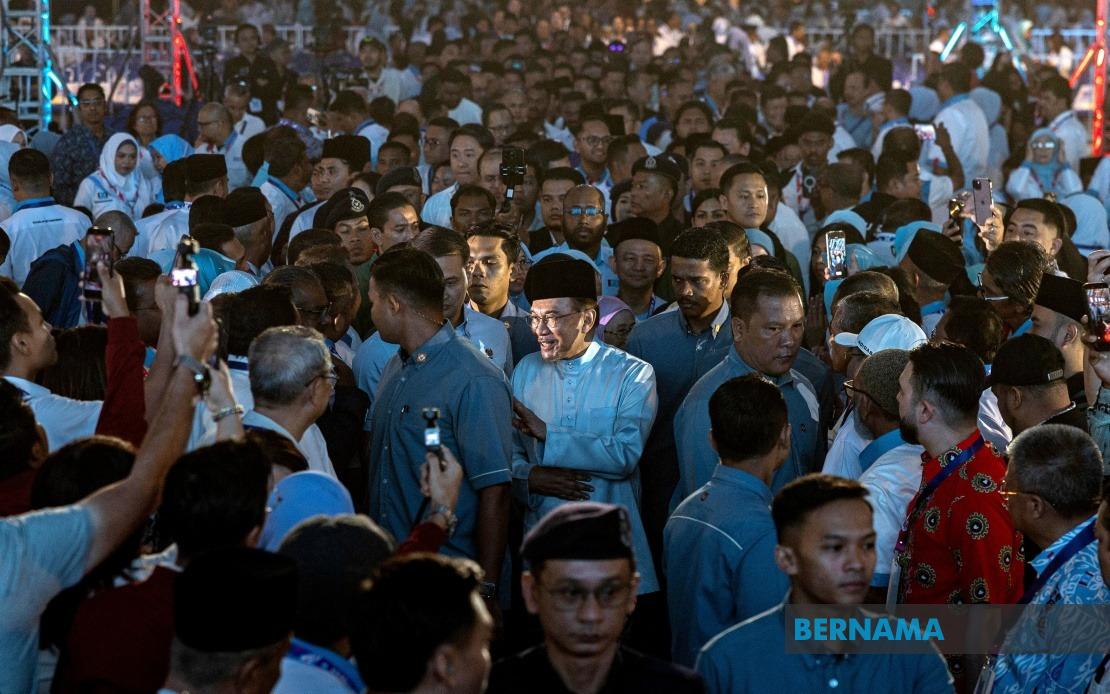
Prime Minister Tengku Datuk Seri Zafrul Tengku Abdul Aziz has urged the PKR party to treat its upcoming 2026 National Congress as a critical turning point for internal renewal and public engagement. Speaking in his capacity as the Prime Minister's senior political adviser and ex-officio member of the PKR Political Bureau, Tengku Zafrul emphasised that the gathering should transcend factional divisions and focus squarely on restoring the party's standing among ordinary Malaysians.
The remarks come against the backdrop of disappointing results in recent state elections, which have prompted difficult questions within PKR about its electoral prospects and organisational effectiveness. Rather than deflecting blame onto coalition partners within the Unity Government, Tengku Zafrul has taken the uncommon step of directing members' attention inward, arguing that the party can only control what it does itself. This pragmatic acknowledgment suggests a shift toward accountability within PKR's leadership, a stance that could reshape how the party positions itself heading into the next general election cycle.
Tengku Zafrul's appeal for honest self-examination represents a departure from the defensive posturing that often characterises Malaysian political discourse. He has explicitly called on party members to identify and confront organisational weaknesses rather than blame external circumstances or coalition partners. This approach implies that PKR's recent setbacks stem partly from internal deficiencies in party machinery and messaging rather than exclusively from factors beyond the party's control. The emphasis on strengthening both grassroots operations and central leadership suggests recognition that PKR's reach and effectiveness have eroded across multiple organisational levels.
A significant component of Tengku Zafrul's message addresses the communication gap between PKR and the electorate. He contended that even when the party delivers tangible results, these achievements often fail to penetrate public consciousness effectively. This observation hints at a broader challenge facing ruling coalition parties in Malaysia: translating policy outputs into public perception and electoral support. For PKR specifically, the failure to clearly articulate government accomplishments to ordinary citizens may have contributed to erosion of support, particularly among constituencies where the party previously held influence.
The senior adviser has also prescribed a listening-first approach to community engagement, cautioning against the trap of formulating responses before fully grasping underlying grievances. This directive suggests that PKR representatives may have become disconnected from constituent concerns, prioritising defensive communication over genuine dialogue. By urging members to "listen, acknowledge, then deliver," Tengku Zafrul has outlined a sequential framework intended to rebuild the relationship between party representatives and the communities they serve. The emphasis on acknowledgment—recognising problems that remain unresolved—suggests that PKR has sometimes minimised or dismissed legitimate public concerns.
The timing of Tengku Zafrul's intervention carries significance within PKR's internal dynamics. As someone close to the Prime Minister's office yet positioned within the party structure, his public statement carries implicit authority and signals leadership backing for an introspective approach. This positioning may be intended to forestall potential factional disputes during congress proceedings and establish parameters for discussion that privilege party unity over individual promotion or factional advantage. His framing of internal strengthening as paramount may also serve to deflate expectations around major policy announcements or structural overhauls, instead normalising incremental improvements across party operations.
For Malaysian politics more broadly, Tengku Zafrul's message reflects growing recognition among ruling coalition figures that simply holding government office does not guarantee electoral success or public approval. The challenge of translating administrative action into political capital has become acute for both PKR and its coalition partners, particularly as public frustration with cost-of-living pressures and economic uncertainty intensifies. PKR's specific vulnerability stems from positioning itself as a reformist party committed to good governance; failure to visibly deliver on these promises undermines its core identity and electoral appeal.
The 2026 congress represents a crucial moment for PKR to demonstrate whether it can genuinely reform itself or whether factional interests and entrenched power structures will resist meaningful change. Tengku Zafrul's emphasis on grassroots strengthening suggests awareness that electoral competition is increasingly won or lost at the community level, where face-to-face engagement and responsive local governance matter more than national-level rhetoric. This insight aligns with emerging political science literature on electoral dynamics in mature democracies, where voter dissatisfaction with distant, unresponsive political establishments has created vulnerabilities for incumbent parties.
The implications for Malaysia's broader political trajectory depend substantially on whether PKR can translate Tengku Zafrul's exhortation into concrete organisational change. If the party succeeds in rebuilding internal discipline, improving grassroots connectivity and communicating achievements more effectively, it could stabilise its electoral position ahead of the next general election. Conversely, if congress proceedings devolve into factional struggles or surface-level reforms that fail to address deep structural problems, public disengagement may deepen further, potentially threatening the Unity Government's parliamentary stability.
Looking forward, the success of PKR's renewal effort will reverberate across Malaysian politics. The party's performance directly influences coalition cohesion, since electoral losses typically provoke demands for leadership accountability and strategic recalibration. Should PKR's internal reinforcement efforts fail to yield improved electoral prospects, heightened pressures on current leadership could emerge, with consequent implications for government stability. Conversely, a successful turnaround would strengthen Anwar Ibrahim's political position and validate the current coalition's overall direction.

