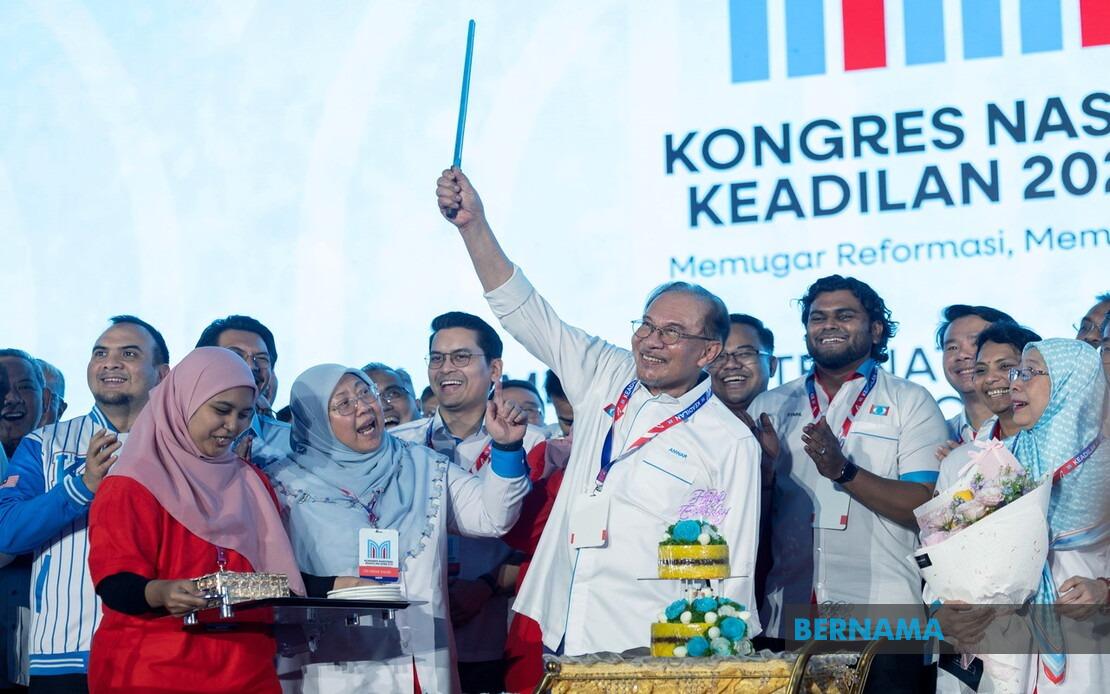
The PKR National Congress 2026 concluded in Melaka with party leadership projecting a carefully calibrated message: unwavering support for the Unity Government framework coupled with determination to preserve the reformist credentials that define the party's identity. In his closing remarks, PKR president Datuk Seri Anwar Ibrahim underscored his personal resolve to maintain cooperative relations within the coalition, framing political stability as essential infrastructure for delivering economic benefits to ordinary Malaysians. Yet this commitment carries an implicit caveat—Anwar pointedly noted that the coalition's longevity ultimately rests with UMNO and Barisan Nasional, signalling that PKR's patience is conditional on its partners' reciprocal commitment.
The underlying tension animating the congress reflects PKR's precarious position within Malaysian politics. As the coalition's reform-minded faction, the party must balance ideological consistency with governmental pragmatism. Anwar specifically cautioned all coalition members against destabilising moves that could jeopardise the Unity Government, language that implicitly acknowledges festering internal strains. The congress messaging suggests that PKR leadership views political stability not as an end in itself but as a prerequisite for advancing the substantive changes the party championed during its decades in opposition. This framing matters for regional observers, as it indicates that despite forming government, PKR has not abandoned its reformist orientation—a position that carries implications for policy direction across Southeast Asia's largest Muslim-majority democracy.
PKR deputy president Nurul Izzah Anwar articulated the party's determination to embed reform across three domains: internal party structures, administrative machinery, and government policy architecture. Her invocation of the Universities and University Colleges Act (AUKU) repeal exemplified the type of transformative change PKR seeks to accomplish while governing. The party views AUKU's rescission—which liberalised restrictions on campus political activity—as emblematic proof that coalition membership need not preclude substantive reform. However, the very need to highlight this single achievement underscores how constrained PKR's reformist agenda has proven in practice. Anwar's supplementary assurance that no replacement legislation would reinstall student restrictions, coupled with his commitment to raise the matter at Cabinet level, reveals ongoing contestation within government on this sensitive issue. The emphasis on existing criminal laws as sufficient safeguards for institutional order suggests PKR is resisting pressure from more conservative coalition partners to implement new control mechanisms.
The congress devoted considerable attention to organisational preparedness and maintaining party cohesion regardless of coming political transitions. PKR leadership signalled that the party must remain election-ready irrespective of Parliament's dissolution timeline or candidate nomination schedules. This forward-looking posture reflects institutional learning from Malaysian coalition politics, where sudden shifts in alignment have historically caught unprepared parties flat-footed. By emphasising continuous readiness, PKR seeks to ensure it can navigate whatever configuration emerges from future electoral contests, whether that involves continued unity with current partners or alternative arrangements. For regional analysts, this messaging underscores how Malaysian coalition politics remains fundamentally fluid, with parties positioning themselves to pivot swiftly if circumstances demand.
Women's political participation emerged as a second organisational priority. PKR Wanita chief Fadhlina Sidek, simultaneously serving as Education Minister, advocated for expanded space for women in leadership and decision-making roles. Her dual position exemplifies both PKR's commitment to gender representation and the concrete progress the party claims within government structures. However, her parallel call for greater openness to criticism and improved governance suggests recognition that institutional change remains incomplete. The emphasis on receptiveness to external feedback, delivered by someone in high office, indicates that even within Malaysia's reform-minded coalition partner, hierarchical defensive instincts can obstruct accountability. This tension between reformist rhetoric and institutional resistance likely resonates across Southeast Asia, where democratic parties frequently struggle to operationalise inclusive governance principles.
PKR's youth wing, Angkatan Muda Keadilan, directed congress attention toward emerging economic and social challenges confronting Generation Z and younger workers. The emphasis on Bumiputera participation in high-technology sectors—artificial intelligence, semiconductors, and biotechnology—reflects broader Malaysian concerns about inclusive development within knowledge economies. By framing technology sector equity as a youth priority, AMK positioned PKR as responsive to demographic anxieties about economic opportunity and class mobility. Simultaneously, the wing raised gig economy recognition, stronger social protection, skills development, and mental health support, issues that transcend party politics and speak to genuine structural challenges facing young Malaysians. These concerns assume particular salience given Malaysia's relatively high youth unemployment and underemployment rates, suggesting PKR perceives significant political vulnerability among younger voters if bread-and-butter issues remain unaddressed.
The congress implicitly acknowledged that sustaining the Unity Government requires managing divergent ideological currents within the coalition. By emphasising reform alongside stability, PKR sought to reassure its base that governmental participation has not compromised principled commitment to democratic advancement and institutional modernisation. The repeated invocation of specific achievements like AUKU repeal functioned to demonstrate tangible returns from coalition membership. Yet the congress's defensive tone—repeatedly cautioning against steps that might destabilise the government—suggested that PKR leadership fears its supporters harbour doubts about whether the coalition arrangement ultimately serves reform objectives. The frequency with which speakers returned to this theme implies ongoing internal party debate about whether the Unity Government represents strategic partnership or strategic compromise.
Anwar's closing warnings against excessive steps by coalition partners carried pointed significance. The language suggested concern about potential moves by UMNO or other BN components that might undermine PKR's reformist agenda or alienate the party's core constituencies. By publicly establishing red lines, Anwar attempted to signal both to party members and to coalition partners that PKR's patience possesses limits. This positioning reflects the delicate equilibrium Malaysian coalition politics requires: sufficient cooperation to deliver governmental legitimacy and policy outputs, yet sufficient independence to maintain distinct party identity and electoral appeal. For regional observers assessing Malaysia's political trajectory, these signals suggest that the Unity Government, while rhetorically committed to long-term cooperation, remains fundamentally contingent on whether competing party interests can be reconciled.
The congress outcomes reveal PKR navigating a fundamental paradox endemic to opposition parties that achieve governmental power: how to maintain the transformative energy and principled opposition that animated their previous political existence while accepting the compromises and constraints that governmental responsibility imposes. The party's emphasis on reform within government attempted to square this circle, positing that participation in the Unity Government need not entail abandonment of progressive objectives. Yet the congress's organisation around themes of stability, readiness, and contingency planning betrayed underlying uncertainty about whether this synthesis can be sustained indefinitely. For Malaysia's broader political future and for regional democratic trajectories, the answer to this question may ultimately determine whether Southeast Asia's reform movements can successfully transition from oppositional challenge to governmental stewardship without losing their transformative purpose.

