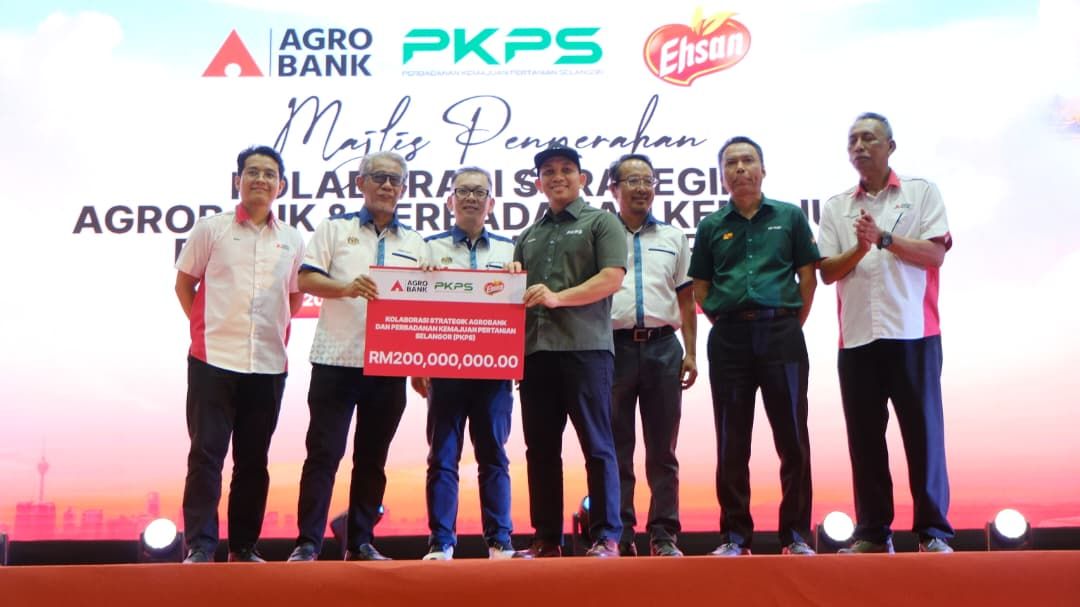
The Selangor Agricultural Development Corporation (PKPS) has established a RM200 million trade financing facility in partnership with Agrobank, a move designed to accelerate infrastructure development across the state's agrifood sector and bolster its capacity to meet rising food security demands. The arrangement, formalised during Malaysia Agriculture, Horticulture and Agrotourism Exhibition (MAHA) 2026 at Malaysia Agro Exposition Park (MAEPS) Serdang on August 29, represents a significant commitment to modernising Selangor's food production and distribution networks at a critical time when regional supply chain resilience has become a top priority for policymakers and industry stakeholders.
The facility will support both capital-intensive infrastructure projects and the corporation's operational requirements, with disbursements structured to proceed based on measurable project milestones. This disciplined approach ensures systematic cash flow management and accountability throughout the partnership period, which officially commences in March 2027. Agrobank group president and chief executive officer Datuk Tengku Ahmad Badli Shah Raja Hussin presented the commitment to PKPS group chief executive officer Datuk Dr Mohamad Khairil Mohamad Razi during a symbolic handover ceremony witnessed by Deputy Agriculture and Food Security Minister Datuk Chan Foong Hin.
The initiative arrives as Malaysian policymakers increasingly recognise the strategic importance of domestic agricultural capacity. Regional supply chain disruptions in recent years have underscored vulnerabilities in food systems across Southeast Asia, making investments in local production and storage infrastructure particularly timely for Selangor, Malaysia's most densely populated state and a major economic hub. The RM200 million allocation reflects confidence from the agricultural financing sector in the potential returns from modernising food systems, even as global economic uncertainties persist.
The cornerstone project under this facility will be construction of a dedicated halal food warehouse in Selangor, which will function as a centralised storage and logistics hub. This facility addresses a recognised gap in the state's infrastructure, enhancing capacity to aggregate, store and distribute products efficiently to retail and institutional buyers. Beyond the flagship warehouse, the facility will finance establishment of a halal chicken processing centre, completion of processing facilities for Ehsan brand products, and construction or upgrading of district-level distribution warehouses. Together, these investments create an integrated supply chain ecosystem designed to reduce inefficiencies between farm-gate and consumer.
The partnership extends beyond brick-and-mortar infrastructure. PKPS will leverage portions of the financing to fund operational expenses and research activities aligned with modern agricultural practices. The Ehsan Agricultural Research Centre will intensify investigations into smart farming methodologies, incorporating precision agriculture, resource optimisation and climate-resilient cultivation techniques. Simultaneously, the Ehsan Agricultural Training Centre will develop human capital within the sector, addressing a persistent challenge in agriculture whereby technical expertise and management capabilities lag behind infrastructure investments. These complementary initiatives recognise that physical assets alone cannot sustain competitive advantage without skilled personnel and evidence-based innovation.
Product development under the Ehsan brand will receive particular attention, with financing earmarked for ready-to-eat and ready-to-heat food lines. This focus responds to shifting Malaysian consumer preferences toward convenience foods and value-added agricultural products rather than raw commodities. By positioning Selangor's agricultural output into higher-margin processed categories, PKPS and Agrobank are effectively raising the sector's economic multiplier effect and creating additional employment along the value chain. Such vertical integration also provides greater resilience during commodity price fluctuations.
Agritourism development at the Ehsan Resort and Convention Centre represents an unconventional but strategically sound component of the arrangement. By transforming agricultural sites into visitor destinations, PKPS generates supplementary revenue streams whilst simultaneously educating consumers about food production methods and building brand loyalty for Selangor-grown products. This diversification of income sources reduces financial risk for PKPS and demonstrates how contemporary agricultural enterprises increasingly blend production, processing, retail and experiential tourism into unified business models.
The timing of this announcement during MAHA 2026, themed around value creation for food security, signals alignment between corporate finance initiatives and state-level food policy objectives. Malaysia faces structural challenges in agricultural competitiveness, including rising input costs, labour shortages and competing land use pressures. By channelling substantial capital into Selangor's agrifood infrastructure, this partnership tacitly acknowledges that market forces alone have underinvested in the sector relative to its strategic importance. Government-linked entities such as PKPS therefore play a catalytic role in mobilising capital and sharing risks that private investors might otherwise avoid.
For Malaysia's broader agricultural sector, this arrangement carries implications beyond Selangor's borders. As the nation's largest state economy and primary consumer market, Selangor's supply chain improvements will establish benchmarks and potentially attract replication in other states. The emphasis on halal certification and processing aligns with Malaysia's positioning as a global halal hub, potentially opening export opportunities across Muslim-majority markets in Southeast Asia, the Middle East and beyond. Selangor's enhanced production and processing capacity could supply halal-certified products to regional trading partners, generating foreign exchange and strengthening Malaysia's competitive position in halal food commerce.
The facility's emphasis on transparency and disciplined disbursement procedures addresses longstanding concerns about infrastructure financing in Southeast Asia. By linking fund releases to project progress rather than upfront disbursement, Agrobank and PKPS establish accountability mechanisms that reduce misallocation risks and protect investor returns. This governance approach may also attract interest from other agricultural lenders and development finance institutions considering similar arrangements, potentially catalysing broader sectoral modernisation.
PKPS's partnership with Agrobank demonstrates how strategic financing can address multiple development objectives simultaneously: strengthening domestic food security, modernising agricultural infrastructure, supporting rural employment and enhancing Malaysia's competitive standing in regional food markets. The RM200 million commitment extends beyond a single transaction to represent a statement of confidence in Selangor's agricultural future. Over the facility's lifespan, success will be measured not only in warehouse capacity or processing throughput but in whether coordinated infrastructure, training and research investments create a self-sustaining ecosystem capable of supporting Malaysia's evolving food security requirements.

