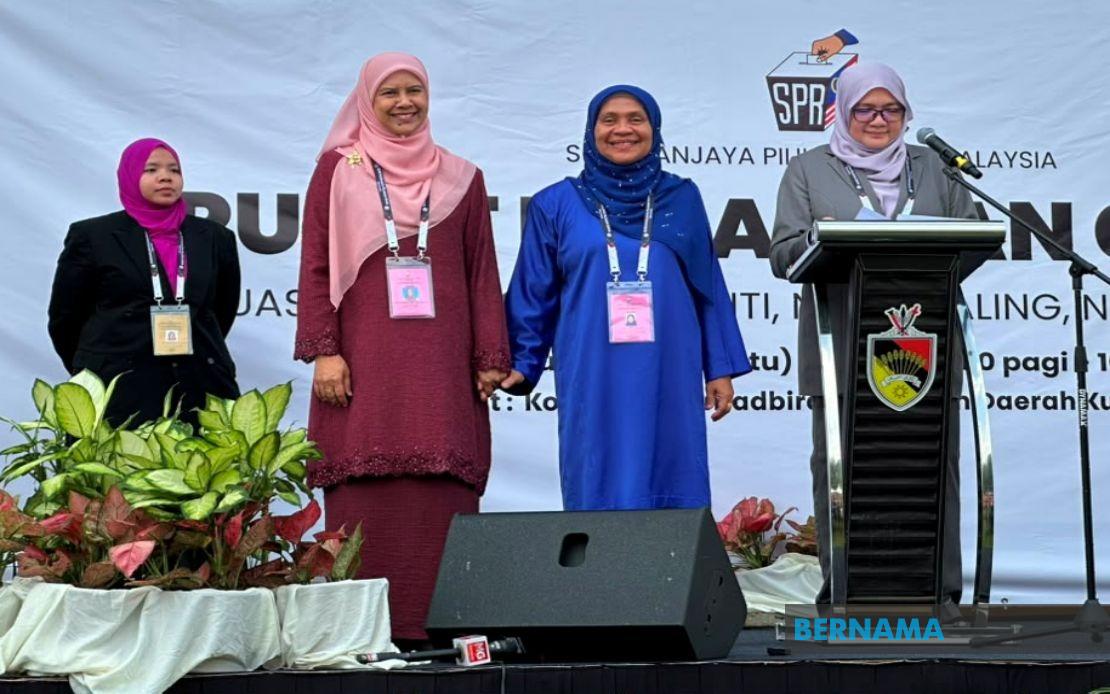
The Pilah state constituency will feature a direct contest between two women candidates in the forthcoming Negeri Sembilan state election, representing a watershed moment for female political representation in the state. Incumbent Datuk Noorzunita Begum Mohd Ibrahim, representing Pakatan Harapan, will square off against Barisan Nasional's S. Leza Md Yasin in what promises to be a closely watched race. The declaration came from Kuala Pilah returning officer Nawal Mohammed Amin following the conclusion of the nomination process on July 18, with both candidates submitting their forms within minutes of each other—Noorzunita at 9.03 am and Leza at 9.09 am.
The Negeri Sembilan state election overall reflects considerable contestation across multiple constituencies, with voters across the state poised to make their choice on August 1 following early voting on July 28. Beyond the headline Pilah race, the election features a mixed contest structure across the remaining constituencies, indicating both competitive pressure between established parties and emerging factional challenges from newer political formations. The nomination results reveal how Malaysia's political landscape continues to fragment at the state level, with multiple viable contenders in several seats rather than the traditional two-party dominance of earlier electoral cycles.
Juasseh presents a three-cornered contest that exemplifies this fractured political terrain. Mohd Aidil Abdullah of Pakatan Harapan competes against the incumbent Datuk Ismail Lasim representing Barisan Nasional, while Bersatu's Mohd Zuhami Md Yusof enters as a third force. This pattern mirrors broader national trends where Bersatu's participation has splintered the traditional opposition-government binary, creating unpredictable electoral dynamics that require broader coalitions or risk vote division among ideologically similar parties.
Similarly, Seri Menanti will see three candidates vie for office: Mohd Kamarul Arifin Mohd Wafa from Pakatan Harapan, incumbent Muhammad Sufian Maradzi of Barisan Nasional, and Bersatu's high-profile Datuk Seri Megat D. Shahriman Zaharuddin. The inclusion of a Bersatu candidate carrying the prestigious Megat title suggests organisational investment in this particular seat, indicating confidence in local support networks or grievances with incumbent performance. The Senaling seat follows a similar template, with Mohd Hanis Mohd Alimin (PH), Mohamad Qayyum Abd Jalil (BN), and Bersatu's Mohd Izzafi Khan competing for voter favour.
In contrast, the Johol constituency maintains the traditional two-cornered structure that characterised Malaysian state elections in earlier decades. Pakatan Harapan's Mohd Zailan Mohd Munawar faces incumbent Datuk Saiful Yazan Sulaiman of Barisan Nasional in what may be a more straightforward choice for voters in that area. These variations across constituencies suggest that Bersatu's challenge is geographically uneven, with particular strongholds or areas of perceived local advantage driving their candidate selections.
The presence of senior federal ministers during the nomination process underscores how state elections retain significance within Malaysia's broader political economy. Pakatan Harapan fielded PKR Wanita chief Fadhlina Sidek, who holds the Education Ministry portfolio, alongside Angkatan Muda Keadilan vice-chief Dr Mohammed Taufiq Johari from the Youth and Sports Ministry, and Sim Tze Tzin, the Deputy Investment, Trade and Industry Minister and Bayan Baru MP. Their attendance signaled party discipline and resource commitment to the Negeri Sembilan campaign, as did Barisan Nasional's deployment of Deputy Home Minister Datuk Seri Dr Shamsul Anuar Nasarah alongside Perak Menteri Besar Datuk Seri Saarani Mohamad.
For Negeri Sembilan specifically, this election matters because the state sits in Malaysia's heartland with a traditionally mixed electorate combining rural, small-town, and suburban constituencies. The results will provide a mid-term assessment of Pakatan Harapan's electoral viability and whether the coalition has consolidated its 2022 federal election gains at state level. For Barisan Nasional, performance in Negeri Sembilan indicates whether the coalition can remain competitive in interior Peninsular Malaysia or whether demographic and political shifts favour the opposition.
The all-female matchup in Pilah deserves particular attention as it reflects growing female participation in elective politics across Malaysia. While women candidates have contested state elections previously, a straight fight between two women for a state seat remains relatively rare, suggesting either organic shifts in party candidate selection processes or deliberate efforts to improve female representation. The presence of Noorzunita as an incumbent strengthens the symbolism, indicating that female candidates can successfully retain office rather than merely being symbolic candidates in unwinnable seats.
The election schedule provides voters with a fortnight to assess candidates and party platforms before casting ballots. Early voting on July 28 accommodates workers, civil servants, and others unable to vote on the main polling day, a practice now standard across Malaysian elections. The staggered approach also provides media and observers with an interim snapshot of turnout patterns before final results.
Regionally, the Negeri Sembilan election carries implications for Southeast Asian observers tracking Malaysia's democratic health and competitive federalism. The presence of multiple viable contenders rather than a binary choice reflects healthy contestation, though fragmentation risks producing governments with weak mandates. For Malaysian readers specifically, the outcome will influence whether Kuala Lumpur pursues particular policy directions in the near term, as Negeri Sembilan's government traditionally influences federal coalition dynamics given its pivotal geographic and demographic position.
The electoral exercise also provides local candidates visibility and organisational experience valuable for future contests. For Leza and Noorzunita, the Pilah race offers a platform for presenting themselves and their respective parties' visions for the constituency. The prominence of federal ministers during nomination suggests this election matters not merely as a state matter but as part of the broader competitive cycle between Pakatan Harapan and Barisan Nasional following the fractious 2022 federal election that reshaped Malaysian politics.
Ultimately, Negeri Sembilan voters will determine not only who represents them in state assembly but also whether Malaysia's pattern of competitive federalism strengthens or weakens. The choice between the parties reflects judgements about development priorities, religious and communal management, and trust in governance quality. With nominations closed and campaigns underway, the political machines of both coalitions now mobilise supporters in anticipation of the August 1 polling day that will reshape the state's political representation.

