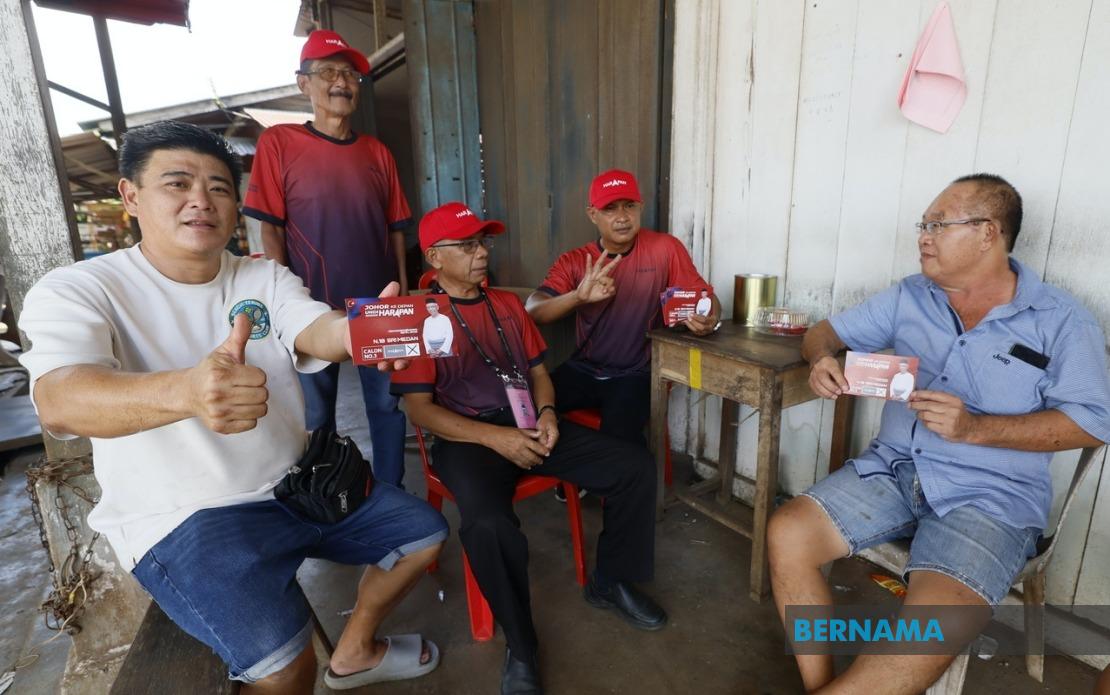
In the run-up to Johor's 16th state election, Pakatan Harapan candidate Hishamudin @ Misrin Ishak is staking his campaign on direct engagement with voters and a commitment to address long-standing local grievances. The former mathematics educator, known colloquially as "Cikgu Misrin", has adopted a strategy centred on listening to constituent concerns and pledging to deliver tangible improvements rather than rhetorical flourishes, framing his candidacy around the principle of "work first, talk later" as he contests the Sri Medan seat.
Flood mitigation emerges as a central plank of his campaign platform, reflecting the persistent drainage challenges that have periodically disrupted daily life for residents of Sri Medan. The recurring inundation issue has long festered without satisfactory resolution, making it fertile ground for political engagement. Hishamudin's focus on this area-specific problem signals an attempt to distinguish himself through localism rather than broader state-level rhetoric, positioning himself as a representative attuned to ground-level realities.
Beyond immediate infrastructure concerns, his platform encompasses a vision of balanced development across the constituency's diverse geographical composition. He commits to ensuring that urban, semi-urban and rural pockets receive equitable attention in resource allocation and facility development. This multi-tiered approach acknowledges the disparate needs across Sri Medan's landscape, where population density and economic activity vary significantly. Such differentiated development planning could appeal to voters fatigued by perceived central-area bias in government spending.
Educational opportunity and economic advancement form another substantive dimension of his campaign messaging. Recognising that young constituents face limited vocational pathways, Hishamudin has signalled readiness to facilitate Technical and Vocational Education and Training programmes alongside expanded digital literacy initiatives. This emphasis on skill development and modern competencies addresses a genuine demographic concern in Johor, where school-leavers often encounter difficulty accessing quality training outside major urban centres.
Small and medium enterprise development features prominently in his economic platform. Hishamudin recognises that local entrepreneurs frequently struggle with market expansion beyond immediate catchment areas, constraining growth potential and employment generation. His commitment to facilitating broader market access and reducing dependence on localised demand suggests an understanding of how SME limitations constrain both business dynamism and job creation in peripheral constituencies. Supporting merchant networks and e-commerce adoption could yield tangible economic benefits.
His background as a village head informs his positioning as an administrative bridge between constituents and governmental structures. This prior experience in grassroots governance, ostensibly, equips him with familiarity in navigating local development mechanics, welfare distribution channels, and administrative procedures that often confound ordinary residents. He frames his candidacy as a continuation of community stewardship at an elevated governmental level, leveraging administrative credibility rather than political novelty.
The electoral landscape in Sri Medan presents a formidable structural challenge. The constituency is widely acknowledged as a Barisan Nasional stronghold, suggesting entrenched voter habits and substantial incumbent organisational advantage. Incumbent Datuk Zulkurnain Kamisan carries the weight of establishment backing and presumably well-oiled party machinery. Hishamudin's positioning as a "fresh face" appears deliberate—an attempt to reframe unfamiliarity as an asset in constituencies potentially fatigued by longtime representation. This narrative strategy, however, battles against the substantial inertia that characterises traditional BN support bases.
Perikatan Nasional's competing candidacy in Ahmad Rosdi Bahari introduces a three-way contest that fragments anti-BN voting potential. In Malaysian electoral geometry, such fragmentation frequently benefits incumbents who maintain consolidated support bases. Whether Pakatan Harapan and Perikatan Nasional voters could coalesce strategically—or whether their ideological and strategic differences prove insurmountable—may ultimately determine whether BN's dominance faces genuine challenge or merely theatrical opposition.
Campaign reception in early engagement phases has reportedly encouraged Hishamudin's continuing efforts. Three days into the formal campaign period, constituent responsiveness appears sufficiently positive to sustain momentum and reinforce his determination despite formidable structural headwinds. Such early feedback, while encouraging, must be weighed against the reality that enthusiasm during campaign phases does not automatically translate into ballot-box results, particularly in constituencies with decades of ingrained voting patterns.
Hishamudin's explicit commitment to serving all residents irrespective of political affiliation distinguishes his framing from partisan alternatives. This universalist positioning—emphasising constituent welfare over party advantage—potentially resonates with swing voters and disaffected existing supporters fatigued by purely factional politics. Whether such rhetoric translates into differential voter behaviour, however, remains contingent upon whether constituents perceive authentic commitment or conventional campaign messaging.
The campaign period leading to July 11 polling day will test whether grassroots accessibility and localism-focused platforms can penetrate traditional BN electoral bastions. Early voting commences July 7, providing a window through which campaign momentum may crystallise into actual support. For Pakatan Harapan's broader state-level ambitions, Sri Medan represents a trial case: whether fresh candidates and people-focused messaging prove sufficient to dislodge incumbent dominance in conservative constituencies, or whether structural advantages remain determinative of electoral outcomes.

