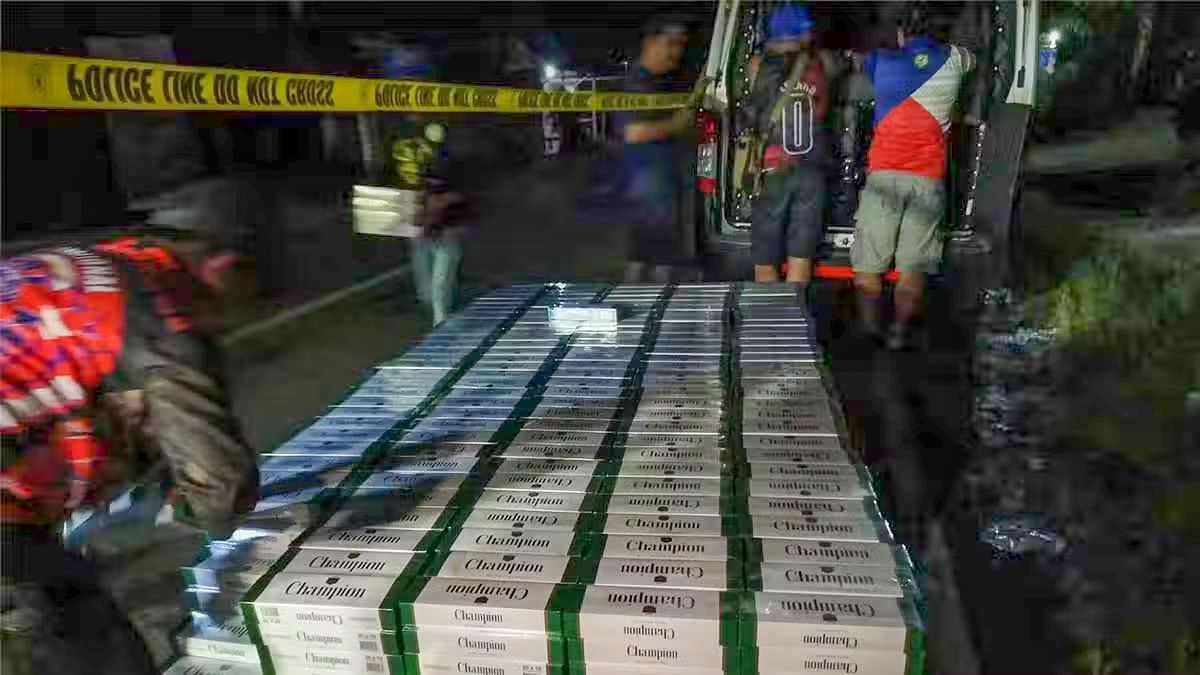
Law enforcement officers in the southern Philippines have arrested a uniformed policeman and a commercial businessman in connection with the seizure of contraband cigarettes valued at approximately P1.9 million. The operation unfolded late Friday evening in the remote barangay of Gatas within Kalawit municipality, Zamboanga del Norte, highlighting ongoing efforts by authorities to combat smuggling networks that have become increasingly brazen across the country's vulnerable maritime corridors.
The interception occurred at a routine checkpoint when personnel from the Zamboanga del Norte 2nd Provincial Mobile Force Company, under the command of Lt. Col. Edwin Verzon, flagged a white Nissan van for inspection just after 10 o'clock that evening. What began as a standard traffic stop escalated dramatically when the vehicle's driver disregarded the signal to halt and instead accelerated in an apparent attempt to breach the security cordon. The rapid evasion prompted immediate pursuit by operating officers, who successfully intercepted the fleeing vehicle within a short distance of the original checkpoint location.
The identity of the suspects reveals a troubling dimension to smuggling operations in the region. The 34-year-old policeman, who held an assignment with Police Station 10 under the jurisdiction of the Zamboanga City Police Office, resides in Barangay Talon-Talon within Zamboanga City. His alleged involvement in contraband trafficking underscores persistent concerns about institutional corruption within law enforcement ranks, a problem that has plagued Philippine police forces and complicated efforts to strengthen public confidence in the system. The second detainee, a 36-year-old businessman from Barangay Tumaga, Zamboanga City, represents the commercial dimension of the smuggling enterprise, suggesting an organized operation rather than isolated criminal behaviour.
Upon thorough inspection of the vehicle's compartments, law enforcement teams discovered an extensive cache of contraband merchandise strategically concealed to evade detection. The authorities recovered a total of 1,630 reams of smuggled cigarettes, with the Bureau of Customs establishing a market valuation of P1,867,980 based on its established standard price index for such goods. The sheer volume of the consignment indicates this was not a minor operation but rather part of a potentially larger distribution network moving illicit products through Mindanao's commercial channels.
The arrest carries significant implications for the broader campaign against cigarette smuggling, which has cost the Philippine government enormous revenue losses whilst simultaneously flooding local markets with untaxed products. Smuggled cigarettes typically undercut legitimate retailers by substantial margins, distorting market competition and depriving the exchequer of customs duties and excise taxes that could otherwise fund public services. The involvement of a serving police officer suggests that enforcement authorities may need to strengthen internal oversight mechanisms and investigate whether other members of the security forces have been compromised.
Zamboanga del Norte's strategic geographic position along major shipping lanes and its proximity to international maritime borders have made the region particularly vulnerable to smuggling activities. The area has emerged as a critical flashpoint in the government's anti-contraband operations, with law enforcement agencies conducting increasingly frequent checkpoint operations and maritime patrols to interdict illicit cargo movements. However, the successful interception also demonstrates that local security forces maintain operational capacity and commitment to disrupting smuggling networks, even when faced with organized resistance.
For Malaysian authorities and neighbouring Southeast Asian nations contending with similar challenges, the case illustrates the transnational nature of cigarette smuggling and the importance of enhanced inter-agency cooperation. Illicit tobacco products often transit multiple countries, creating complex enforcement challenges that require coordinated intelligence-sharing and joint operations across maritime boundaries. The Philippines' efforts to strengthen internal controls and hold accountable officials involved in corrupt activities reflect broader regional trends toward institutional reform and anti-corruption initiatives.
The detention of both suspects pending investigation represents a significant operational success, yet observers note that addressing the root causes of smuggling requires comprehensive approaches addressing demand factors, supply chain vulnerabilities, and the economic incentives driving organised criminal groups. The Philippine government has intensified efforts to combat contraband trafficking through various initiatives, including enhanced port security, improved intelligence gathering, and stricter penalties for offenders. However, the continued emergence of sophisticated smuggling operations suggests that criminally organised networks possess significant resources and adaptability.
The arrest also raises questions about the effectiveness of existing checkpoint systems and whether current deployment patterns adequately cover known smuggling routes. The late-evening timing of Friday's interception aligns with typical patterns of illicit commodity movements, when reduced daylight hours and diminished traffic volumes provide cover for contraband transportation. Law enforcement agencies may need to recalibrate their operational schedules and intelligence gathering methodologies to maintain pressure on smuggling networks that continuously seek to identify and exploit security gaps.
As investigations proceed into the circumstances surrounding the arrest and the potential existence of broader smuggling networks, the case will likely generate increased scrutiny of internal police accountability mechanisms. The accusation against a serving officer underscores vulnerabilities within institutional oversight structures and suggests that some enforcement personnel may have been recruited into smuggling operations through corruption, coercion, or financial inducement. Such compromises within security forces threaten not only revenue collection but also undermine public confidence in law enforcement and governmental legitimacy.

