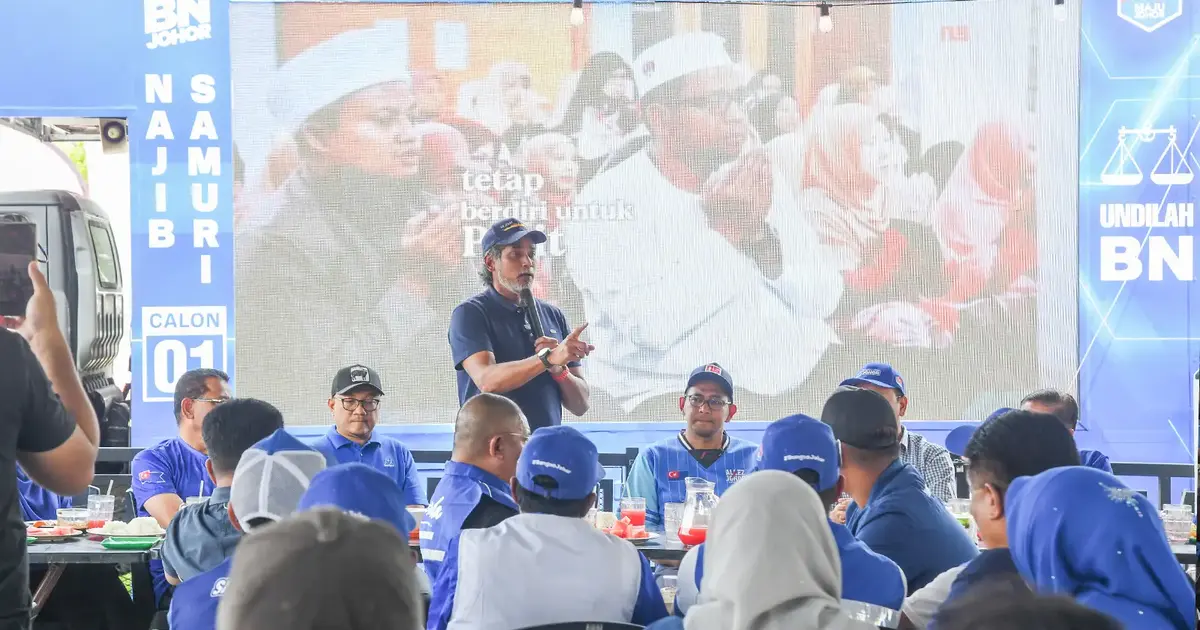
Former Umno Youth chief Khairy Jamaluddin has raised the political stakes for opposition engagement in Johor, insisting that any meaningful debate with Johor Barisan Nasional chairman Onn Hafiz Ghazi must feature candidates of comparable standing. His assertion underscores the growing emphasis on hierarchical equivalence in Malaysian political discourse, where the calibre of participants becomes a proxy for legitimacy and gravity of engagement.
KJ's position reflects broader dynamics within Johor's political landscape, where the Barisan Nasional coalition under Onn Hafiz's stewardship has consolidated significant influence. The demand for a "same level" counterpart is not merely procedural; it carries substantive implications about how political contests are framed and what weight different voices carry in the electoral narrative. By specifying that Pakatan Harapan should field its prospective menteri besar candidate, KJ effectively sets a threshold that requires the opposition coalition to mobilise its most senior figures.
This threshold is strategically significant for several reasons. First, it acknowledges that political debates in Malaysia increasingly function as public tests of leadership capability and readiness for high office. A prospective menteri besar candidate represents the clearest embodiment of opposition aspirations in a state contest, making such an individual the logical counterpart to an incumbent or leading coalition figure. The equivalency principle thus becomes both a legitimacy question and a practical scheduling matter.
For Pakatan Harapan, the demand presents a tactical consideration. The coalition must weigh whether engaging in a high-profile debate with Onn Hafiz serves its broader campaign objectives or risks amplifying the BN chairman's visibility and authority. Fielding a prospective menteri besar candidate simultaneously raises that individual's public profile and establishes their credentials as a viable alternative, but it also commits senior leadership to direct confrontation at a moment the opposition may prefer to consolidate grassroots support through other channels.
Johor's political context adds particular complexity to this dynamic. The state has been a traditional BN stronghold, though Pakatan Harapan made significant inroads in recent years, particularly among younger voters and urban constituencies. Onn Hafiz, as BN chairman, carries the weight of defending the coalition's position in what remains strategically crucial territory for federal politics. His willingness to debate reflects confidence in both his personal standing and the coalition's narrative, but it also signals recognition that opposition forces cannot be dismissed or ignored.
The emphasis on candidate equivalency also reflects evolving standards in Malaysian electoral politics regarding democratic participation. Unlike some earlier contests where politicians debated opponents of varying seniority, contemporary electoral contests increasingly demand that significant platform moments feature matched hierarchies. This mirrors global trends in presidential and prime ministerial politics, where debates typically occur between candidates of equivalent competitive standing. Extending this principle to state politics in Malaysia suggests a maturing of electoral culture, even as questions about accessibility and inclusivity remain.
KJ's intervention is notable given his position in national politics. As a former Umno Youth leader and subsequent cabinet minister, he carries credibility within BN circles while maintaining certain distance from current party leadership dynamics. His framing of the debate condition suggests an effort to both elevate the standing of any such engagement and to establish parameters that serve BN's interests. By requiring a prospective menteri besar, he essentially demands that PH commit a figure of genuine consequence to the arena.
For Malaysian and regional observers, the debate question illustrates how opposition coalitions navigate engagement opportunities. Pakatan Harapan's response to KJ's condition will signal its strategic priorities and confidence levels heading into the next electoral cycle. Accepting the condition with a credible menteri besar candidate would demonstrate the coalition's readiness for high-stakes competition; declining could be portrayed as risk aversion or insufficient preparation for contested contests in traditionally opposing territory.
The underlying principle about candidate equivalency also has implications for democratic practice more broadly. While matching ranks ensures substantive engagement, the practice can also create barriers to participation for emerging leaders or smaller parties lacking obvious senior figures. Malaysian electoral discourse would benefit from clearer thinking about when such thresholds serve democratic legitimacy and when they merely entrench hierarchies.
Looking forward, the debate prospect remains contingent on whether Pakatan Harapan agrees to KJ's conditions and whether both sides can agree on format, timing, and moderation. The condition itself, however, has already shaped the terms of engagement, establishing expectations about who speaks for whom and what weight different voices carry in the state's political conversation. In Malaysian politics, setting such parameters often proves as consequential as the debate itself.

