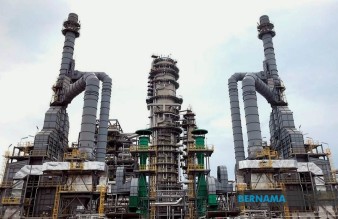
Prime Minister Datuk Seri Anwar Ibrahim's proposal to establish a strategic petroleum reserve deserves serious consideration, but policymakers must recognise this initiative as one element within a far more expansive economic resilience architecture rather than as an isolated energy policy. According to Mohd Sedek Jantan, director of investment strategy and country economist at IPPFA Sdn Bhd, the vulnerabilities facing Malaysia's economy extend well beyond petroleum supply disruptions, requiring a multifaceted approach to protecting national prosperity against geopolitical and economic shocks.
The fundamental weakness of treating a petroleum reserve as a standalone solution lies in its narrow focus on a single commodity when future crises may originate from entirely different strategic sectors. Mohd Sedek emphasises that disruptions to global food supplies, critical mineral availability, semiconductor production capacity or digital infrastructure could prove equally—or more—devastating to Malaysia's economic stability and social cohesion. The country's heavy reliance on imported food products makes it particularly vulnerable to international supply chain fractures, with direct consequences for inflation rates, household purchasing power and ultimately social stability. This reality underscores why energy security, though increasingly vital, cannot be viewed in isolation from these other critical components of national economic resilience.
The economist's core argument rests on a crucial distinction between stockpiling as mere accumulation and stockpiling as a strategic tool embedded within comprehensive risk management. Storing barrels of petroleum provides little genuine protection unless complemented by diversified supply sources, robust logistics networks, and coordinated governance structures that address multiple vulnerability points simultaneously. Success in building economic resilience cannot be measured simply by the volume of reserves held, but rather by whether those reserves contribute meaningfully to Malaysia's capacity to absorb and recover from major geoeconomic shocks. This reframing shifts the evaluation criteria from quantitative metrics to qualitative outcomes regarding national economic durability.
Mohd Sedek identifies three essential principles that should guide policymakers as they study the petroleum reserve proposal. First, the government must articulate a clear strategic purpose for any reserve system, distinguishing between genuine safeguards against legitimate supply disruptions and tools for market manipulation. A petroleum reserve designed to stabilise the economy during authentic crises serves the national interest, whereas one intended to influence short-term price movements reflects misaligned priorities that could eventually undermine fiscal sustainability and public confidence. This definitional clarity proves crucial for establishing appropriate operational parameters and performance metrics.
Second, the study framework should accommodate flexibility for addressing evolving strategic challenges beyond petroleum. Today's critical concern may centre on energy security, but tomorrow's threat could materialise in food production networks, rare earth mineral supply chains, semiconductor manufacturing capacity or the digital infrastructure that increasingly underpins modern economies. Rather than designing a system optimised solely for petroleum reserves, Malaysia should develop adaptable methodologies for identifying emerging vulnerabilities and calibrating responsive mechanisms as circumstances change. This forward-looking orientation prevents the nation from becoming locked into policies optimised for yesterday's risks while remaining exposed to tomorrow's threats.
Third, implementation must satisfy stringent commercial and fiscal standards ensuring long-term public value. Decisions regarding reserve size, financing mechanisms, storage infrastructure and governance arrangements require rigorous cost-benefit analysis rather than proceeding from ideological convictions about reserve quantities. Malaysia faces significant fiscal pressures and competing budgetary demands; a petroleum reserve programme that drains public resources without demonstrable returns would prove counterproductive to broader economic resilience goals. Sustainable implementation demands evidence-based policymaking grounded in realistic assessments of costs, benefits and opportunity costs compared to alternative uses of public capital.
International experience offers valuable guidance for Malaysian policymakers. Japan demonstrates how strategic reserves achieve maximum effectiveness when integrated with diversified supply chains, sophisticated logistics networks and robust public-private coordination mechanisms. Rather than relying principally on government-held stockpiles, Japan combines strategic reserves with supplier diversity, long-term contracts with multiple partners, technological innovation to reduce consumption, and institutional arrangements ensuring rapid coordination during crises. This integrated approach provides greater resilience than any single reserve system could achieve, offering Malaysia a practical template for designing genuinely comprehensive economic security architecture.
Food security merits equal priority with energy security within Malaysia's long-term economic strategy, particularly given the nation's substantial food import dependence. Global agricultural disruptions—whether from climate stress, geopolitical conflict or pandemic-related supply chain fractures—threaten household food access and inflation stability more directly than most petroleum supply scenarios. The 2022 global energy crisis demonstrated vulnerabilities in energy markets, yet food price spikes have proven equally consequential for Malaysian household welfare and social stability. An integrated economic security strategy must therefore address food production and supply diversification with equivalent commitment and resources as petroleum reserves receive.
Critical minerals and semiconductors represent emerging vulnerability domains that command increasing strategic importance as global technology competition intensifies. Malaysia's electronics manufacturing sector depends on reliable semiconductor supply, while the country's mineral endowments could face disruption or strategic restriction as great powers compete for critical material resources. Digital infrastructure underpinning financial systems, communications networks and government services similarly requires protective consideration within national security frameworks. Collectively, these sectors constitute an interconnected ecosystem where weakness in any component could cascade throughout the broader economy, justifying coordinated policy attention.
The economist's analysis suggests that Malaysia should develop a national risk management framework treating petroleum reserves not as the centrepiece but as one component within integrated economic security architecture. This approach requires establishing clear institutional coordination across multiple government agencies responsible for energy, agriculture, mining, semiconductors and digital infrastructure. International partnerships and supply diversification strategies should complement domestic reserves, recognising that no single nation can achieve complete self-sufficiency across all critical sectors. Strategic reserve policies must align with broader economic diversification objectives, reducing systemic dependence on vulnerable supply chains through investment in domestic production capacity, technological innovation and alternate sources.
Moving forward, Malaysia's policymakers should commission comprehensive assessments identifying critical vulnerability points across multiple economic sectors rather than narrowly focusing on petroleum supplies. This diagnostic work should inform strategic choices about reserve systems, supply diversification initiatives, technological innovation investments and institutional capacity-building. The petroleum reserve proposal offers opportunity to establish broader economic security governance structures and analytical frameworks that position Malaysia to respond effectively to multifaceted future challenges. By embracing Mohd Sedek's integrated perspective, Malaysia can transform the reserve study into a catalyst for developing genuinely comprehensive national economic resilience.

