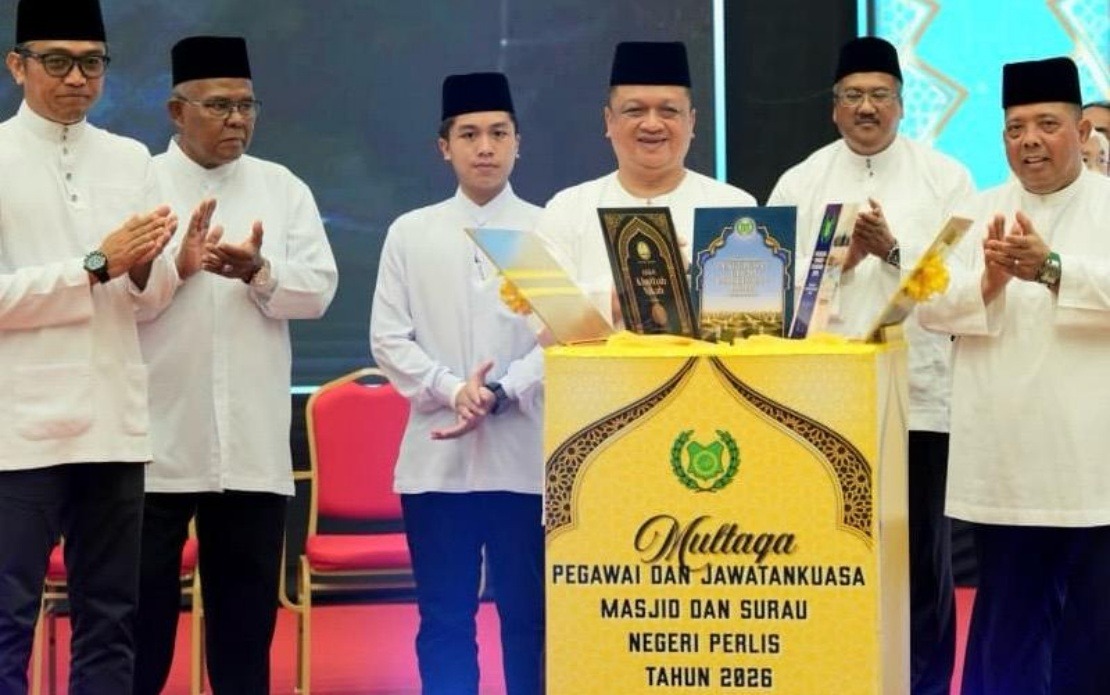
The Raja Muda of Perlis, Tuanku Syed Faizuddin Putra Jamalullail, has emphasized the critical importance of integrity and professionalism in how mosque and surau committees discharge their responsibilities across the state. Speaking at the inaugural 2026 Perlis State Mosque and Surau Officers and Committees Multaqa Programme held at Dewan 2020 in Kangar, His Royal Highness underscored that those entrusted with managing these religious institutions must maintain the highest standards of administrative conduct and operational excellence. The remarks reflect growing recognition among Perlis's leadership that public confidence in religious institutions depends fundamentally on transparent, accountable governance.
In his address, Tuanku Syed Faizuddin Putra stressed that all personnel involved in mosque and surau management must familiarize themselves thoroughly with the regulatory framework established by the Perlis Islamic Religious and Malay Customs Council (MAIPs) and the Perlis Islamic Religious Affairs Department (JAIPs). This emphasis on adherence to formal guidelines signals the state's commitment to standardizing practices across its religious institutions rather than allowing inconsistent management approaches to persist. By anchoring mosque and surau operations to codified procedures aligned with both Islamic jurisprudence and state legislation, Perlis aims to ensure that community affairs are conducted with systematic rigor and legal compliance. Such centralized guidance also protects individual committee members by providing clear benchmarks for acceptable conduct.
The 2026 programme agenda itself reveals the practical scope of governance concerns facing religious institutions today. Three principal areas form the focus: revised guidelines for managing Muslim cemeteries throughout Perlis, comprehensive protocols for mosque management divisions, and standardized procedures governing marriage registration and the responsibilities of jurunikah officials. These topics are far from merely ceremonial; they touch directly on services affecting thousands of Muslim residents annually. Cemetery management, for instance, involves financial stewardship, record-keeping, and family consultations—all domains where institutional integrity proves essential. Similarly, marriage administration intersects with legal documentation and state recognition, making procedural consistency especially important for protecting individual rights.
The Raja Muda articulated a vision of contemporary religious institutions that extends well beyond their traditional devotional functions. He acknowledged that in an increasingly complex society, Muslim communities expect mosques and surau to operate as professionally managed facilities delivering services with the same standards applied across government and corporate sectors. This reframing acknowledges demographic shifts and evolving public expectations; younger, more educated congregants particularly demand transparency in financial matters, clear communication of institutional policies, and responsiveness to community feedback. By validating these expectations from the highest level of state leadership, Tuanku Syed Faizuddin Putra has effectively positioned professional mosque management as compatible with religious authenticity rather than antagonistic to it.
The deliberate expansion of this year's multaqa to encompass surau committees represents a strategic institutional innovation with implications for religious administration across Perlis. Surau—smaller prayer facilities often located in neighborhoods and workplaces—serve complementary roles to mosques but have historically received less formalized oversight and training. By bringing surau leaders into a unified governance framework alongside their mosque counterparts, Perlis recognizes that fragmented institutional structures create accountability gaps and inconsistency. This inclusive approach strengthens the entire religious infrastructure while affirming that both settings merit equivalent standards of stewardship, regardless of their size or prominence within the community.
From a broader Southeast Asian perspective, Perlis's emphasis on institutional governance carries relevance for Malaysian Islamic administration generally. As states across the region grapple with balancing religious authority with modern administrative demands, Perlis's model of combining spiritual leadership (through MAIPs oversight) with professional management standards offers a potential template. The approach does not subordinate religious law to secular bureaucracy; rather, it recognizes that Islamic principles themselves demand trustworthiness, transparency, and sound stewardship. By framing professional management as an Islamic obligation rather than a Western imposition, Perlis's leadership has neutralized potential ideological resistance to governance reforms.
The multaqa programme itself functions as an institutional mechanism for closing the gap between policy formulation and ground-level implementation. Rather than assuming that guidelines issued from state headquarters automatically translate into consistent practice, the gathering creates direct channels between senior religious administrators and frontline committee members. This approach acknowledges that implementation challenges often arise not from deliberate defiance but from ambiguity, competing interpretations, or resource constraints. By providing a platform for dialogue and clarification, the programme enhances the likelihood that new procedures—particularly around cemetery management and marriage administration—will be understood and applied uniformly across the state's diverse communities.
The language employed by Tuanku Syed Faizuddin Putra throughout his address reveals careful attention to legitimizing governance reform within Islamic frameworks. Terms such as "trust" (amanah in Islamic Arabic), "integrity" (amanah and honesty), and "systematic work culture" resonate with both traditional Islamic values and modern administrative principles. This rhetorical strategy—grounding contemporary governance demands in Islamic sources—proves particularly effective in contexts where segments of society view Western management practices with suspicion. By demonstrating that professional administration represents an expression of Islamic principles rather than a departure from them, the Raja Muda has created space for institutional modernization without triggering defensive reactions.
Implementing the 2026 programme's outlined agenda will require significant capacity-building investments, particularly in training committee members who may lack formal administrative experience. Cemetery management, for instance, involves surveying, record-keeping, budget management, and sensitive family consultation skills—competencies that many volunteer committee members have never formally studied. Marriage administration similarly demands knowledge of legal documentation requirements, proper record archiving, and interaction with state civil registrars. The multaqa programme's success will ultimately depend on whether it catalyzes sustained, resource-backed training initiatives rather than serving as a one-time awareness event.
For Malaysian readers, particularly those in Perlis or other northern states, these institutional reforms carry practical implications. Improved cemetery management procedures may mean clearer records, more orderly facilities, and more respectful handling of family concerns during grief. Enhanced marriage administration protocols could reduce bureaucratic delays or errors in religious marriage documentation. More transparent mosque financial management might generate greater community confidence in how zakat and other donations are deployed. These tangible improvements in service quality reflect the real-world dividends of governance professionalization.
The Raja Muda's initiative also signals broader institutional maturation within Malaysia's Islamic administration. Rather than viewing governance reform as externally imposed or culturally inauthentic, Perlis's leadership has positioned professional standards as intrinsic to Islamic values. This rhetorical and practical reframing has potential ripple effects across Malaysian states, potentially normalizing discussions around institutional transparency, financial accountability, and service quality standards within Islamic religious contexts. As global attention on institutional governance intensifies—from NGO scrutiny to regulatory pressures—religious institutions that proactively adopt professional standards position themselves as responsive to contemporary demands rather than defensive or resistant.
Moving forward, the sustained success of Perlis's mosque and surau governance agenda will depend on several factors: adequate funding for training and administrative infrastructure, genuine commitment to accountability mechanisms that can address institutional failures, and willingness from senior leaders to model transparency in their own decision-making. The multaqa programme represents a necessary beginning, but transforming governance culture requires long-term institutional commitment. If executed effectively, Perlis's approach could establish a model that balances respect for religious authority with the accountability standards that modern diverse societies increasingly demand from all institutional actors.

