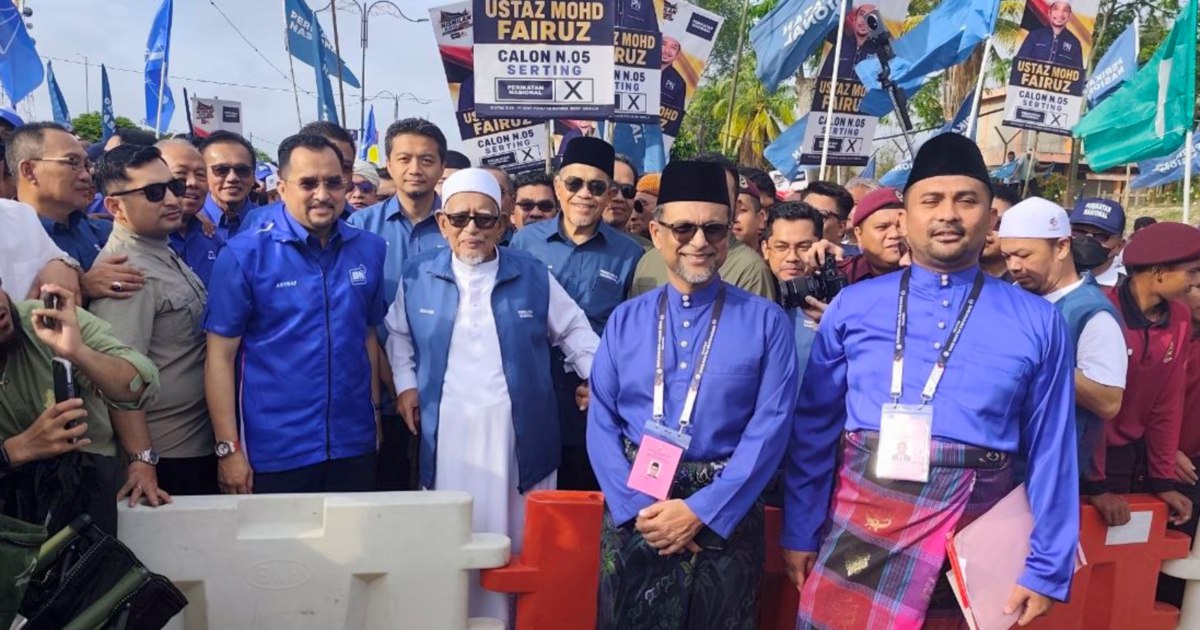
The political landscape in Negri Sembilan is taking shape with a significant coalition announcement as Perikatan Nasional moves to solidify support for Barisan Nasional during the state election campaign. Tan Sri Abdul Hadi Awang, the president of Parti Islam Se-Malaysia (PAS) and a key figure within the PN coalition, confirmed that his alliance would extend campaign assistance to BN, signalling deepening political coordination between the two major bloc forces.
This development underscores the evolving dynamics of Malaysian politics following the 2022 general election, when PN emerged as a formidable parliamentary presence. The coalition's decision to back BN in Negri Sembilan reflects the complex web of political negotiations and alliances that define contemporary electoral contests at the state level. Such cooperation illustrates how coalitions attempt to consolidate voter support and prevent vote-splitting that could benefit opposition parties.
Negri Sembilan has long been a competitive state politically, with BN historically holding dominant control over the state assembly. The involvement of PN in the campaign machinery represents a tactical consideration, as the combined organisational strength of both coalitions could prove significant in determining the election outcome. The state election, whenever it materialises, will be closely watched as a barometer of public sentiment given the recent shifts in federal politics.
The support from PN carries practical implications for BN's campaign structure and reach. With PAS bringing its established grassroots network and community connections, particularly in rural constituencies, the combined effort promises a more comprehensive electoral outreach. PAS's mobilisation capacity has been demonstrated in previous electoral contests, where the party has shown particular strength in securing traditional Malay-Muslim constituencies.
For Malaysian voters, this alliance arrangement means a unified campaign strategy from two significant political coalitions. The decision reflects how state elections in Malaysia often serve as extensions of federal political positioning, with national coalition dynamics playing out in local contests. This coordination also indicates that both PN and BN leadership see mutual advantage in preventing opposition gains in what remains a strategically important state in Peninsular Malaysia.
The timing of such an announcement typically precedes official election calls and campaign periods. Negri Sembilan's state assembly currently operates under its existing term, though state elections must be held within the constitutional timeframe. The advance commitment from PN suggests both coalitions have begun preliminary political positioning and campaign groundwork preparation.
Regionally, this PN-BN cooperation in Negri Sembilan fits into broader Southeast Asian patterns of coalition politics in democracies managing multiple power centres. Malaysia's federal system creates these layered political dynamics where national alliances must navigate state-level contests and local political considerations. The willingness of PN to assist BN represents pragmatic coalition management in an era when no single bloc consistently dominates all electoral levels.
For BN specifically, PN's campaign support addresses a structural challenge faced by older political machinery. The coalition has worked to modernise its electoral approach and PN's youthful energy and digital-savvy components could complement BN's traditional organisational strengths. This cross-coalition cooperation demonstrates how established parties adapt to maintain competitiveness against opposition coalitions and movements.
The Negri Sembilan election will likely serve as a proving ground for how effectively PN and BN can coordinate campaign efforts in practice. Previous collaborative attempts between coalitions have yielded mixed results, with coordination sometimes complicated by internal faction rivalries and competing interests at the grassroots level. Success in Negri Sembilan could establish a template for future cooperative campaigns in other states.
From an opposition perspective, the unified PN-BN campaign presence will require strengthened coordination among PKR, DAP, and other Pakatan Harapan components. The announcement effectively raises the competitive stakes for the election and suggests both major blocs view Negri Sembilan as a significant contest worth intensive campaign investment. State elections increasingly function as important political thermometers for national sentiment, making Negri Sembilan's eventual electoral result consequential for broader Malaysian political trajectories.

