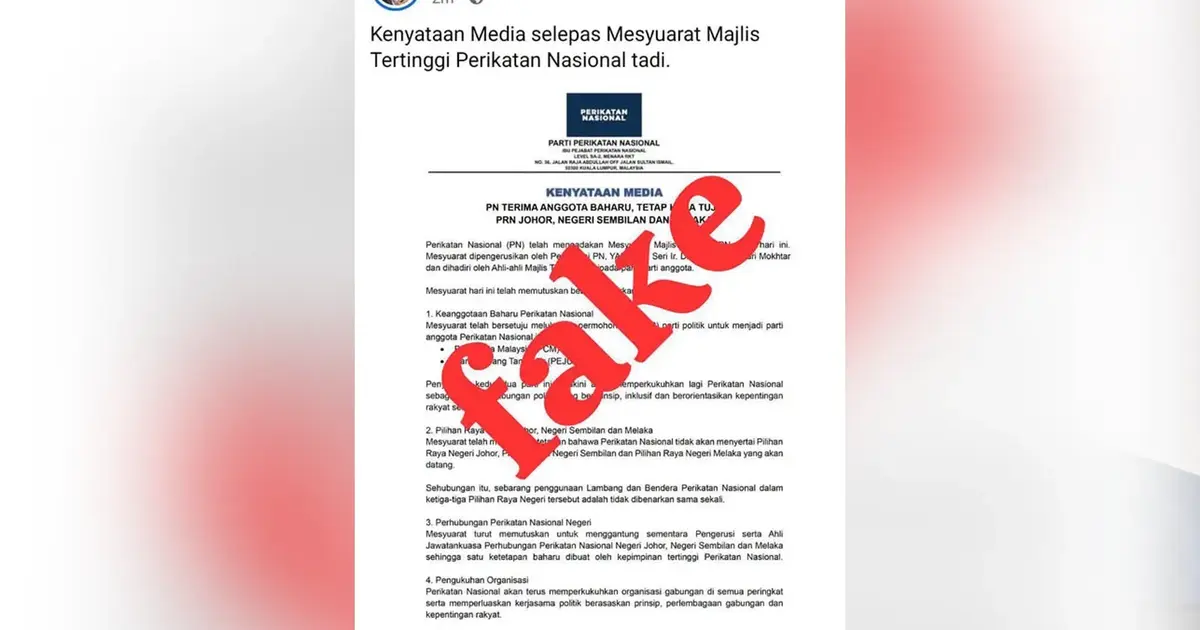
The Perikatan Nasional opposition coalition has firmly rejected a misleading statement making the rounds across social media and online platforms, which alleged that the alliance would abstain from participating in three forthcoming state elections. The coalition's authoritative response underscores the importance of distinguishing between credible political communications and deliberately fabricated narratives designed to confuse voters and sow discord within the political landscape.
The false claim, which circulated without any verified source or official endorsement from the PN leadership, suggested a significant strategic shift in the coalition's electoral approach. Such allegations carry substantial weight in Malaysia's competitive political environment, where election participation decisions fundamentally shape parliamentary representation and regional power balances. The rapid dissemination of unverified information highlights the vulnerability of the Malaysian public to misinformation, particularly during periods of heightened political activity and electoral anticipation.
PN's categorical denial of the statement reflects the coalition's commitment to transparent communication with its supporters and the broader electorate. By immediately addressing the false narrative, the alliance sought to prevent the spread of confusion that might otherwise undermine public confidence in its strategic direction. The incident illustrates the ongoing challenge Malaysian political parties face in combating deliberately crafted disinformation that seeks to manipulate public perception and erode trust in opposition movements.
In the context of Malaysia's federal structure, state-level elections represent critical opportunities for political coalitions to demonstrate grassroots support and consolidate regional influence. Any decision by a major political force to voluntarily abstain from such contests would represent a dramatic retreat with profound implications for the party's viability and electoral prospects. The baseless nature of the claim becomes apparent when examined against the strategic incentives facing opposition coalitions seeking to challenge the incumbent government's dominance.
The PN coalition, which comprises Bersatu, PAS, and other allied parties, maintains a substantial presence across multiple Malaysian states and continues pursuing electoral opportunities to expand its parliamentary representation and influence over governance. Withdrawing from any electoral contest would contradict the coalition's fundamental objectives and alienate its diverse supporter base, which spans various regions and demographic groups. The alleged strategy would have represented a self-defeating political manoeuvre inconsistent with any rational party calculus.
This episode underscores the sophisticated challenges facing Malaysia's information ecosystem, where coordinated campaigns or opportunistic fabrications can rapidly gain traction before verification mechanisms can assess their accuracy. The speed with which false statements can propagate across digital networks leaves political parties in a reactive position, forced to expend resources combating misinformation rather than advancing positive messaging. For Malaysian voters, the proliferation of such claims creates a daunting environment where critical evaluation of political claims requires substantial effort and digital literacy.
The broader implications of this incident extend beyond the immediate controversy surrounding PN's electoral intentions. The existence and circulation of such fabricated statements raises important questions about the mechanisms through which false information enters the political discourse and the motivations of those responsible for creating and amplifying it. Whether originating from rival political actors, external interference, or simply unverified rumour-mongering, such claims pose genuine threats to the integrity of Malaysia's democratic processes.
For Southeast Asian democracies more broadly, the challenge of combating political misinformation has become increasingly acute as digital communication channels proliferate and algorithmic systems amplify sensational content. Malaysia's experience with this particular false claim reflects patterns observed across the region, where opposition movements often become targets of deliberate disinformation campaigns designed to undermine their credibility and electoral prospects. The PN's swift response demonstrates one approach to countering such efforts, though systemic solutions require broader societal commitment to information verification and media literacy.
Election observers and political analysts have highlighted the necessity for all stakeholders—including mainstream media organisations, digital platforms, and civil society groups—to develop more robust mechanisms for identifying and combating false political claims before they achieve widespread circulation. The responsibility does not fall solely on political parties to address misinformation; rather, combating disinformation requires coordinated effort across multiple sectors of Malaysian society. Without such collective action, false claims about major political developments will continue proliferating, potentially influencing voter behaviour and distorting electoral outcomes.
Moving forward, the PN's explicit denial of these false claims serves as a reminder for Malaysian voters to approach extraordinary political allegations with appropriate scepticism, particularly when such claims lack corroboration from multiple credible sources or official channels. As Malaysia approaches various electoral contests at state and national levels, maintaining vigilance against misinformation becomes increasingly critical. The coalition's insistence on the falsehood of these claims reaffirms its commitment to contesting elections and engaging with voters across all regions, notwithstanding deliberate attempts to suggest otherwise.