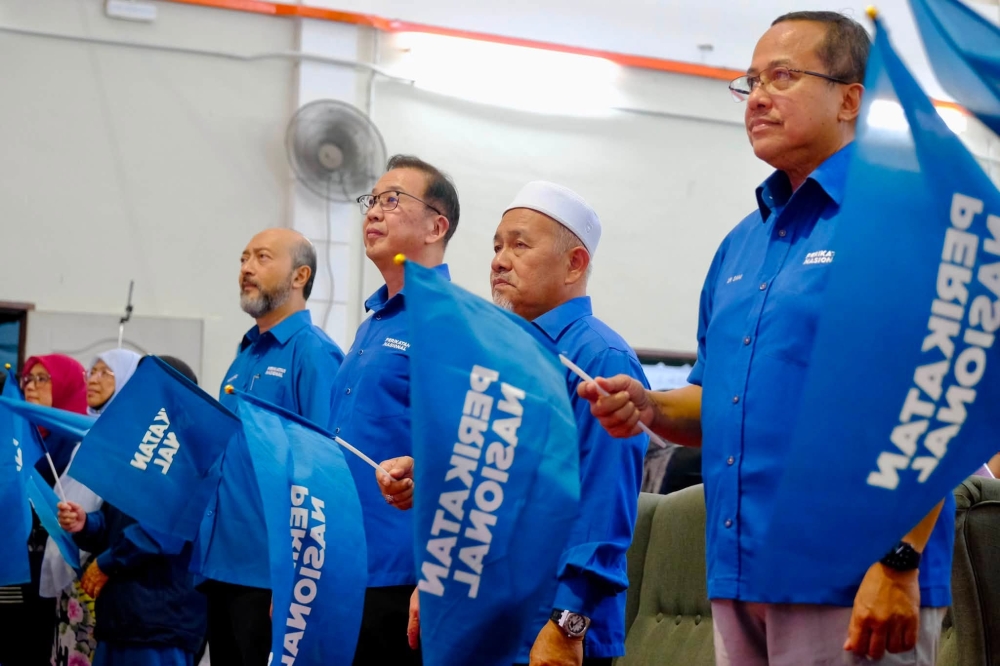
Perikatan Nasional chairman Datuk Seri Ahmad Samsuri Mokhtar has proposed that the coalition's current working arrangement with Barisan Nasional might develop into a more permanent political partnership, potentially lasting through the next general election cycle. His remarks underscore a significant shift in the relationship between two major political blocs that have historically maintained separate identities and competing electoral strategies throughout Malaysian politics.
The PN leader's comments emerge from the backdrop of an experimental collaboration established in Negeri Sembilan, where the two coalitions have agreed to operate jointly at the state level. This arrangement represents one of the most concrete examples of cross-coalition cooperation in recent Malaysian political history, moving beyond rhetorical gestures to actual shared governance. The success or failure of this partnership will serve as a barometer for whether broader national-level integration becomes feasible for the 16th general election, currently slated for 2028.
Negeri Sembilan has become the testing ground for a political experiment with far-reaching implications for Malaysia's two-coalition system. The state's relatively manageable size and political complexity make it an ideal location to pilot collaboration mechanisms that could, if proven successful, be scaled up to national elections. Both PN and BN have incentives to make this work: PN seeks to strengthen its political footprint beyond its traditional strongholds in the Malay-Muslim heartland, while BN aims to broaden its coalition and secure a more stable governing majority in increasingly competitive electoral environments.
The implications of such an alliance extending to the general election stage would be transformative for Malaysian politics. For decades, Malaysian elections have been shaped by clear bipolar competition between Barisan Nasional and its challengers, later restructured around Pakatan Harapan and PN as the primary contenders. A formal merger or long-term alliance between PN and BN would essentially collapse this binary structure, potentially creating a single dominant coalition that would fundamentally alter the nation's competitive political landscape. This development could concentrate power more heavily within a unified bloc while potentially marginalizing opposition forces.
Such a merger would also carry implications for the composition and character of both organizations. Perikatan Nasional has built its political base significantly through PAS, the Malaysian Islamic Party, which brings religious conservatism and grassroots organizational strength to the coalition. Barisan Nasional, meanwhile, historically centered on UMNO's secular-nationalist framework alongside component parties representing various communal interests. An integration of these two distinct political traditions would require substantial compromises on policy orientation, governance philosophy, and internal power-sharing arrangements.
The economic and governance ramifications deserve careful consideration. A unified PN-BN coalition controlling supermajorities in parliament and most state governments could enable rapid implementation of policies without the checks and balances that arise from genuine electoral competition. Conversely, it might provide stability and policy consistency that some analysts argue Malaysia's economy requires. Malaysian investors and international observers would likely scrutinize whether such consolidation produces developmental benefits or entrenches patronage networks and reduces accountability.
From a Southeast Asian perspective, Malaysia's internal political realignment holds regional significance. As ASEAN's third-largest economy and a crucial player in regional affairs, changes to Malaysian governance structures attract attention from neighboring countries and regional powers. A more concentrated power structure in Malaysia could influence the nation's approach to ASEAN consensus-building, bilateral relationships, and economic cooperation frameworks across Southeast Asia.
The success of the Negeri Sembilan experiment will depend on several practical factors: whether joint governance mechanisms function smoothly, whether resource allocation and power-sharing arrangements satisfy both coalition partners, and whether local voters perceive the collaboration as beneficial or divisive. If friction emerges or public sentiment turns negative, Ahmad Samsuri's vision of a permanent national alliance could falter before reaching implementation stage.
Political observers note that such alliances often face pressure from internal factions within constituent parties. UMNO's significant internal divisions, PAS's divergent interests, and other component parties within both coalitions maintain separate agendas and power bases that may resist full integration. Historical precedent in Malaysian politics suggests that coalitions often fracture when component parties perceive threats to their autonomy or influence.
The timeline for decision-making on GE16 alignment extends several years into the future, providing sufficient opportunity for political circumstances to shift dramatically. Economic conditions, leadership changes, electoral performance in intervening state elections, and unforeseen political developments could all reshape the landscape that currently supports Ahmad Samsuri's vision.
For now, the Negeri Sembilan partnership represents the most tangible manifestation of PN-BN cooperation. Whether this experiment evolves into a full pre-election alliance or remains confined to state-level arrangements will depend substantially on the practical benefits both organizations perceive from their collaboration and the receptiveness of their respective party memberships to deeper integration.

