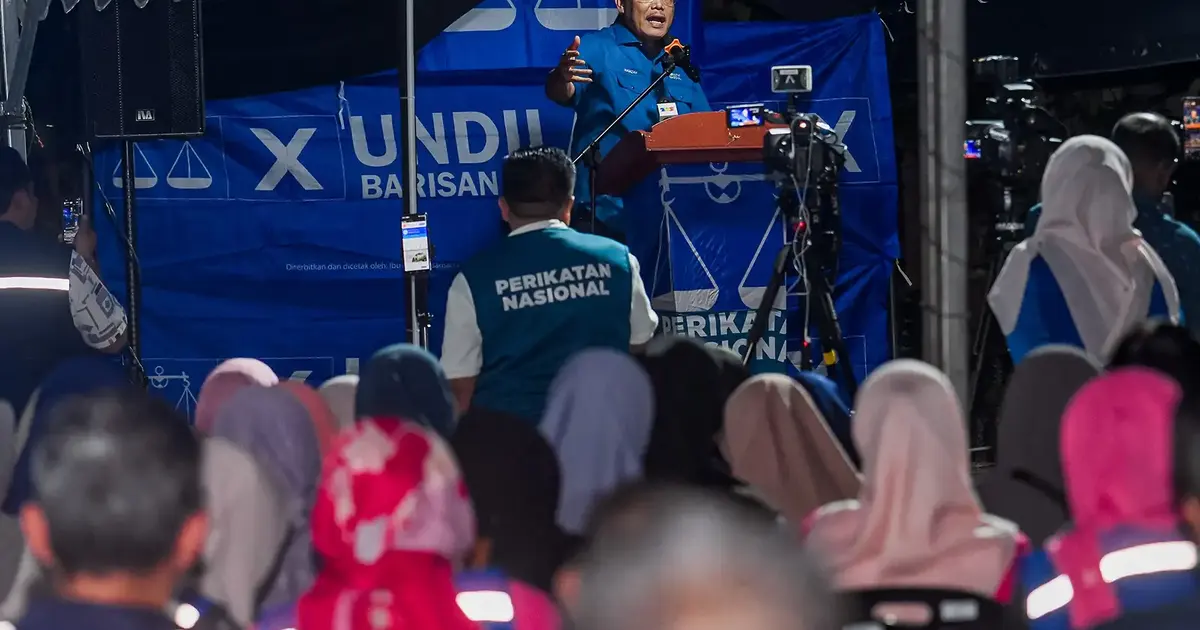
The Perikatan Nasional-Barisan Nasional electoral alliance has taken a significant step toward formalising their political cooperation by adopting a unified coalition identity. Wawasan president Hamzah Zainudin announced that the two blocs have settled on the name 'Perikatan Barisan Nasional' to represent their combined political front, marking a milestone in the ongoing negotiations between these historically distinct political forces. The decision comes as both coalitions prepare for the Negeri Sembilan state election scheduled for August 1, with the new branding signalling a consolidated approach to winning voter support across the state.
Central to the emerging partnership is a power-sharing arrangement that underscores the delicate balance between the two coalitions. Hamzah confirmed that Perikatan Nasional has agreed to cede the leadership position in Negeri Sembilan's state government to Barisan Nasional, should their joint ticket secure victory at the polls. This concession by PN represents a strategic calculation—accepting a secondary role in state governance in exchange for maintaining coalition cohesion and maximising combined electoral strength. For BN, the arrangement offers an opportunity to reassert control over a state where its political dominance has been challenged in recent years, while simultaneously validating its relevance in an increasingly fragmented political landscape.
The naming of the coalition as 'Perikatan Barisan Nasional' carries symbolic weight beyond mere branding. The term 'perikatan,' meaning alliance or coalition in Malay, positions the arrangement as an equal partnership rather than a complete absorption of one bloc by the other. This linguistic framing matters significantly in Malaysian politics, where perceptions of subordination or dominance can trigger internal dissent and grassroots resistance. By emphasising the perikatan structure, both PN and BN signal to their respective party members and supporters that neither entity has surrendered its identity or independence, merely coordinating efforts for electoral purposes.
Negeri Sembilan holds particular importance in Malaysian politics as a traditionally BN-stronghold that has seen increasing competition. The state has been a barometer of shifting political preferences, and control of its state assembly carries implications that extend beyond its borders. A successful joint PN-BN campaign would consolidate a powerful political bloc capable of influencing national-level coalition dynamics, potentially reshaping the balance of power at the federal level. Conversely, a poor showing could expose fractures within the newly-minted partnership and embolden opposition forces seeking to capitalise on disunity among ruling coalitions.
The agreement on governance leadership reflects broader pragmatism within both coalitions. PN's acceptance of a secondary role suggests confidence that maintaining structural integrity and electoral success takes precedence over claiming every available state government position. This calculation may also reflect PN's strength in other contexts—the coalition already controls several state governments and holds significant federal parliamentary representation, reducing the urgency of maximising every available advantage. For PN's component parties, accepting the arrangement could be justified as a temporary concession that preserves coalition unity during a critical electoral period.
The August 1 election represents a test case for the PN-BN partnership's viability as a sustained political arrangement. Negeri Sembilan's electorate will essentially vote on whether this new coalition model offers meaningful governance and policy benefits compared to alternatives. The outcome will signal to other states and to the federal parliament whether such arrangements can deliver electoral victories and stable governance, or whether the fundamental differences between PN and BN remain too substantial for meaningful cooperation. If successful, the template established in Negeri Sembilan could inform future electoral strategies in other state contests and influence how these coalitions position themselves relative to the federal government.
The coalition's choice of the 'Perikatan Barisan Nasional' branding also addresses practical communication challenges. Malaysian voters have grown accustomed to clear partisan identities, and introducing a new coalition name risks voter confusion. However, the decision to blend both names rather than privileging one suggests an attempt to signal inclusive leadership and shared commitment. This approach requires effective messaging to ensure voters understand the partnership's mechanics and that their votes will translate into the intended governance arrangements.
For Malaysian politics more broadly, the PN-BN agreement demonstrates ongoing flux in coalition formation and realignment. The traditional BN framework that dominated Malaysian politics for decades has fragmented, forcing new partnerships and creative political arrangements. PN's rise as an alternative power bloc has injected competition into state-level politics, but the August 1 election suggests that purely adversarial positioning may be giving way to pragmatic alliances on specific issues or contests. This evolution reflects voters' apparent preference for multiple viable options and power alternatives, even if it complicates the political landscape.
Looking ahead, the success of the 'Perikatan Barisan Nasional' brand will depend substantially on how party leaderships manage internal dynamics and maintain message discipline. Component parties within both PN and BN carry their own interests and constituencies, and securing their buy-in for the arrangement requires careful communication about how the partnership serves their long-term strategic goals. Any perception that leadership decisions are being imposed without consultation risks triggering defections or electoral underperformance as grassroots activists lose enthusiasm for a coalition they view as compromised or unrepresentative.

