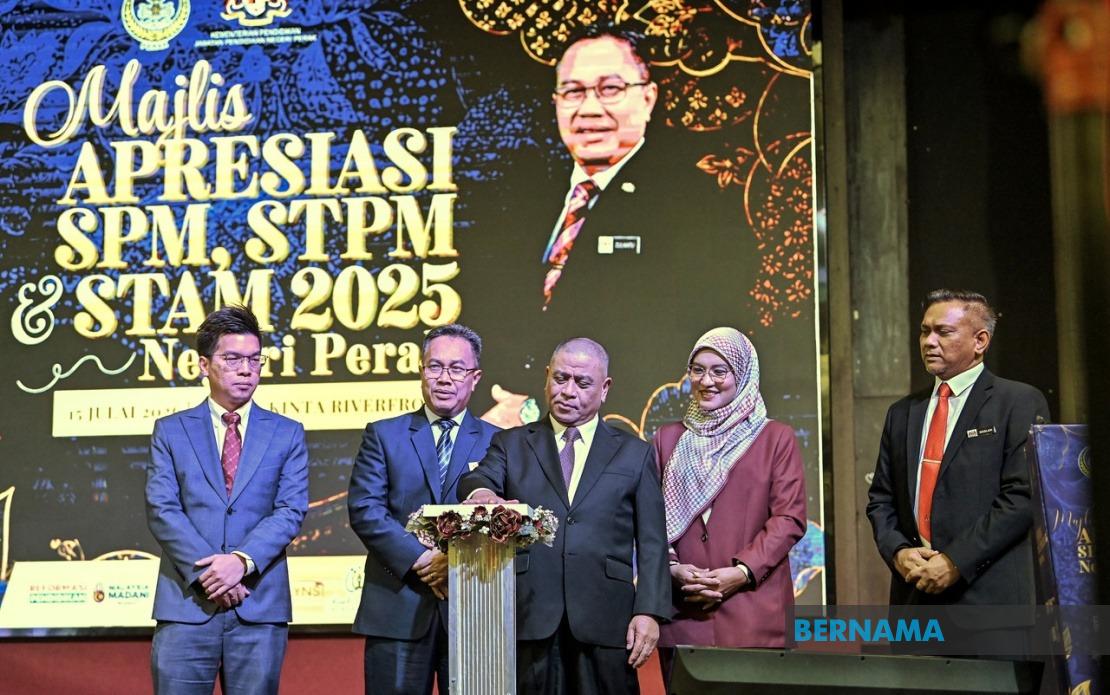
Perak's education scholarship scheme is making tangible differences in student lives, offering meaningful financial relief that extends well beyond classroom walls. Administered through the Menteri Besar Scholarship initiative, the programme demonstrates how targeted state investment in student welfare can simultaneously reduce family hardship and create pathways to academic achievement. The initiative gained fresh recognition during a state-level appreciation ceremony held in Ipoh on July 15, where Menteri Besar Datuk Seri Saarani Mohamad and education officials highlighted how scholarships have become catalysts for excellence across the state's educational system.
Yoong Lam, a 20-year-old from Sekolah Menengah Kebangsaan Sultan Yussuff, exemplifies the scheme's impact. The STPM graduate achieved a rare perfect Overall Grade Point Average of 4.00, and she attributes much of her success to the RM1,200 semester assistance she receives. This money stretches across essential needs—examination fees, reference materials, and private tuition—creating breathing room in her family's budget. As the eldest of two children in a household depending on her self-employed father's income, Yoong Lam's scholarship represents more than mere academic support; it constitutes structural relief for her entire family unit. She voices a sentiment likely echoed by many beneficiaries: the reduction in parental financial anxiety frees households to invest more comprehensively in their children's educational futures.
The scholarship recipients recognised at the ceremony reveal the diversity of students accessing these funds. Muhammad Haziq Hafit, 19, from Al-Ulum Al-Syar'Iyyah Religious Secondary School in Bagan Datuk, received RM1,000 to facilitate his transition to university, where he plans to pursue education studies at the University of Malaya. A fellow recipient from the same school, Muhammad Taufiq Ikwan Mohammad Asri, 19, has earmarked his scholarship allocation for preparatory expenses before undertaking further education in Egypt. Both students articulated appreciation that assistance existed specifically for middle-income families—a cohort often overlooked by either means-tested welfare or merit-based awards reserved for the exceptionally affluent. This targeting suggests that policymakers have recognised a critical gap in educational financing infrastructure.
The timing of Perak's scholarship recognition comes as the state announced its most impressive examination performance in thirteen years. The 2025 SPM cohort achieved a state average Grade Point Numerical value of 4.49, extending a three-year upward trajectory in results. This achievement carries particular significance when examined through an equity lens. The gap between urban and rural students narrowed to just 0.04 points—a measure indicating that quality education access is becoming genuinely distributed across geographic boundaries. For Malaysian policymakers grappling with persistent rural-urban disparities in educational outcomes, Perak's results suggest that financial support paired with targeted academic interventions can materially narrow long-standing achievement gaps.
Understanding these improved results requires attention to complementary initiatives that function alongside the scholarship programme. The Tuisyen Cikgu Saarani programme—itself led by Yayasan Perak in partnership with the state education department—distributes supplementary reference materials designed specifically to address Perak students' learning needs. Rather than importing generic study guides, the programme engaged experienced local educators to develop materials reflecting actual student difficulties and examination patterns. A total of 63,567 copies have reached daily school students, with approximately 25,000 SPM candidates in 2026 anticipated to benefit. The initiative has now expanded to tahfiz schools and religious secondary institutions, recognising that exam support should transcend denominational boundaries.
This expansion to religious schools marks a structural innovation in state educational support. Previously, scholarship and tutoring initiatives often concentrated on secular schools, implicitly creating hierarchies of state investment. By extending the reference book programme to Sekolah Menengah Tahfiz Darul Ridzuan and Sekolah Menengah Agama Rakyat under Perak Islamic Religious Department supervision, authorities have signalled that educational excellence matters equally across all institutional frameworks. For families with children in religious schools—often operating with tighter budgets and smaller donor networks than their secular counterparts—this inclusion represents genuine equity in opportunity provision.
The scholarship amounts themselves, while modest by international standards, carry outsized importance within Malaysian family contexts. RM1,000 to RM1,200 per semester may seem limited, yet represents substantial relief for households with multiple children and competing financial obligations. The emphasis recipients place on using scholarships for examination fees, reference books, and tuition classes reveals how financial barriers accumulate in education. A student unable to afford practice test papers or supplementary lessons faces compounding disadvantages that extend beyond raw academic capability. By removing these friction points, scholarships convert latent potential into actualised achievement.
For Southeast Asian observers, Perak's approach offers instructive lessons about calibrating educational investment. Many regional governments struggle to identify whether improving student outcomes requires massive per-pupil spending increases or smarter allocation of existing resources. The Perak evidence suggests that strategic targeting—scholarships to middle-income families, reference materials addressing specific curriculum gaps, support extended equitably across school types—can generate measurable improvement without necessarily requiring extraordinary budget expansion. This matters particularly for nations with constrained fiscal capacity seeking to improve educational equity and outcomes simultaneously.
The state's approach also highlights an often-overlooked dimension: the psychological and emotional impact of educational assistance. When families know scholarships and support programmes exist, financial anxiety diminishes. Students can concentrate on learning rather than household economics. Parents experience reduced guilt about educational limitations imposed by circumstances rather than effort. These intangible benefits accumulate into measurable academic gains, though economic analyses often overlook them. Yoong Lam's comment that the scholarship helps her father—permitting him to redirect resources elsewhere—illustrates how educational support radiates outward through family structures.
Looking forward, Perak's results create accountability expectations. Achieving the best SPM results in thirteen years establishes a baseline; maintaining or improving that performance becomes the implicit commitment. The state education department will face scrutiny regarding whether the upward trajectory continues and whether rural-urban equity gains hold. This public recognition, whilst positive, imposes implicit pressure on educational administrators to sustain improvements. For other Malaysian states observing Perak's success, the question arises: what prevents similar scholarship and support initiatives from becoming standard practice nationwide rather than state-specific innovations?
The broader Malaysian context matters here. Educational inequality within the nation remains substantial, with disparities shaped by geography, socioeconomic background, and institutional type. Federal government scholarship programmes exist but often target exceptionally high-achieving or exceptionally disadvantaged students, leaving the broad middle ground underserved. Perak's demonstration that state-level targeted intervention can yield results without requiring transformative budget increases suggests a replicable model. States controlling their own education budgets might examine whether similar scholarship frameworks, combined with locally-developed academic support materials, could generate comparable outcomes.
Ultimately, Perak's scholarship programme represents education policy working functionally. Students receive financial support that demonstrably eases family burdens. Academic results improve across the student cohort. Geographical and socioeconomic disparities narrow. No element appears accidental; each component—scholarship provision, curriculum-specific reference materials, equitable institutional coverage—connects to measurable outcomes. For Malaysian policymakers and Southeast Asian education authorities watching how nations balance competing priorities, the Perak model merits serious study as evidence that modest, well-designed interventions can catalyse meaningful improvement in educational access and achievement.

