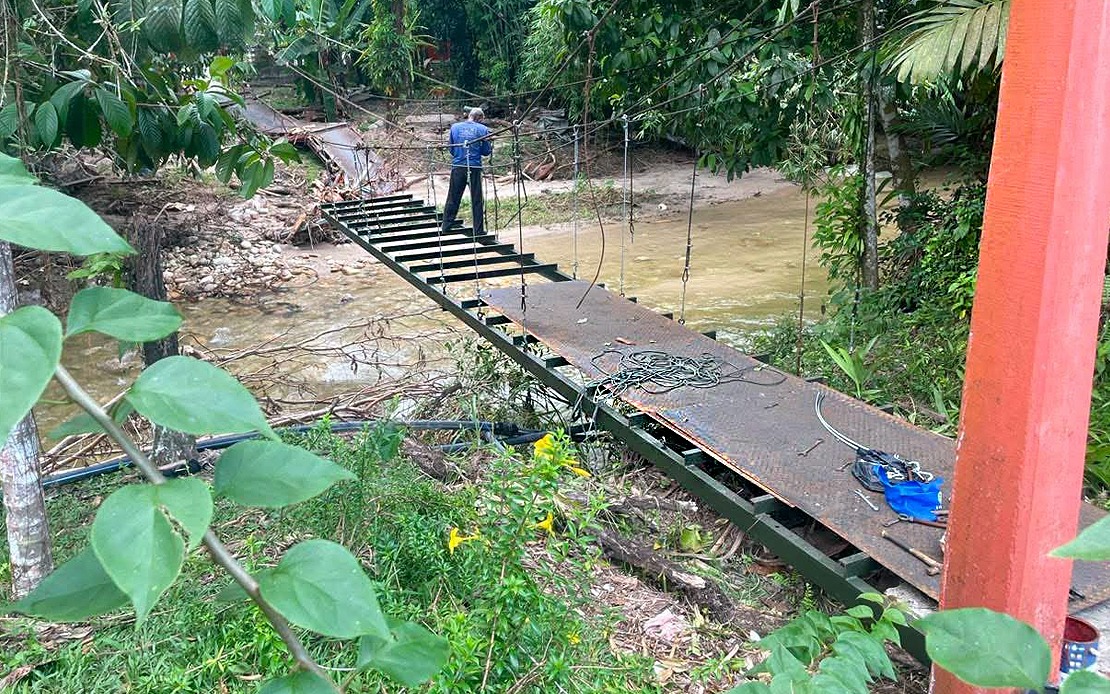
The Perak state government has pledged RM500,000 to reconstruct a permanent concrete bridge in Kampung Ulu Geruntum, Gopeng, addressing infrastructure damage caused by a devastating water surge that struck the rural settlement on June 19. The disaster left the village's primary bridge destroyed and more than 50 residents evacuated to emergency relief facilities at Gopeng Town Hall, cutting off access to the isolated community and disrupting essential services.
State Housing and Local Government Committee chairman Sandrea Ng Shy Ching disclosed the reconstruction plan in a Facebook announcement, emphasizing the government's commitment to restoring normalcy for affected villagers. Construction of the permanent bridge will commence once remedial measures currently underway are finalized, with the committee chair acknowledging the substantial efforts undertaken by multiple agencies and ground-level personnel involved in the immediate disaster response and recovery operations.
Beyond the primary reconstruction project, the state administration has mobilized additional funding to address immediate humanitarian needs. Sandrea, who represents the Teja state assembly constituency, authorized RM45,000 from her own constituency development allocation specifically to repair damaged water supply infrastructure and restore the interrupted water services that villagers depend upon for daily consumption and household use.
The multifaceted emergency response demonstrates coordinated planning across different government tiers. In tandem with the long-term bridge reconstruction, the state government approved a separate RM150,000 emergency allocation for construction of a temporary suspension bridge designed to provide immediate connectivity for the stranded residents. This interim crossing was expected to become operational by mid-July, establishing a functional passage before completion of the permanent concrete structure.
The June 19 incident highlighted the vulnerability of rural communities in Perak to extreme weather events and water surges. The sudden collapse of the main bridge during strong currents illustrated infrastructure fragility in areas where single access routes serve as lifelines for isolated settlements. The destruction forced authorities to rapidly establish evacuation procedures and temporary shelters, while simultaneously planning longer-term reconstruction strategies to prevent similar crises.
For Malaysian rural communities, the situation underscores broader infrastructure challenges across the country. Many villages rely on aging or inadequately maintained bridges, often the sole connection between settlements and main supply chains, healthcare facilities, and educational institutions. The Perak government's decision to prioritize concrete construction over temporary solutions reflects recognition that permanent infrastructure investments protect against repeated disruptions.
The water surge itself raises environmental and climate adaptation questions relevant to Southeast Asian development contexts. Increasingly unpredictable weather patterns demand that state governments reassess infrastructure resilience standards, particularly in areas historically prone to flooding or rapid water level changes. Perak's response suggests growing awareness that reactive emergency funding must complement proactive infrastructure hardening.
Sandrea's engagement across multiple administrative channels—from constituency-level allocations to state committee oversight—illustrates how decentralized governance structures attempt to address localized crises. Her dual role as both a state committee leader and constituency representative enables more flexible resource deployment than centralized systems might permit, though coordination efficiency remains crucial when managing simultaneous construction projects and service restoration efforts.
The timeline for completion carries significance for village residents currently experiencing restricted mobility and disrupted services. A mid-July operational date for the suspension bridge would reduce displacement duration, though the permanent concrete structure's completion timeline remains unspecified. This gap between temporary and permanent solutions typifies disaster recovery phases where rapid interim measures must precede more substantial reconstruction.
For policymakers across Southeast Asia monitoring infrastructure resilience, the Kampung Ulu Geruntum case demonstrates practical implementation of integrated response frameworks combining emergency relief, interim solutions, and permanent reconstruction. The RM695,000 total commitment—comprising bridge construction, suspension bridge costs, and water infrastructure repair—represents substantial provincial investment in a single rural settlement, signaling that Perak recognizes obligations to restore connectivity and services comprehensively rather than partially.
The broader implications extend to insurance and risk management discussions within Malaysian governance. Rural infrastructure destruction, while devastating locally, often receives less national media attention than urban disasters, potentially affecting resource allocation prioritization. Perak's visible commitment to full restoration suggests awareness that equitable development requires treating rural community welfare as equivalent to urban center needs.
As Kampung Ulu Geruntum transitions from emergency response to reconstruction, the success of these initiatives will likely influence future disaster preparedness frameworks across Perak and neighboring states. Whether completion timelines are met and whether the permanent bridge proves resilient to future water surges will establish precedents for infrastructure investment standards in comparable Malaysian rural contexts facing similar environmental vulnerabilities.

