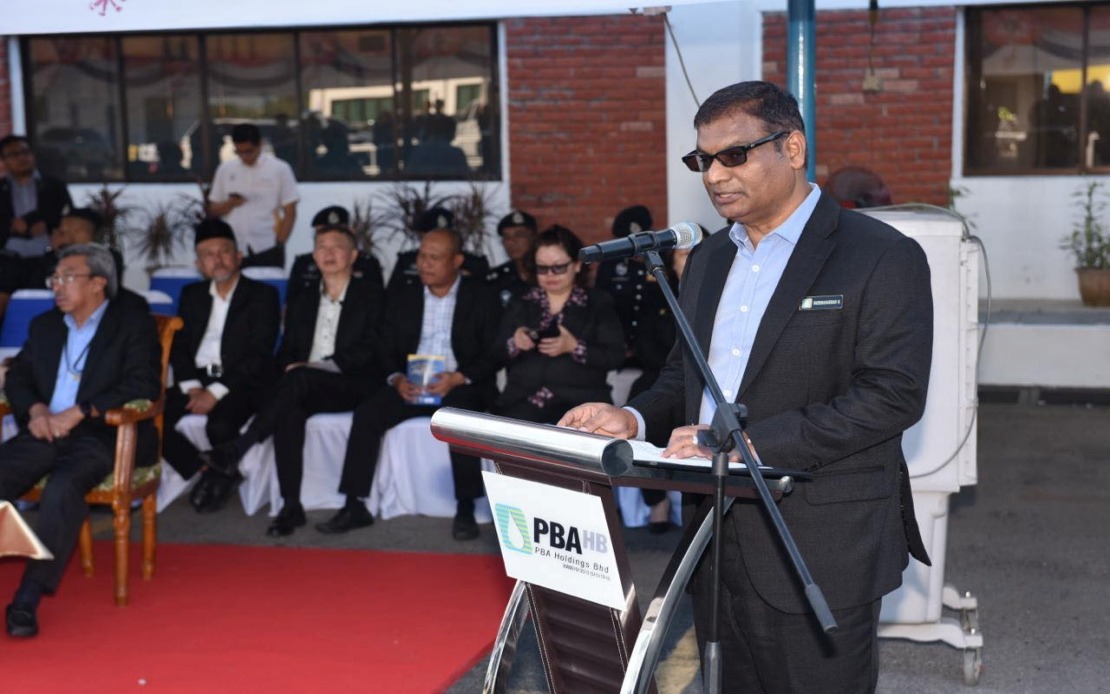
Penang's water utility is making substantial infrastructure investments to address mounting supply pressures in its southern region, with a new treatment facility set to come online within the next two years. The Penang Water Supply Corporation (PBAPP) announced plans for an 80 million litres-per-day (MLD) water treatment plant in Seberang Perai Selatan (SPS), which will utilise raw water sourced from Sungai Kerian under a Build-Operate-Transfer arrangement. The facility, expected to commence operations in 2027, represents a critical component of the state's medium-term strategy to ensure adequate water availability as the region experiences significant population growth and accelerating industrial activity.
CEO Datuk K. Pathmanathan framed the project as essential infrastructure to prevent water scarcity from constraining Penang's economic development trajectory. The 80 MLD plant forms part of a tiered expansion strategy spanning the remainder of this decade, with each phase designed to build capacity incrementally while new sources are developed. By 2030, a further facility drawing from Sungai Kerian—the 114 MLD Sungai Kerian treatment plant under the Water Contingency Plan 2030—will commence operation, substantially increasing regional availability. The third and most ambitious phase involves the Perak-Penang Water Project, anticipated to deliver between 300 and 500 MLD of treated water from neighbouring Perak beginning in 2031, serving both Seberang Perai Selatan and Seberang Perai Tengah.
The urgency behind these expansion plans stems from documented consumption patterns and ambitious development projects already underway. Seberang Perai Selatan currently serves 87,611 registered water users, consuming an average of 116.8 MLD in 2025—approximately 13.5 percent of Penang's total state demand. However, this baseline demand obscures the substantial increases anticipated from major industrial and commercial initiatives. The RM2.2 billion Batu Kawan Industrial Park 3 project, spanning 165 hectares, alone is projected to require around 220 MLD by the 2030s. Additional large-scale developments, including the SkyWorld Cassia mixed-use complex and a proposed semiconductor manufacturing facility by Siliconware Precision, will further strain existing infrastructure if expansion does not proceed on schedule.
PBAAPP has already taken interim measures to manage immediate shortfalls while permanent solutions are implemented. A compact treatment facility costing RM8.1 million began operations in Seberang Perai Selatan in March of last year, producing up to 6.4 MLD of treated water from Sungai Kerian. Although this modest-capacity plant currently serves approximately 4,000 users, it was explicitly designed as a temporary three-year bridge solution rather than a permanent answer. This approach acknowledges the reality that infrastructure development typically requires considerable lead time, and interim measures—however limited—help ease the transition period while larger projects are constructed.
The infrastructure strategy reflects broader state policy under Chief Minister Chow Kon Yeow's administration, emphasising that Penang's development agenda must not be constrained by resource limitations. By sequencing investments across multiple facilities drawing from different sources, policymakers have adopted a diversification approach intended to reduce vulnerability to supply disruptions from any single source. The decision to incorporate the Perak-Penang Water Project represents a significant inter-state collaboration, recognising that Penang's geographic limitations—its peninsular position and finite local water resources—necessitate seeking supply from neighbouring territories to support sustained growth.
For Malaysian and broader Southeast Asian observers, the Penang case illustrates mounting water infrastructure challenges facing rapidly industrialising regions. The state's southern district exemplifies pressures facing many manufacturing hubs across Malaysia and the region: accelerating demand driven by semiconductor plants, electronics assembly facilities, and heavy industrial projects coinciding with population expansion and urbanisation. Penang's historical status as a manufacturing centre, combined with its continued appeal to foreign direct investment, creates competing demands on limited water resources that single-source supply arrangements cannot sustain. The state's response—building redundancy and importing supplies from beyond traditional boundaries—may foreshadow strategies other states will need to adopt.
The Build-Operate-Transfer model employed for the 80 MLD facility represents an increasingly common approach to funding infrastructure development in Malaysia and across Southeast Asia. Rather than relying solely on government capital budgets, such arrangements typically involve private operators constructing and managing facilities for a specified period before transferring assets to public authorities. This structure allows governments to spread capital expenditures over time through operational payments while gaining technical expertise from private partners. However, the model's effectiveness depends on establishing transparent procurement processes and contracts that protect public interests while providing investors with reasonable returns.
Water supply infrastructure development also connects to broader sustainability considerations relevant to Malaysia's climate adaptation strategies. Diversifying sources—utilising both local watercourses and inter-state supplies—provides resilience against drought or pollution events affecting individual catchments. The Sungai Kerian, which will supply multiple treatment facilities, benefits from this redundancy approach, as does the reliance on Perak's water sources. As climate variability increases across Southeast Asia, utilities and governments must balance growth imperatives against the reality that water availability cannot be taken for granted. Penang's phased expansion, while partly driven by immediate industrial demand, also incorporates medium-term risk management.
The financial scale of these investments warrants attention given Malaysia's broader infrastructure financing context. Across 2027 to 2031, Penang will invest billions in water infrastructure—including the 80 MLD plant, the Sungai Kerian facility, and contributions to the Perak-Penang Water Project. These expenditures compete with other state development priorities and reflect confidence that water supply constraints genuinely threaten economic competitiveness. For industries considering relocation or expansion within Malaysia, water security has become a material decision factor, elevating infrastructure investment from routine utility spending to strategic economic necessity. States lacking adequate water supply planning risk losing manufacturing investment to competitors with secure, predictable supplies.
The timeline for these projects also reflects practical construction and operational realities often underestimated in policy discussions. An 80 MLD treatment facility requires significant lead time for engineering design, environmental assessments, land acquisition, and construction—typically several years for projects of this complexity. The 2027 target date means procurement and planning should already be underway. Delays in any component—securing necessary land rights, environmental approvals, or financing—could cascade through the entire schedule, potentially leaving a gap between when demand rises and when new capacity comes online. Penang's decision to implement the interim 6.4 MLD facility reflects awareness that timeline pressures cannot be wished away, necessitating transitional solutions.
For policymakers elsewhere in Malaysia and Southeast Asia monitoring Penang's approach, several considerations emerge. First, acknowledging water supply constraints transparently—rather than hoping demand growth somehow moderates—enables proactive planning. Second, building capacity ahead of projected demand, rather than always playing catch-up, provides operational flexibility and reduces crisis management. Third, establishing inter-regional water-sharing arrangements, while politically sensitive, may become necessary for manufacturing-intensive states lacking sufficient local sources. Penang's strategy of combining local development with inter-state projects suggests that water security increasingly transcends state-level planning horizons, requiring coordination across administrative boundaries. As other Malaysian states experience similar industrial expansion pressures, they may need to adopt comparable approaches, ultimately linking water infrastructure development to broader regional economic integration and resilience.

