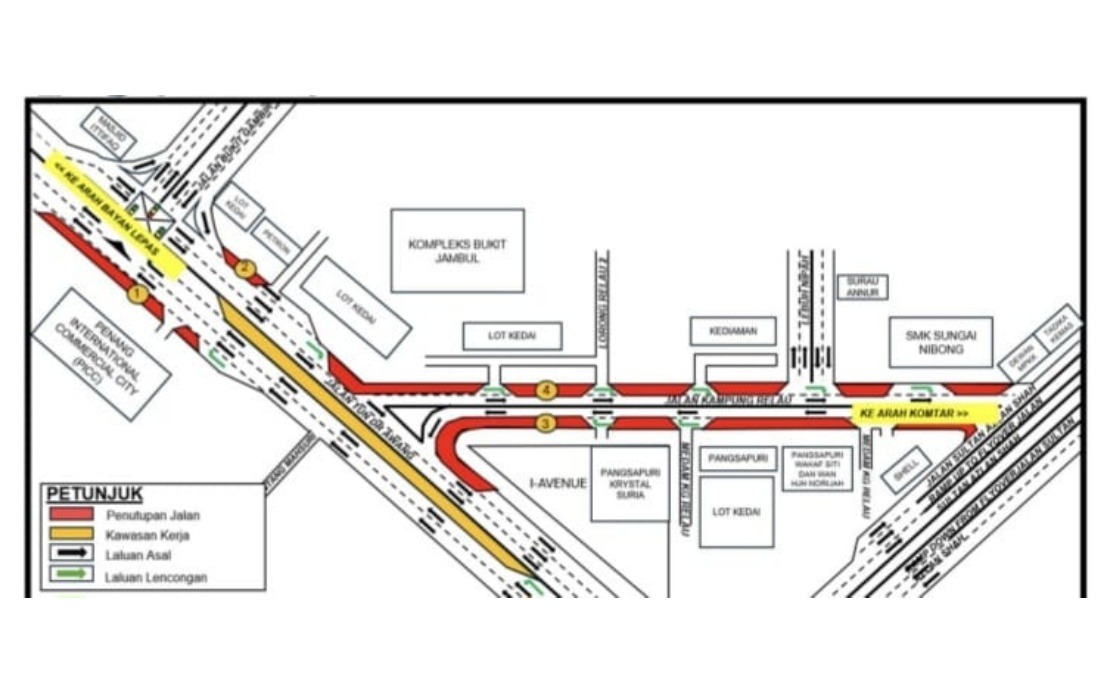
Commuters and businesses along two major Penang arterial roads face significant traffic disruptions beginning August 1, as Malaysia Rapid Transit Corporation Sdn Bhd (MRT Corp) implements a three-month programme of partial lane restrictions to support the Mutiara Line Light Rail Transit (LRT) Project. The temporary closures will affect Jalan Kampung Relau and Jalan Tun Dr Awang until October 15, representing a substantial commitment of construction time that reflects the infrastructure demands of connecting Penang's expanding transport network.
The work undertaken during this 75-day period focuses on foundational activities essential to the Mutiara Line's eventual operation. Specifically, the CMC1 Package involves critical drainage infrastructure installation and road widening initiatives that will ultimately support the new transit system while maintaining the capacity of existing road networks. These preparatory works, though disruptive in the short term, form part of a broader vision to integrate light rail connectivity across the island and reduce traffic congestion through modal shift to public transport.
The restrictions operate within defined geographical zones that represent the most critical segments requiring intervention. The leftmost lane fronting Penang International Commercial City (PICC) heading towards Bayan Lepas will be affected, along with the leftmost lane at Petron Bukit Jambul petrol station on the route toward Komtar. Additionally, traffic on Jalan Tun Dr Awang entering Jalan Kampung Relau in the direction of Komtar and the school area near SMK Sungai Nibong will experience capacity reductions during daylight hours. This targeted approach attempts to balance construction necessity with maintaining functional road capacity during the critical daytime period.
MRT Corp has established defined working hours of 8 am to 4 pm for the lane closures, a decision that reflects concern for avoiding peak rush-hour congestion that typically characterises Malaysian urban centres during early morning and late afternoon periods. By confining restrictions to mid-day hours, the corporation aims to minimise spillover effects onto alternative routes and preserve the ability of the remaining open lanes to accommodate baseline traffic volumes. However, this timing still affects commercial deliveries, school traffic, and business operations centred in the affected districts, suggesting the need for advance planning by affected stakeholders.
The multiple lane closures occurring simultaneously at different locations underscores the scale of infrastructure coordination required for the Mutiara Line project. Rather than a single, concentrated disruption, commuters will encounter intermittent restrictions across a network of critical junctions and commercial zones, necessitating flexibility in route planning and journey timing. The distributed nature of these works reflects the linear geography of transit-oriented development and the impossibility of isolating construction to purely peripheral areas without severing essential connectivity.
Recognising potential community frustration, MRT Corp has provided detailed information regarding which lanes remain operational, emphasising that alternative lanes will sustain traffic flow despite restrictions. This communication strategy attempts to counter perceptions of complete closure while acknowledging that lane reductions inherently reduce overall capacity. For routes with previously adequate capacity, the loss of a single lane may prove manageable; for congested corridors, even partial restrictions invite significant queuing and delays.
The infrastructure project itself carries broader implications for Penang's transport future. The Mutiara Line represents a significant investment in reducing car-dependent mobility patterns and building transit-oriented urban development. While construction disruption imposes near-term costs on commuters and businesses, the completed system promises enhanced connectivity across the island and potential relief for persistently congested arterial roads. This tension between short-term inconvenience and long-term benefit characterises major infrastructure development in rapidly urbanising Southeast Asian cities.
For Malaysian and regional observers, the Penang project demonstrates the practical challenges of implementing major transit infrastructure in established urban areas where existing road networks must simultaneously serve ongoing traffic demands and accommodate construction activities. Unlike greenfield development scenarios, inserting new infrastructure into consolidated urban fabric requires careful management of community expectations and meticulous coordination of traffic flows. The Mutiara Line's progression illustrates both the commitment to enhancing regional transport networks and the genuine operational difficulties such programmes entail.
MRT Corp has implemented comprehensive support mechanisms for affected commuters and businesses. Directional signage will guide motorists through affected zones, and the corporation has established multiple contact channels including the MRT Careline at 1-800-88-6782 and email address [email protected] for inquiries and feedback. This accessibility framework recognises that infrastructure projects generate legitimate questions about routing, timing, and anticipated duration that deserve responsive engagement from implementing authorities. The willingness to facilitate communication may substantially mitigate frustration among users navigating unfamiliar detours and unexpected delays.
Business operators and residents situated along these corridors face particular planning challenges over the coming weeks. Delivery schedules, employee commute arrangements, and client access considerations all require adjustment around the published closure windows. Commercial establishments accustomed to customer foot traffic generated by passing vehicles may experience reduced patronage during construction phases, a cost that typically receives insufficient recognition in infrastructure development planning. The corporation's apology for inconvenience, while acknowledging the disruptive reality, offers limited practical mitigation for affected enterprises.
Looking forward, the successful completion of this 75-day construction phase will represent a milestone in the Mutiara Line's development trajectory. However, the project will likely require additional phases of road works, utility relocation, and station construction extending well beyond October 15. Commuters and businesses should anticipate that current restrictions represent merely the opening chapter of a longer disruption narrative. Strategic planning for future phases and communication regarding anticipated impacts will prove essential for maintaining public confidence in the project's ultimate value proposition.
The Mutiara Line project ultimately reflects Malaysia's commitment to modernising transportation infrastructure and addressing urban mobility challenges through transit-oriented solutions. For Penang specifically, the initiative positions the state as a centre of innovation in regional transport planning while imposing genuine costs on current users of affected corridors. Balancing these competing imperatives—delivering necessary infrastructure while minimising disruption to established communities—remains an ongoing challenge for planners and policymakers across Southeast Asia navigating rapid urbanisation.

