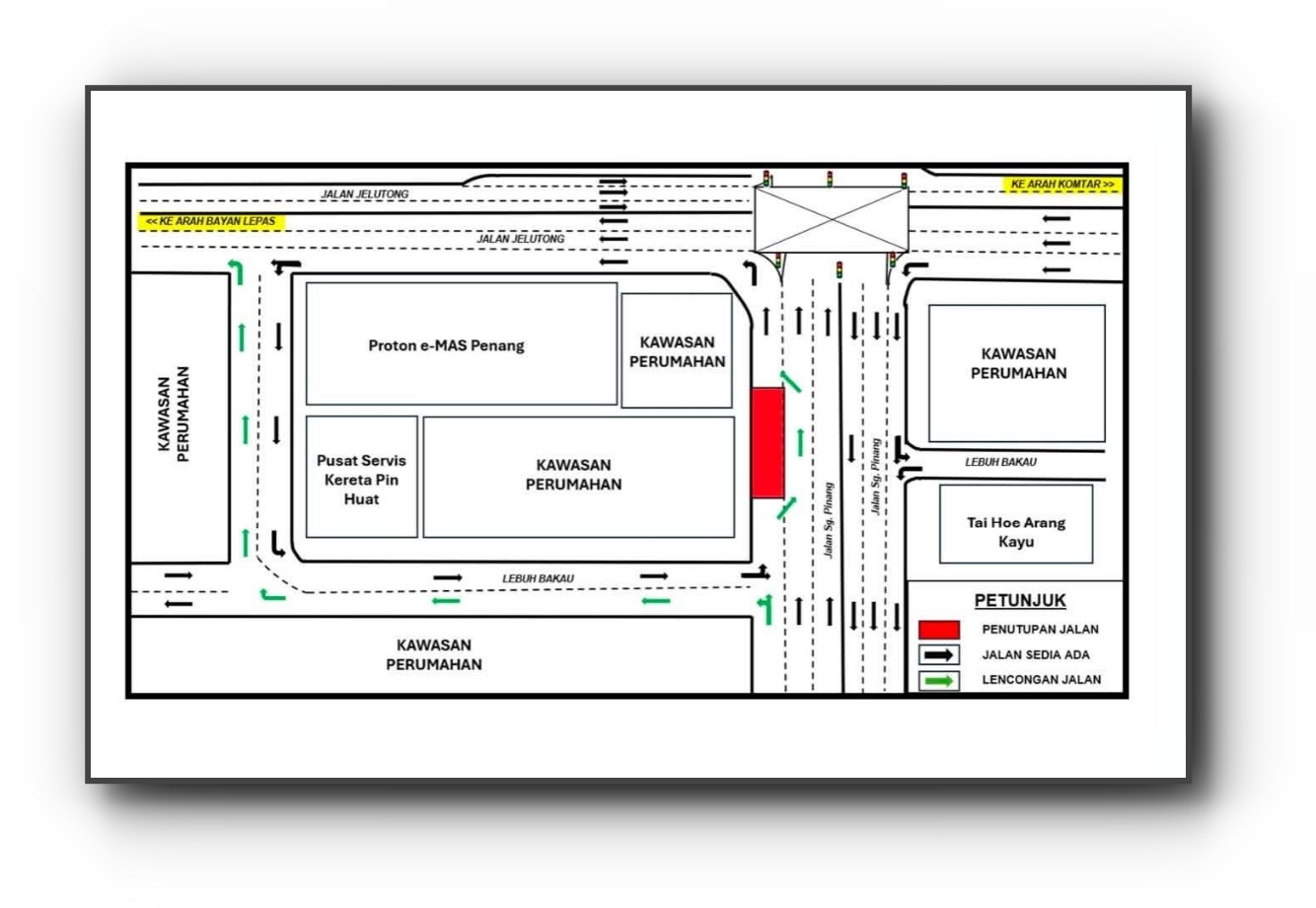
Residents and commuters in George Town, Penang, face a significant traffic adjustment as authorities prepare to close the leftmost lane of Jalan Sungai Pinang from Thursday, 28 August, through to late evening on 6 September. The closure forms part of essential utility relocation works being undertaken by Tenaga Nasional Bhd, the national power provider, requiring round-the-clock access to the roadway.
Sungai Pinang state assemblywoman Lim Siew Khim announced the closure details in a social media statement, confirming that the 24-hour work schedule will commence at 9 am on 28 August and conclude at 11.59 pm on 6 September. The affected section spans from the Lebuh Bakau junction through to the traffic light intersection where Jalan Sungai Pinang meets Jalan Jelutong, a critical junction handling substantial daily traffic flow in the eastern part of George Town.
The decision to seal off just the leftmost lane rather than impose a full road closure reflects authorities' efforts to balance infrastructure maintenance needs with minimizing disruption to daily commuter patterns. By keeping the remaining lanes operational, through-traffic can continue flowing, though with reduced capacity and predictably slower movement during peak hours. This partial approach requires careful traffic management and public cooperation to prevent congestion from overwhelming adjacent lanes.
For drivers typically using this route to access Jalan Jelutong, the authorities recommend diverting through Lebuh Bakau, which runs parallel to the affected section and provides a viable alternative corridor. However, this detour will likely add time to journeys, particularly during morning and evening rush periods when traffic volumes peak. Commuters are advised to factor additional travel time into their schedules and consider alternative routes if possible.
Lim, who holds the additional responsibility of chairing the state Social Development, Welfare and Non-Islamic Religious Affairs Committee, emphasised the importance of exercising heightened caution throughout the closure period. The combination of utility machinery, reduced road width, and the presence of construction personnel creates a higher-risk environment compared to normal traffic conditions. She stressed that road safety during infrastructure works depends significantly on driver awareness and compliance with temporary traffic regulations.
To facilitate safe passage through the work zone, traffic authorities will deploy a comprehensive safety apparatus including directional signboards, traffic cones marking lane boundaries, and trained flagmen positioned at key points to guide vehicles and coordinate movement. These measures serve dual purposes: they protect construction workers from vehicular hazards while simultaneously managing traffic flow and preventing accidents caused by sudden lane changes or congestion-related collisions.
The utility relocation project itself reflects ongoing infrastructure modernisation efforts across Penang's urban areas. Tenaga Nasional Bhd's work typically involves relocating electrical cables and related power infrastructure to accommodate road improvements, maintenance projects, or urban development initiatives. Such projects, while essential for long-term service reliability and capacity expansion, inevitably create short-term inconvenience to road users and businesses in affected areas.
Small businesses and residents with property fronting Jalan Sungai Pinang and Lebuh Bakau may experience reduced customer access and delivery difficulties during the closure period. Shop owners and service providers in the vicinity are likely aware of the disruption timeline and may have made contingency arrangements, though the economic impact of reduced foot traffic and delayed supply chains cannot be entirely mitigated.
The timing of this project during the final week of August and opening week of September means the closure spans a transition period when many Malaysians are returning to work and school after holiday breaks. This scheduling carries implications for commuter volumes and public patience with traffic disruptions. Coordinating major infrastructure work during holiday periods is often preferable, yet practical constraints sometimes necessitate work during regular business days.
Transportation planners and road users would benefit from similar advance notification of upcoming closures, allowing adequate preparation time. The state government's proactive communication through state assemblywomen represents good governance practice, enabling residents to adjust travel plans and businesses to prepare for temporary revenue impacts. Regular updates throughout the 10-day period would further assist the public in adapting to changed road conditions.
Once completed, the utility relocation work should enhance the long-term reliability of electrical services to residents and businesses throughout the affected corridor. Infrastructure maintenance and modernisation, though disruptive in the short term, ultimately supports Penang's continued development as a major urban centre. The inconvenience of the 10-day closure represents an investment in maintaining the utility systems upon which the state's economy and residents depend.
Motor vehicle users should mark their calendars and plan accordingly, selecting optimal travel times outside peak periods if flexibility permits. Delivery companies and public transport operators should similarly adjust schedules to account for the reduced road capacity. Cooperation from all road users in adhering to temporary traffic signs and flagmen instructions will ensure the work progresses safely and efficiently, minimising the duration and intensity of traffic impacts throughout the closure period.

