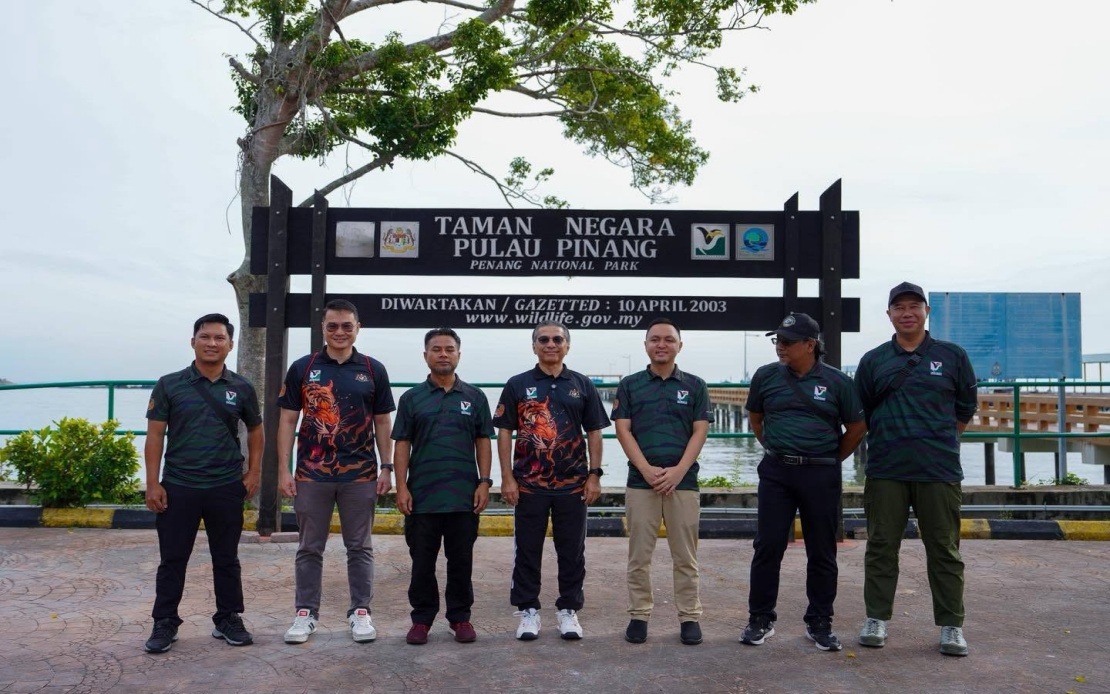
Conservation in Malaysia must extend beyond simply protecting natural spaces—it must integrate communities as active stewards of the nation's biodiversity. This message resonated during a recent inspection of Penang National Park in Teluk Bahang, where Deputy Minister of Natural Resources and Environmental Sustainability Syed Ibrahim Syed Noh underscored the critical link between preservation efforts and public participation. The park, with its intricate blend of forests, coastal zones, wildlife habitats and the distinctive meromictic lake, exemplifies the kind of complex ecosystems that demand innovative approaches combining scientific management with grassroots support.
The delegation's visit to Penang National Park revealed the multifaceted nature of contemporary conservation work in Malaysia. The Penang Department of Wildlife and National Parks provided comprehensive briefings on the park's ecological composition and current management frameworks before conducting field inspections. A boat tour of the coastal area offered firsthand observation of the marine environment, demonstrating how terrestrial and aquatic systems remain interdependent within this protected landscape. Such visits serve not merely as administrative checkpoints but as opportunities to assess real-world implementation of conservation policies and identify areas where community involvement could strengthen outcomes.
One critical initiative witnessed during the inspection centred on turtle conservation at Kerachut Beach, where the Department of Fisheries Malaysia operates a dedicated conservation centre. The facility focuses on protecting endangered sea turtle species, particularly Green Turtles and Olive Ridley Turtles, through habitat safeguarding and breeding programmes. For Malaysian policymakers and conservation professionals, this represents a model of sectoral cooperation—environmental, fisheries, and local government agencies working in concert to address species-specific challenges. The success of such programmes depends not only on technical expertise but on cultivating community awareness of why these creatures matter to coastal ecosystems and human livelihoods alike.
The meromictic lake inspected during the visit exemplifies Penang National Park's ecological distinctiveness. This unusual water body, stratified by salinity and resistant to conventional mixing, supports specialised microbial and aquatic communities found nowhere else in Malaysia. Its preservation illustrates a broader conservation principle: that unique geological and hydrological features often anchor entire ecosystems, making their protection foundational to biodiversity safeguards. Understanding such interconnections helps communities grasp why certain areas warrant protection—not as restrictions on human use, but as investments in long-term environmental stability.
Educational initiatives became a focal point of the ministerial visit, with particular attention to Entopia Penang's conservation messaging programmes. Interactive experiences that allow visitors—especially younger Malaysians—to engage directly with biodiversity information foster deeper appreciation for nature than passive observation alone. The Deputy Minister emphasised that this educational dimension serves a critical function in contemporary conservation: transforming abstract environmental concerns into tangible, experiential understanding. When schoolchildren and families encounter living butterflies, observe ecological relationships firsthand, or learn about species conservation efforts through interactive platforms, they become more likely to support protective policies in later life.
Ecotourism represents another promising bridge between preservation and community engagement, provided it operates within sustainability parameters. Responsible tourism generates economic incentives for local communities to maintain natural areas, distributes conservation benefits beyond government institutions, and creates employment opportunities tied to environmental protection. However, the Deputy Minister's comments underscore an essential caveat: ecotourism must be carefully managed to prevent overuse, habitat degradation, or disruption of wildlife breeding and feeding patterns. For Malaysian destinations like Penang, where tourism already plays a significant economic role, integrating conservation education into visitor experiences offers a pathway to balancing commercial interests with ecological integrity.
The Ministry of Natural Resources and Environmental Sustainability's emphasis on ground-level realities reflects a maturation in Malaysian conservation thinking. Rather than imposing top-down preservation mandates disconnected from local contexts, contemporary approaches recognise that durable conservation requires buy-in from communities whose livelihoods and cultural practices intersect with protected areas. In the case of Penang National Park, this means engaging fishing communities in turtle conservation, involving local guides in ecotourism ventures, and ensuring that park management decisions reflect community input alongside scientific expertise.
The intergenerational dimension of conservation featured prominently in the Deputy Minister's remarks. Framing natural preservation as a legacy obligation—safeguarding biodiversity for future Malaysians—reframes conservation from a constraint on present development to an investment in national assets. This rhetorical shift carries practical implications: it helps justify funding allocations for what might otherwise be seen as non-productive land use, and it encourages longer-term thinking in environmental policy beyond election cycles or quarterly economic reports.
Penang's position as a high-density urban and tourism centre makes its conservation challenges distinctly Malaysian. Unlike remote protected areas where human pressure remains limited, Penang National Park experiences proximity to residential development, commercial fishing, and heavy tourist traffic. Managing these competing pressures requires institutional coordination that transcends traditional sectoral boundaries. The involvement of PERHILITAN, the Department of Fisheries Malaysia, and commercial conservation education providers signals an emerging multi-stakeholder governance model suited to Malaysia's development context.
For Southeast Asian conservation efforts more broadly, Penang National Park exemplifies emerging best practices. The region's rapid urbanisation and development pressures demand conservation approaches that accommodate human proximity rather than assuming pristine wilderness preservation remains possible. Integrating community education, sustainable tourism, species-specific protection programmes, and ecosystem management into coherent strategies reflects conservation philosophy adapted to contemporary realities. Other Malaysian states and ASEAN nations facing similar pressures might draw lessons from Penang's multi-dimensional approach.
The ministerial inspection also underscores Malaysia's international conservation obligations under agreements like the Convention on Biological Diversity. Demonstrating effective protection of unique ecosystems—particularly the meromictic lake and its specialised biota—strengthens Malaysia's standing in global biodiversity forums while securing ecosystem services that benefit residents throughout Penang and beyond. When such efforts succeed visibly and involve communities meaningfully, they generate political support for conservation investment that transcends narrow bureaucratic mandates.
Looking forward, the challenge lies in sustaining community engagement beyond episodic ministerial visits. Lasting conservation requires institutional structures that continuously involve communities in decision-making, distribute conservation benefits equitably, and adapt management practices as environmental conditions change. Penang National Park's existing initiatives—the turtle centre, educational programmes, and guided tourism—provide platforms for such ongoing engagement, yet their effectiveness depends on adequate funding, professional staffing, and genuine responsiveness to community concerns. The Deputy Minister's statements suggest governmental commitment, but translating rhetoric into sustained resource allocation remains the critical test ahead.

