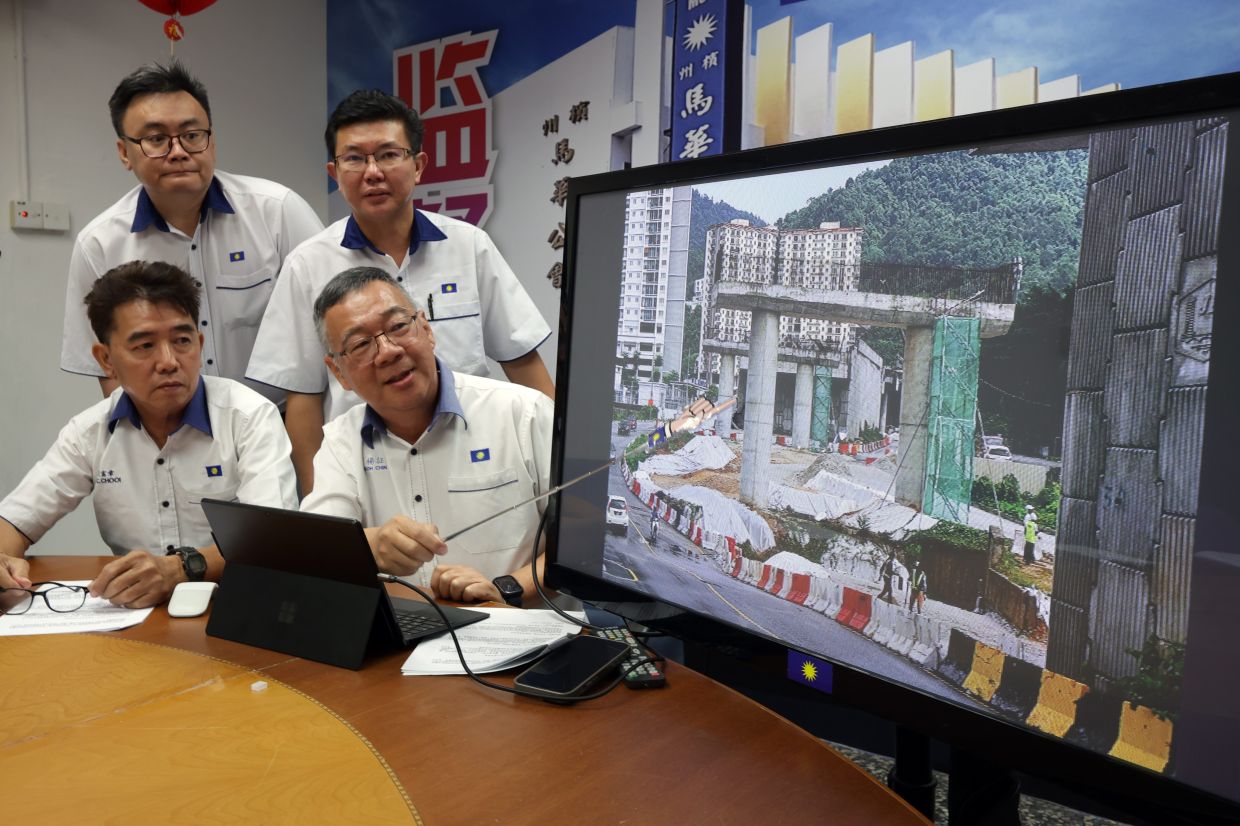
Penang MCA is pressing the state government to release comprehensive documentation on the Air Itam-Tun Dr Lim Chong Eu Expressway bypass project, citing concerns that official progress figures do not align with observable construction conditions on the ground. The party's secretary Yeoh Chin Kah has framed the dispute not as a matter of schedule delays—which have already extended the project timeline twice—but as a fundamental question of public accountability and governance. His intervention represents a notable shift in political focus, moving beyond typical complaints about project duration to challenge the credibility of completion metrics being publicly reported.
Yeoh's critique centres on the apparent inconsistency between statistical progress claims and physical evidence visible during a site inspection conducted by party members on July 1. The state government had previously described the undertaking as being in its "final sprint," with completion rates jumping from 80 per cent in May to 89 per cent by December. Yet when Penang MCA representatives examined key sections including Valley Road, Changkat Tembaga and Jalan Thean Teik, they observed substantial work still outstanding on multiple fronts. Bridge infrastructure remained incomplete, with pier structures visible but deck components and superstructure elements absent. Road surfacing across numerous zones was unfinished, and ancillary systems including guardrails, noise barriers, and electrical-mechanical installations were either absent or partially constructed in many locations.
These observations directly challenge the numerical completion percentages being circulated officially. Yeoh contends that the gap between reported progress and observable reality raises legitimate questions about how completion rates are being calculated and verified. Such discrepancies in infrastructure project reporting are not uncommon in Malaysia and across Southeast Asia, often reflecting different methodologies for assessing work stages or inconsistent documentation of individual task completion. However, their emergence in a project of this prominence—serving a dense urban corridor—has sharpened political attention and invited scrutiny from opposition quarters.
The MCA's formal request targets three categories of documentation: payment records showing contractor disbursements and financial compliance, consultants' certification reports detailing phase-by-phase validation, and comprehensive project assessment documents tracking progress against contractual milestones. Yeoh has stipulated a seven-day response window, after which the party intends escalating the matter to the National Audit Department and the Malaysian Anti-Corruption Commission. This escalation strategy signals the political stakes involved and reflects broader concerns about infrastructure governance transparency in Penang, a state where development projects frequently attract political contestation.
The 6-kilometre toll-free bypass, formally designated as Package Two of the broader Penang undersea tunnel and three paired roads initiative, represents a significant regional infrastructure investment. The route connects Lebuhraya Thean Teik in Bandar Baru Air Itam with the Tun Dr Lim Chong Eu Expressway through a mixed engineering solution combining elevated viaducts, underground tunnels, and conventional ground-level roadways. The project's complexity—involving multiple engineering disciplines and construction methodologies across urban terrain—inherently complicates progress assessment and increases scheduling risks, factors that may explain the repeated timeline extensions already implemented.
Original completion targets of 2024 have already slipped twice, with the current contractual deadline now set for April 12, 2027. This represents a substantial delay from initial expectations, stretching the project across multiple political cycles and electoral periods. For the approximately 300,000 residents in Air Itam, Bandar Baru Air Itam and Paya Terubong who stand to benefit from congestion relief and shortened commute times, these repeated postponements represent genuine inconvenience and disrupted planning assumptions. The bypass is intended to function as a critical alternative corridor, diverting traffic from congested existing routes and improving mobility across northern Penang's densely populated zones.
Paya Terubong assemblyman Wong Hon Wai has countered the MCA critique by asserting that the project has reached 91 per cent completion and remains aligned with the April 2027 deadline. Wong claims direct engagement with the construction team, citing a June 30 progress meeting and detailing specific near-term milestones. Twelve bridge beams are scheduled for installation on the Gelugor section between the current month and August, with a further six beams targeted for fourth-quarter 2024 deployment. He notes that bridge beam launching on the Bandar Baru Air Itam side is complete, though road surface preparation remains ongoing.
Wong's account introduces an important distinction regarding construction logic that may explain apparent discrepancies in completion assessment. He indicates that full construction completion does not automatically trigger road opening. Following structural finishing, the relevant government agencies must conduct a Road Safety Audit, with the Public Works Department subsequently determining the actual opening date based on audit outcomes. This multi-stage validation process—a standard requirement for major road infrastructure—means that construction completion percentages and public usability timelines operate on different schedules. The contractor's responsibility extends to structural delivery, while government agency responsibilities encompass safety certification and operational clearance.
The technical complexity of bridging and tunnel work on this project further complicates progress assessment. Deck slab and parapet works on completed bridge structures require precision installation and cure periods, particularly for reinforced concrete elements exposed to tropical weather conditions. Mechanical and electrical systems—essential for tunnel ventilation, lighting, traffic management, and emergency response—represent specialized installations that proceed partly in parallel with structural work and partly sequentially. These systems cannot be fully tested or commissioned until structural elements are substantially complete, creating genuine dependencies that affect overall scheduling and measurable progress attribution.
The political dimension of this dispute extends beyond immediate project management. Penang has emerged as a competitive terrain where state-level governance performance directly influences electoral outcomes, with infrastructure delivery serving as a visible metric of administrative competence. MCA's intervention on behalf of urban constituents reflects broader coalition dynamics, with the party positioning itself as an accountability watchdog within a state governed by different political forces. The demand for documentary transparency touches on governance legitimacy—whether residents and taxpayers can access sufficient information to independently verify official claims about public resource deployment.
This situation illuminates persistent challenges in Malaysian infrastructure governance: the gap between technical progress metrics used by contractors and engineers versus public perception based on observable site conditions; the distinction between construction completion and operational readiness; and the political sensitivity surrounding delayed major projects in densely populated urban areas. The MCA's intervention, whether ultimately productive or politically motivated, has succeeded in elevating public awareness of the transparency question, forcing government and contractor representatives to engage with specific technical and documentary challenges rather than accepting reassurances at face value.
The coming weeks will clarify whether the state government releases requested documentation, how comprehensively such disclosure addresses MCA's specific concerns, and whether technical explanations adequately resolve the perceived gap between stated completion figures and observed construction conditions. For residents dependent on this bypass to improve mobility and economic connectivity, the underlying technical and logistical realities matter more than political positioning—though political pressure for transparency may ultimately serve public interests by increasing accountability for timely, quality delivery of this strategically important transport corridor.

