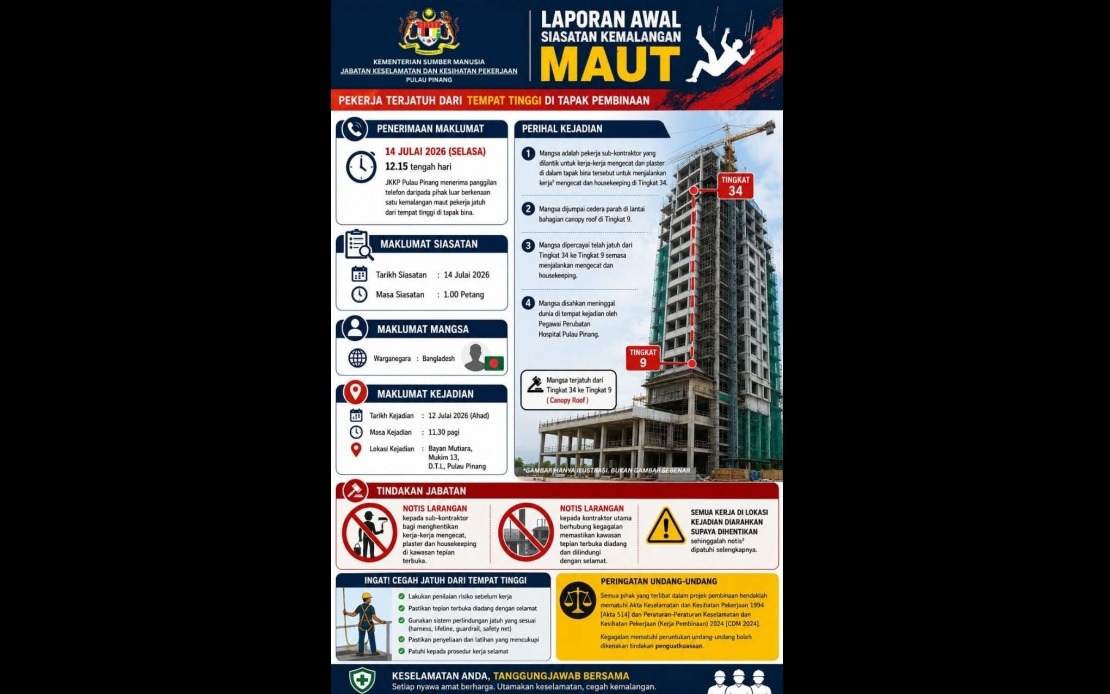
The Penang Department of Occupational Safety and Health has opened a formal investigation into the death of a Bangladeshi migrant worker who fell from a high-rise construction project in Bayan Mutiara, marking another tragedy in Malaysia's demanding construction sector. The worker, employed through a subcontracting firm, sustained fatal injuries in the incident and was pronounced dead at the scene by medical personnel from Penang Hospital.
According to Penang DOSH director Hairozie Asri, the department received notification of the accident at 12.15 pm on July 14, prompting the immediate dispatch of investigating officers to the Bayan Mutiara site. The initial probe revealed that the victim had been engaged in painting, plastering, and housekeeping duties on behalf of a subcontractor working on the building. What emerged as particularly alarming was the significant vertical distance involved in the incident—the worker was believed to be operating on the 34th floor when he fell, yet was subsequently discovered sustaining severe injuries on a canopy roof structure situated at Level 9.
The circumstances surrounding the fatal fall underscore persistent challenges within Malaysia's construction industry regarding worker safety protocols and fall prevention measures. High-rise construction projects involve inherent risks, and deaths resulting from workers tumbling from elevated platforms remain a recurring concern across Southeast Asia. The gap between the 34th floor and Level 9 canopy roof suggests the worker fell through an open-edge area, a configuration that demands rigorous safety barriers and personal protective equipment procedures.
In response to the incident, DOSH has taken decisive regulatory action against both the subcontractor and the primary contractor overseeing the Bayan Mutiara development. The department issued a prohibition notice specifically targeting the subcontractor, requiring an immediate halt to all painting, plastering, and housekeeping operations in open-edge zones across the site. A concurrent prohibition notice was extended to the main contractor, underscoring shared responsibility for safety compliance throughout the project hierarchy.
Furthermore, DOSH mandated a comprehensive work stoppage at the accident site, suspending all construction-related activities until both the subcontractor and main contractor fully satisfy the conditions outlined in the respective prohibition notices. This enforcement approach reflects Malaysia's regulatory framework, which holds multiple parties accountable when workplace fatalities occur on construction projects. The cessation of work represents both a practical investigation measure and a symbolic enforcement of safety standards.
The reliance on migrant workers like the deceased Bangladeshi national reflects a structural reality of Southeast Asia's construction industry, where foreign labourers constitute a substantial proportion of the workforce on major projects. These workers frequently face heightened vulnerability due to language barriers, unfamiliarity with local safety regulations, and sometimes inadequate training in site-specific hazard recognition. Investigations into migrant worker deaths often reveal gaps in communication and safety orientation that could have been preventable through stronger onboarding protocols.
Penang's construction boom, driven by major development initiatives in the state, has expanded employment opportunities but simultaneously increased exposure to occupational hazards. The Bayan Mutiara project represents the type of high-rise development that transforms the state's skyline while simultaneously creating complex safety management challenges. Multi-level structures with numerous subcontractors demand coordinated safety oversight, and failures at any level—whether in providing equipment, conducting training, or enforcing protocols—can prove catastrophic.
The incident also highlights the importance of fall protection systems on construction sites, particularly in tropical climates where weather conditions can affect visibility and grip. Modern safety practices recommend multiple protective layers, including physical barriers such as guardrails or nets, personal protective equipment including harnesses and lanyards, and administrative controls such as work permits and safety briefings. The gap between best practice and actual site conditions remains a persistent problem in Malaysia and across the region.
For Malaysian construction companies and contractors, this fatality carries implications beyond regulatory penalties. International reputation, insurance costs, and recruitment challenges can follow high-profile safety failures. Major international investors increasingly scrutinize safety records before committing to projects, making occupational health and safety a competitive business consideration alongside cost and timeline factors.
The investigation by Penang DOSH will examine multiple dimensions including whether the subcontractor provided adequate safety equipment and training, whether the main contractor conducted sufficient oversight of subcontractor operations, and whether site conditions themselves created hazardous configurations. These inquiries typically inform enforcement decisions and potential prosecutions under occupational safety legislation.

