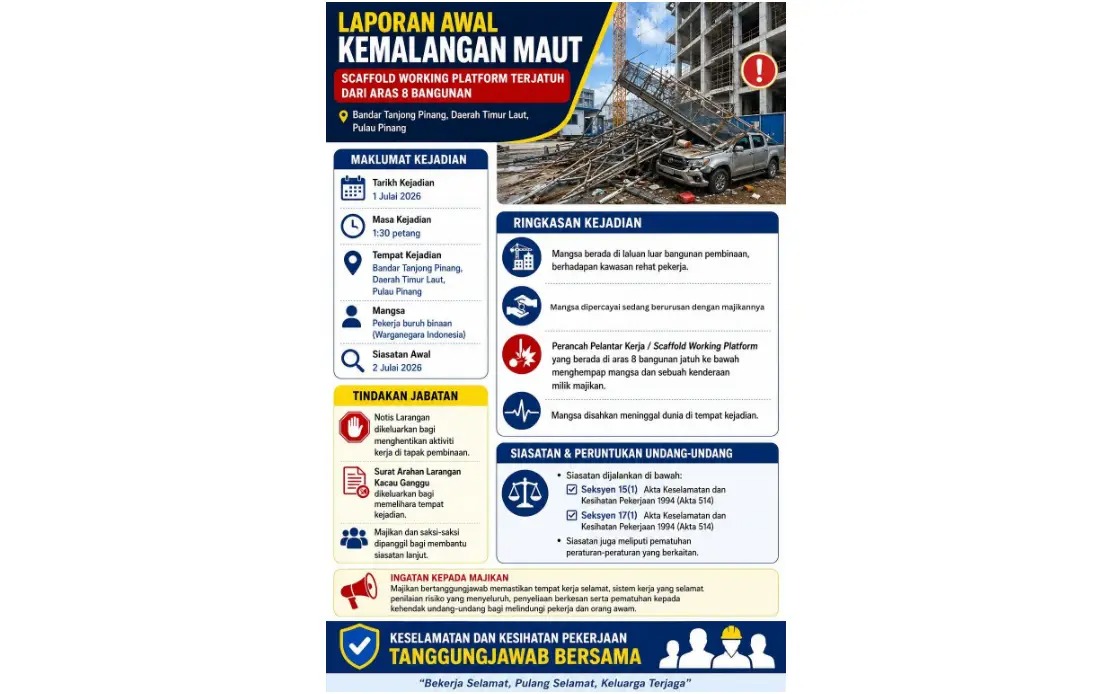
The Department of Occupational Safety and Health (DOSH) in Penang has moved swiftly to impose a complete work prohibition at a construction site in Bandar Tanjong Pinang following the death of an Indonesian worker in a scaffolding collapse on July 1. The decision reflects escalating regulatory scrutiny of workplace safety standards across Malaysia's construction sector, an industry that continues to grapple with a troubling pattern of fatal accidents despite existing legislation and enforcement mechanisms.
According to DOSH's formal statement, the tragic incident occurred at approximately 1.30 pm when a scaffolding working platform detached from the eighth floor of the building under construction. The worker, stationed on an external walkway adjacent to the workers' rest area at ground level, was struck by the falling structure. The collapse also damaged a vehicle belonging to the worker's employer, underscoring the scale of the impact. Initial documentation of the scene indicates the victim had been engaged in discussion with his employer at the moment of the incident, adding a layer of human circumstance to what authorities are treating as a preventable tragedy.
The issuance of the prohibition notice represents DOSH's immediate enforcement response, effectively freezing all related construction activities at the site. Accompanying this action is a non-disturbance order that preserves the accident scene in its original condition, a crucial preservation mechanism that enables thorough forensic investigation and evidence collection. This dual approach—stopping work while maintaining scene integrity—reflects established international best practices for major incident investigation and is designed to establish a comprehensive factual record before remedial or cleanup activities can commence.
The investigative focus has centered on potential breaches of the Occupational Safety and Health Act 1994, specifically Sections 15(1) and 17(1), which delineate the fundamental duties and responsibilities of employers in maintaining safe workplaces. Section 15(1) requires employers to provide and maintain work systems, plant, and equipment that are safe and without risk to health, while Section 17(1) establishes duties regarding the provision of information, instruction, training, and supervision necessary for safety. These provisions form the legal backbone of Malaysia's workplace safety framework, yet their application in high-risk construction environments remains inconsistently enforced across the country.
Investigators are systematically interviewing employers and witnesses to reconstruct the sequence of events leading to the collapse. This process aims to determine whether the scaffolding installation, inspection, and maintenance protocols complied with relevant safety standards and whether proper risk assessments were conducted before deployment. The involvement of multiple parties—principal contractors, subcontractors, and equipment suppliers—often complicates accountability chains in Malaysia's construction industry, where subcontracting hierarchies frequently create ambiguity regarding which entity bears responsibility for safety compliance.
The construction sector remains one of Malaysia's most hazardous work environments, with foreign workers comprising a substantial proportion of the labour force. The death of an Indonesian worker in this incident reflects a broader pattern wherein migrant workers from countries including Indonesia, Bangladesh, and Myanmar often undertake the highest-risk tasks while operating under precarious employment conditions. Language barriers, unfamiliarity with local safety protocols, and limited access to worker representation create particular vulnerabilities for this population, a reality that raises questions about whether current enforcement mechanisms adequately protect non-citizen workers.
DOSH's statement included a pointed reminder directed at employers, developers, main contractors, and subcontractors to ensure comprehensive safety planning and execution. This advisory language, while standard in regulatory communications, implicitly acknowledges that workplace fatalities in Malaysia's construction sector frequently stem not from unavoidable accidents but from preventable failures in planning, supervision, and risk management. The department emphasized that all workplace fatalities are treated with utmost seriousness, suggesting an institutional commitment to aggressive investigation and prosecution where violations are identified.
Enforcement action will follow if investigations establish violations of the occupational safety legislation. Potential penalties could range from substantial fines to criminal prosecution of responsible individuals and entities, depending on the severity of any breaches identified. Previous high-profile construction accident cases in Malaysia have resulted in sentences ranging from hefty financial penalties to imprisonment for those deemed criminally negligent, establishing precedent that serious consequences can attach to safety failures. However, critics have contended that penalties remain insufficient to meaningfully deter unsafe practices across an industry where profit margins often incentivize cost-cutting on safety measures.
The Bandar Tanjong Pinang incident arrives amid broader regional and national discussions about construction safety standards. Southeast Asian countries have grappled with similar challenges as rapid urbanization and infrastructure development accelerate, often outpacing regulatory capacity and workplace safety culture. Singapore and Thailand have implemented more stringent enforcement regimes in recent years, raising questions about whether Malaysia's regulatory framework adequately matches the complexity and risks inherent in modern construction projects, particularly high-rise developments in metropolitan areas.
The suspension of work activities represents significant financial implications for the project stakeholders, extending timelines and incurring additional costs during the investigation period. However, DOSH's decision prioritizes thorough investigation and accountability over operational convenience, a stance that reflects evolving international norms regarding worker protection. The agency's willingness to impose comprehensive work stoppages signals potential shifts toward more aggressive enforcement postures across Malaysian regulatory agencies overseeing workplace safety.
Looking forward, this incident may catalyze discussions about strengthening Malaysia's construction safety standards, particularly regarding scaffolding installation, inspection certification, and the responsibilities of equipment suppliers. Industry observers have suggested that more rigorous third-party inspection requirements and enhanced worker training protocols could significantly reduce preventable fatalities. The extent to which this particular tragedy prompts systemic improvements across the construction sector will depend on DOSH's investigative conclusions and the regulatory and legislative responses that follow.

