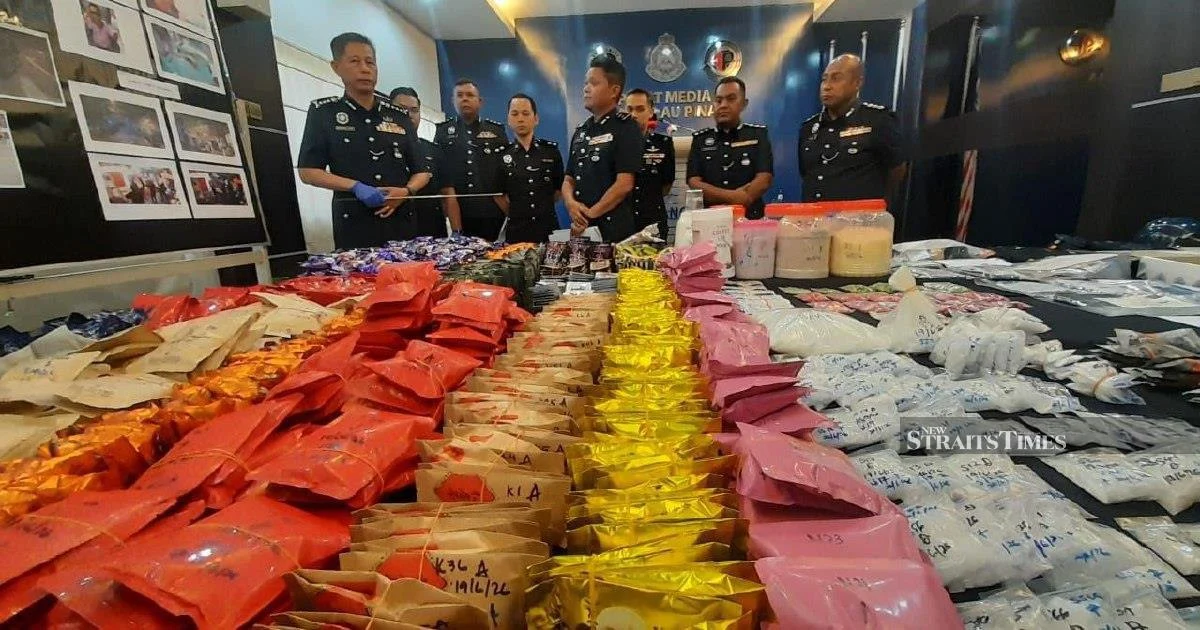
A major drug operation has been disrupted in Penang after authorities arrested a couple and recovered nearly RM10 million in illicit narcotics from a residential condominium in Butterworth. The bust represents a significant victory for state police in their ongoing campaign against organised drug trafficking networks that exploit high-rise residential properties across the northern corridor.
The arrests stemmed from an investigation into a coordinated drug-processing and distribution scheme operating from within the condominium complex. Police conducting surveillance and intelligence work identified suspicious activity at the unit before executing a raid that revealed the scale of the operation. The seizure of RM9.7 million in drugs indicates that the network had established considerable infrastructure for manufacturing and preparing substances for street-level distribution across Penang and potentially neighbouring regions.
The use of a residential condominium for such activities reflects a broader trend across Malaysian urban centres, where traffickers exploit the anonymity and accessibility of high-rise living spaces to conduct illicit operations away from public view. Butterworth, as a densely populated commercial and residential hub, has increasingly become a focal point for drug syndicates seeking to establish distribution networks that feed demand across Penang and Kedah. The strategic location near the Penang Bridge makes it an ideal staging point for moving drugs into other states.
The apprehension of the couple signals police commitment to tackling not just street-level dealers but the mid-level operatives who manage manufacturing and distribution logistics. Couples engaged in drug trafficking often present particular investigative challenges, as their domestic cover can make detection more difficult. Their arrest suggests police possessed sufficient evidence from earlier surveillance and intelligence gathering to move in decisively.
The RM9.7 million valuation underscores the substantial profit margins driving such operations. At street value, quantities of this magnitude represent months or even years of supply for an entire district's user population. The distinction between manufacturing capacity and retail distribution capacity indicates this was likely a hub facility supplying multiple downstream dealers rather than a simple storage point.
For Malaysian authorities, combating residential drug operations requires coordination between state police narcotics units, federal drug enforcement agencies, and municipal bodies. Landlords and condominium management companies have also come under increasing scrutiny to ensure they conduct proper tenant vetting and remain vigilant against suspicious activity. Enhanced reporting mechanisms between security personnel and law enforcement have been implemented in several major urban centres to catch operations earlier.
The seizure contributes to ongoing efforts to quantify the scale of drug manufacturing on Malaysian soil. Whilst much public attention focuses on transnational trafficking and seizures at border crossings and ports, domestic clandestine laboratories represent a growing challenge. The existence of such operations in ordinary residential properties means drug networks have become highly decentralised and resilient to disruption.
Southeast Asian drug syndicates have increasingly diversified their logistics, with manufacturing shifting from exclusively jungle-based labs towards urban residential settings. This evolution complicates enforcement strategies that traditionally focused on rural areas. The Butterworth operation exemplifies how criminals adapt to regulatory pressure by embedding activities within civilian landscapes.
Investigators will now examine connections between the arrested couple and broader trafficking networks. Whether they operated independently or as part of a larger syndicate will determine the scope of follow-up enforcement actions. Secondary arrests, asset seizures, and financial investigations typically extend well beyond the initial bust.
The case also highlights the importance of community vigilance. Residents observing unusual patterns at neighbouring units—excessive visitors, strong chemical odours, or unusual hours of activity—play a crucial role in providing intelligence to authorities. Public awareness campaigns have steadily increased reports of suspicious activity from residents concerned about the effects of drugs on their communities.
Drug trafficking remains one of Malaysia's most serious crime challenges, with penalties among the world's strictest. The couple now faces potential narcotics charges carrying mandatory imprisonment and possible capital offences depending on the specific substances and quantities involved. Their prosecution will likely be pursued with vigour as a demonstration of law enforcement capacity.
Penang, as a major urban and commercial centre with significant port facilities and international connectivity, remains an attractive target for trafficking networks. Disrupting operations like the Butterworth facility, whilst welcome, represents only one element of a broader anti-narcotics strategy requiring sustained resource allocation, international cooperation, and community engagement across the state and the broader region.