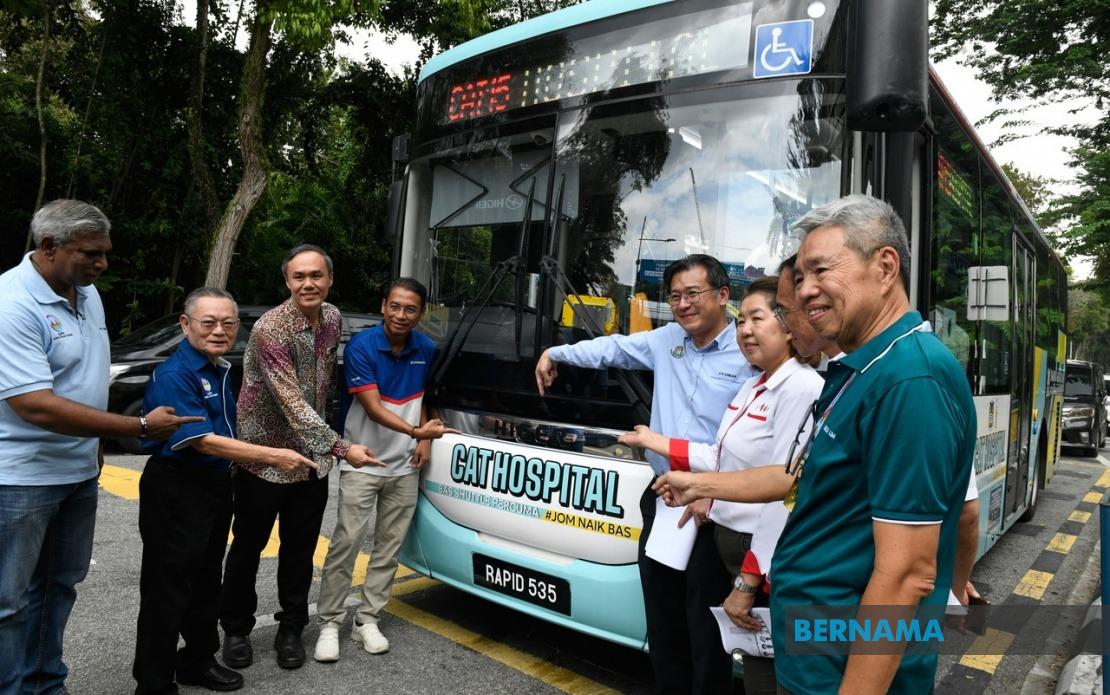
The Penang Island City Council (MBPP) is injecting RM900,000 annually into a free public transport initiative designed to alleviate traffic pressures around one of the state's largest medical institutions. The Central Area Transit (CAT) shuttle service, which commenced operations on January 1, provides direct connectivity between Komtar and Penang Hospital (HPP), alongside three private healthcare facilities and several clinics scattered throughout the city centre. According to MBPP Engineering Director Cheah Chin Kooi, the scheme represents a strategic response to the infrastructure challenges posed by the hospital's recent expansion, which has intensified parking demands and congestion in the surrounding area.
The initiative reflects a broader urban mobility strategy centred on reducing dependence on private vehicles within Georgetown's congested commercial district. By offering free access to medical facilities, the council aims to serve not only patients seeking treatment but also elderly visitors and family members accompanying them, for whom navigating the crowded streets and scarce parking spaces poses genuine hardship. Cheah emphasised that this public health dimension extends beyond simple convenience, potentially improving accessibility for vulnerable populations who might otherwise struggle to reach critical healthcare services.
Operational details reveal a modest but focused deployment of resources. Three Rapid Penang buses traverse the eight-kilometre corridor daily between 6 am and 8 pm, dispatching vehicles at 20-minute intervals and completing 36 trips per day. This frequency and timing reflect careful scheduling to capture commuter demand during peak medical facility visiting hours while maintaining service during early morning and evening periods when workers and visitors typically access the district.
Initial uptake has exceeded expectations, signalling strong community appetite for the service. Ridership figures have nearly doubled since launch, climbing from approximately 300 daily passengers to around 600 currently. This trajectory suggests the scheme addresses a genuine mobility gap that residents had previously filled through less efficient means, whether private vehicles, taxis, or ride-sharing services. The sustained growth pattern indicates the free shuttle complements broader commuting patterns rather than displacing existing public transport usage.
For Malaysia's urban planning practitioners, this Penang initiative demonstrates how targeted subsidies for specific high-traffic destinations can effectively reduce citywide congestion without requiring wholesale public transport overhauls. The concentrated geography around a major hospital creates ideal conditions for such pilots—destinations are fixed, passenger flows are predictable, and health considerations justify subsidisation. Similar models could potentially apply to other institutional anchors such as university campuses, major shopping complexes, or government administrative centres.
The project emerged directly from an MBPP survey conducted following Penang Hospital's expansion, highlighting how evidence-based planning can identify specific infrastructure gaps. Rather than implementing generic transport improvements, council officials diagnosed a precise problem—hospital expansion creating parking scarcity—and calibrated a proportionate solution. This diagnostic approach contrasts sharply with more generic infrastructure spending that may not address underlying mobility challenges.
Physical infrastructure improvements accompanying the shuttle service underscore a comprehensive approach. Penang Hospital management has simultaneously upgraded pedestrian walkways along Jalan Residensi and is undertaking work to enhance the main entrance on Jalan Utama, ensuring the bus service integrates smoothly with hospital facilities. These complementary investments demonstrate recognition that transport solutions require integrated site planning; providing buses means little without corresponding improvements to walking environments and building access points.
The partnership structure involving MBPP, Rapid Bus Sdn Bhd, Penang Hospital, and the Penang Women's Development Corporation illustrates the multi-stakeholder coordination necessary for successful urban transport initiatives. Each entity contributed distinct expertise and institutional capacity, with the hospital leadership demonstrating particular commitment through infrastructure upgrades and the bus operator providing operational expertise and fleet management. Such collaborative frameworks often prove more resilient and adaptable than single-agency schemes.
From a broader Southeast Asian perspective, Penang's approach aligns with emerging urban sustainability priorities across the region. As Malaysian cities grapple with motorisation rates exceeding those of developed countries at comparable income levels, initiatives that increase public transport viability become increasingly critical. Free or heavily subsidised transit at specific high-traffic destinations represents a pragmatic middle ground between comprehensive transit networks—which require enormous capital investment—and laissez-faire systems that generate severe congestion.
The RM900,000 annual expenditure merits contextual analysis. For a city council managing a population exceeding 800,000 residents, this represents a modest fraction of typical transport budgets, yet addresses a concentrated problem affecting thousands of daily visitors. Cost-per-trip calculations suggest the service delivers reasonable value, particularly when accounting for prevented congestion, reduced parking search time, and health benefits from improved healthcare facility accessibility. Such targeted spending often generates returns exceeding broader transit investments with diffuse benefits.
Looking ahead, the initiative's success may encourage expansion to other institutional anchors within Georgetown or replication across other Malaysian municipalities facing similar hospital-centred congestion challenges. The straightforward model—free buses, fixed routes, institutional partnerships—provides an adaptable template for other cities. Crucially, the scheme remains flexible, with MBPP able to adjust service frequency and routes based on emerging ridership patterns and changing hospital facility locations.
Beyond the immediate transportation benefits, the free shuttle service reflects evolving thinking about public health and urban equity. By removing cost barriers to healthcare facility access, MBPP acknowledges that mobility challenges constitute a genuine health equity issue, particularly for lower-income residents and elderly patients. This framing positions transport not merely as an urban efficiency problem but as a social determinant affecting health outcomes.

