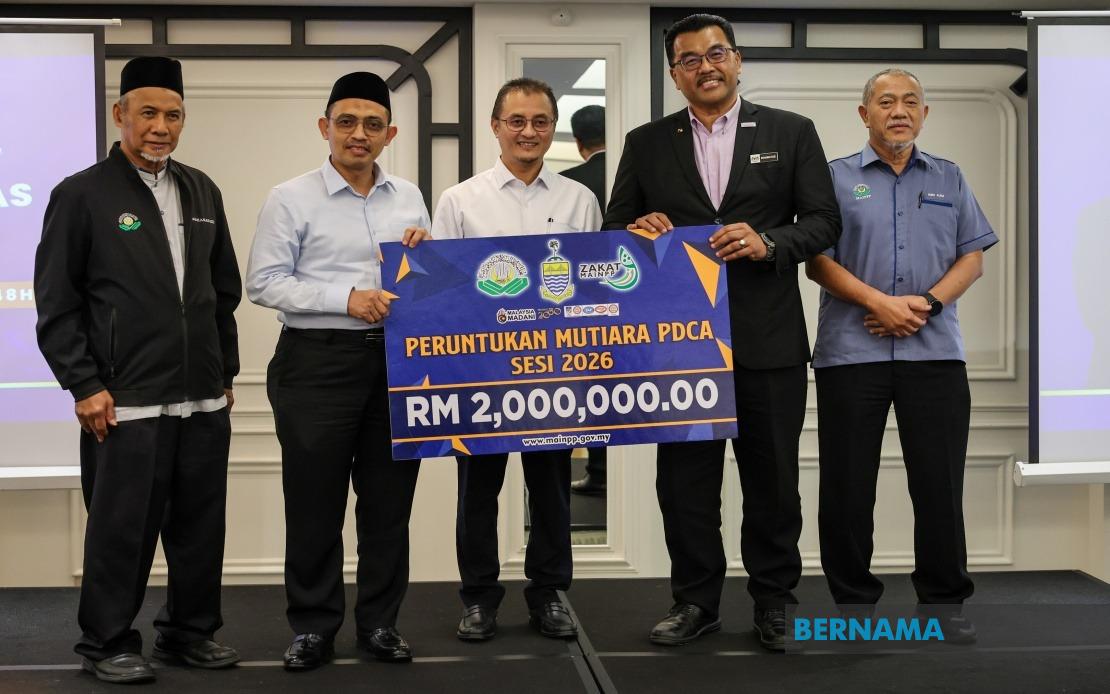
The Penang State Islamic Religious Council (MAINPP) is channelling RM2 million into educational support for Bumiputera students this year, a commitment that extends its two-decade investment in academic advancement across the state. Announced at a briefing for coordinating teachers in Kepala Batas, the funding represents part of a broader regional strategy to strengthen educational outcomes among disadvantaged communities—a priority that resonates across Malaysia's educational landscape as states seek to bridge performance gaps and ensure equitable access to quality learning.
Penang Deputy Chief Minister I Datuk Dr Mohamad Abdul Hamid, who also serves as MAINPP president, unveiled the allocation whilst emphasising the council's sustained dedication to empowering young Bumiputeras through structured academic intervention. The programme itself, which traces its origins to 2006, has evolved into a multi-stakeholder initiative involving the Penang State Education Department (JPNPP), the Penang Bumiputera Participation Coordination Division, and the Penang Regional Development Authority (PERDA). This collaborative framework reflects a deliberate approach to consolidating resources and expertise across government education bodies, administrative agencies, and religious institutions—a model that other states may adapt as they grapple with similar equity challenges.
For 2026, the programme encompasses 698 coordinating teachers stationed across 71 primary schools and 38 secondary schools throughout Penang. The scale of deployment underscores the logistical complexity of reaching nearly 7,500 pupils and students, necessitating careful coordination and training to ensure consistent delivery of support. The presence of nearly 700 teachers working in a coordinating capacity signals that the initiative goes beyond simple fee-waived tuition, instead requiring systematic curriculum alignment, standardised teaching methodologies, and regular monitoring of student progress across multiple schools and localities.
The curriculum focus for primary students concentrates on four foundational subjects: Bahasa Melayu, English, Mathematics and Science. At secondary level, the scope expands significantly, with thirteen subjects available to students preparing for the Sijil Pelajaran Malaysia (SPM) examination, including sciences, languages, humanities, and additional mathematics. This breadth acknowledges that academic excellence depends not merely on basic competency but on choice and specialisation—factors that enable students to pursue diverse pathways in higher education and vocational training. The inclusion of Arabic and Islamic studies subjects reflects the programme's positioning within a religiously-informed educational ecosystem, catering to students in government-aided religious schools through three Integrated Dini Curriculum subjects.
Beyond classroom tuition, the programme incorporates learning modules, academic seminars, and examination technique workshops—components designed to address not just knowledge gaps but also test anxiety and assessment strategies. Such ancillary support is increasingly recognised as critical in narrowing achievement disparities, as many lower-income students lack access to private coaching and mentoring that their more affluent peers receive. By bundling these services within the MPDCA framework, the council removes financial barriers that would otherwise exclude capable but economically disadvantaged students from enhanced preparation.
MAINPP's broader educational investment extends considerably beyond the MPDCA programme. The council is simultaneously allocating RM22.36 million for higher education bursaries, RM6.3 million for the Permulaan IPT (Initial Higher Education) scheme, RM3 million for early schooling assistance, and RM3 million for school uniform aid. Collectively, these expenditures—totalling over RM36 million—constitute a comprehensive human capital investment spanning from early primary education through tertiary qualification. This multi-tier approach acknowledges that educational equity requires sustained support across the entire journey, from primary preparation through university access and completion.
Teachers implementing the programme on the ground offer compelling testimony to its practical impact. Hartina Arjan, a Bahasa Melayu teacher at Sekolah Kebangsaan Permai Indah in Bukit Minyak, reports that systematically developed learning modules have meaningfully improved student mastery, particularly by targeting speaking, reading, and writing competencies essential for classroom-based assessment and final examinations. The modules' emphasis on multiple skill dimensions—rather than rote memorisation—aligns with contemporary educational practice emphasising communicative competence and critical thinking.
Equally significant is testimony from Sadiah Roslan at Sekolah Rendah Islam Al-Masriyah Halimatun in Bukit Mertajam, who emphasises the programme's particular value for low-income families unable to afford private tuition. In Malaysia's context, where out-of-school expenditure on educational services has become increasingly burdensome for middle and working-class households, programmes that substitute or supplement private coaching perform a vital redistributive function. By rendering premium educational services freely available, MPDCA directly counters the market-driven stratification that tends to concentrate academic advantage among fee-paying families.
The pedagogical improvements documented by teachers—including more interactive approaches, quiz-based activities, and updated teaching materials—suggest that the programme benefits not merely from financial injection but from deliberate curriculum design and teaching methodology enhancement. This distinction matters: funding alone cannot guarantee educational improvement if deployed through outdated or ineffective instructional approaches. MAINPP's sustained involvement since 2006 has permitted gradual refinement of delivery models based on accumulated experience and feedback from teaching professionals.
For the broader Southeast Asian context, Penang's experience offers instructive lessons about sustaining educational equity initiatives. The programme's longevity—now spanning twenty years—demonstrates that meaningful educational change requires institutional commitment beyond electoral cycles or political shifts. The coordination across multiple government departments and statutory bodies, whilst administratively complex, prevents fragmentation and ensures that resources reinforce rather than duplicate efforts.
The impact metrics referenced by Mohamad—that MPDCA has demonstrably contributed to improved academic performance since 2006—merit independent verification and detailed analysis, as such data would illuminate not merely whether the programme reaches intended beneficiaries but whether it produces measurable learning gains relative to comparable populations without access. Such evidence would strengthen the case for programme replication or expansion, particularly as Malaysia grapples with persistent regional and socioeconomic disparities in educational outcomes.
Looking forward, the sustainability of such programmes depends partly on securing adequate and predictable funding streams, as well as on maintaining teacher motivation and quality within the coordinating teacher cadre. The allocation of RM2 million annually suggests institutional commitment, yet the actual per-student spending—approximately RM270 per beneficiary annually—warrants examination against programme cost-effectiveness compared to alternative educational interventions. Whether this represents optimal resource deployment, and how comparative effectiveness might be established, constitutes an important policy question as states allocate scarce education budgets across competing priorities and programmes.

