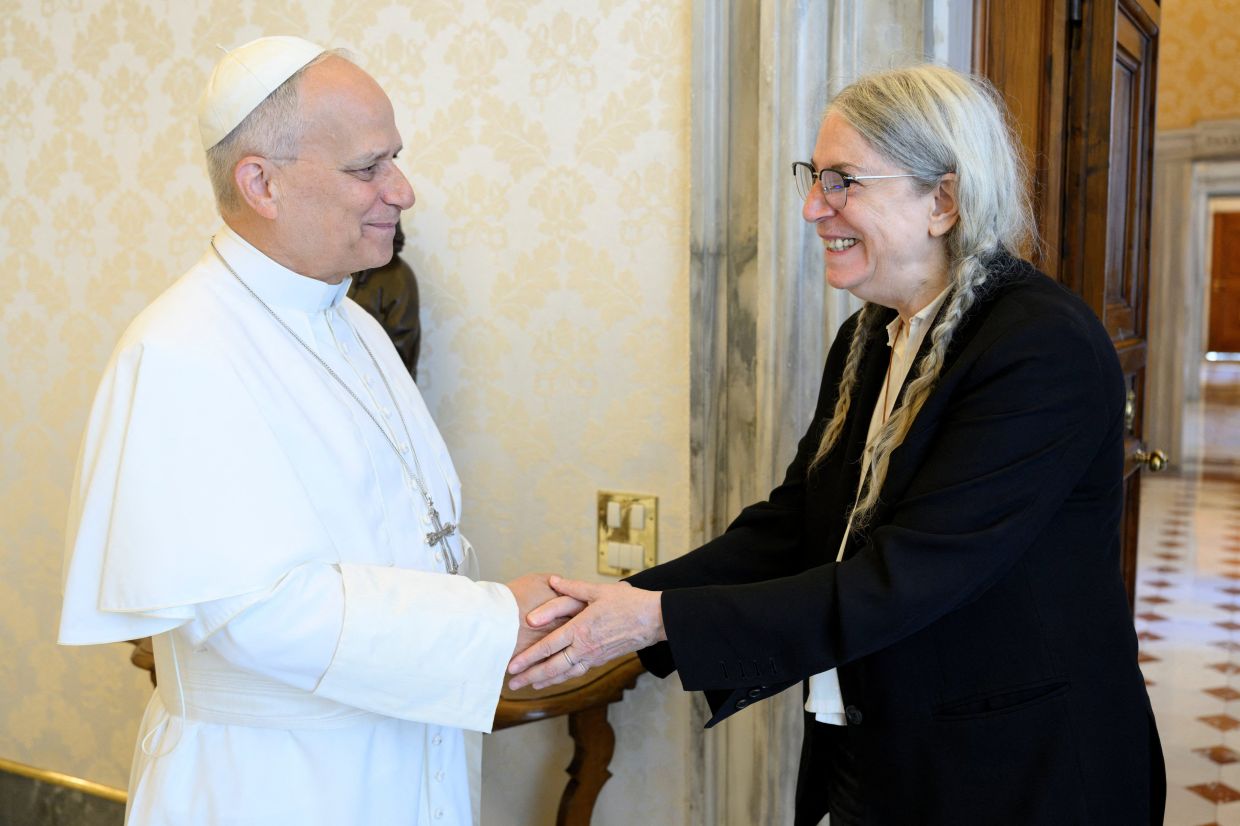
American rock legend Patti Smith encountered Pope Leo XIV on Friday, experiencing a moment of quiet connection within the formal halls of the Apostolic Palace. The exchange was characteristically understated—Smith offered a soft greeting as she settled into the seat opposite the pontiff at his desk—yet the meeting carried significance for both parties, particularly given Smith's evolving role as a cultural bridge between the secular music world and Vatican circles.
Smith's presence at the Holy See has grown increasingly prominent over recent months, a development largely facilitated through her friendship with Rev Antonio Spadaro, who serves as undersecretary in the Vatican's culture ministry. This institutional connection has provided her with unprecedented access to Vatican events and leadership, positioning her as a rare example of a major recording artist maintaining an active cultural presence within the Church's highest echelons. Her appearance at these gatherings stands in marked contrast to the traditional separation between popular music and religious hierarchy that has historically characterised institutional Catholicism.
Despite her non-Catholic background, Smith has articulated a clear spiritual attraction to Pope Francis and his teachings, describing his approach as characterised by "gentle, open, and steadfast sense of humanity." This articulation reveals something important about contemporary religion: spiritual resonance need not depend on formal religious membership. Francis's emphasis on mercy, social justice, and inclusive theology appears to have struck a chord with Smith, whose own artistic output has long engaged with themes of suffering, redemption, and human dignity. Her earlier admiration for Pope John Paul I further demonstrates a pattern of engagement with papal figures she perceives as champions of compassionate faith.
Earlier this year, Smith's cultural contribution to Vatican initiatives became more tangible when she performed during the inauguration of the Holy See's pavilion at the Venice Biennale, one of the world's most prestigious contemporary art exhibitions. The timing of this performance—May 8—coincided with Pope Leo's election anniversary, suggesting deliberate coordination between the Vatican and Smith's representatives. This appearance underscored the Holy See's strategic interest in engaging with prominent cultural figures to project an image of openness and relevance to contemporary artistic communities.
According to Spadaro, the Friday meeting between the two Chicago natives extended across approximately 40 minutes, a substantial duration for a papal audience. Rather than adhering to formal protocol, the encounter apparently unfolded as a genuine exchange between two individuals recognising shared sensibilities. Spadaro's characterisation of the meeting as feeling "like a conversation between two people discovering they were old friends, sharing memories woven from words and music, dreams, visions, and hopes" suggests that both participants engaged authentically, transcending the typical formality that surrounds pontifical meetings. This description implies a rapport built on artistic understanding and humanitarian concerns rather than religious doctrine.
Smith's connection to the previous pontiff, Francis, extended beyond philosophical alignment. She had met him in 2013 and performed for him in 2014, establishing a personal relationship that transcended her status as a visiting artist. When Francis died on April 21, 2025, Smith responded by composing a poem on social media that compared him to a dandelion—"humble yet strong"—and lamented that "Nature and poetry and the suffering shall miss their champion." This poetic tribute revealed Smith's genuine affection for the late pope and her perception of him as an advocate for marginalised communities and artistic expression.
The Vatican's cultivation of relationships with prominent musicians appears to be a deliberate strategy under Pope Leo's tenure. Just days before meeting Smith on Friday, Leo attended a concert honouring him performed by world-renowned tenor Andrea Bocelli on Wednesday, July 29. This back-to-back engagement with major musical figures suggests a concerted effort to position the papacy as engaged with contemporary and classical arts alike, broadening the Church's cultural footprint and demonstrating papal appreciation for aesthetic achievement. Such gestures serve multiple purposes: they humanise the pope, signal openness to secular culture, and provide positive media coverage in an era when institutional Catholicism faces declining influence in many Western societies.
For Malaysian and Southeast Asian readers, Smith's Vatican engagement offers perspective on how religious institutions globally are adapting to retain cultural relevance. As Christianity remains a minority faith in Muslim-majority Malaysia and much of the region, the Vatican's emphasis on universal humanitarian values and artistic partnership represents a strategic approach to maintaining influence beyond traditional Catholic communities. Smith's participation demonstrates that spiritual or ethical engagement need not depend on formal religious affiliation—a principle with resonance across diverse faith traditions in the region.
The meeting also illuminates how individual relationships and artistic collaboration can transcend institutional boundaries. Smith's braided hair and crucifix necklace, as described in accounts of the audience, symbolise the blending of personal identity with spiritual openness that characterises her approach. She neither abandoned her artistic identity nor adopted exclusively Catholic markers; instead, she brought her authentic self to the encounter. This approach appears to resonate with Pope Leo, suggesting the pontiff's willingness to engage with figures who embody complexity and cannot be easily categorised within traditional religious frameworks.
As the Holy See navigates contemporary challenges regarding institutional credibility and cultural relevance, its engagement with established artists like Smith represents an investment in soft power and cultural diplomacy. Smith's international stature ensures that positive Vatican encounters receive attention from constituencies that might otherwise dismiss the Church as irrelevant or exclusively focused on doctrinal matters. Her presence within Vatican spaces implicitly communicates that the institution values creativity, questions about meaning, and humanistic concerns alongside theological tradition.

