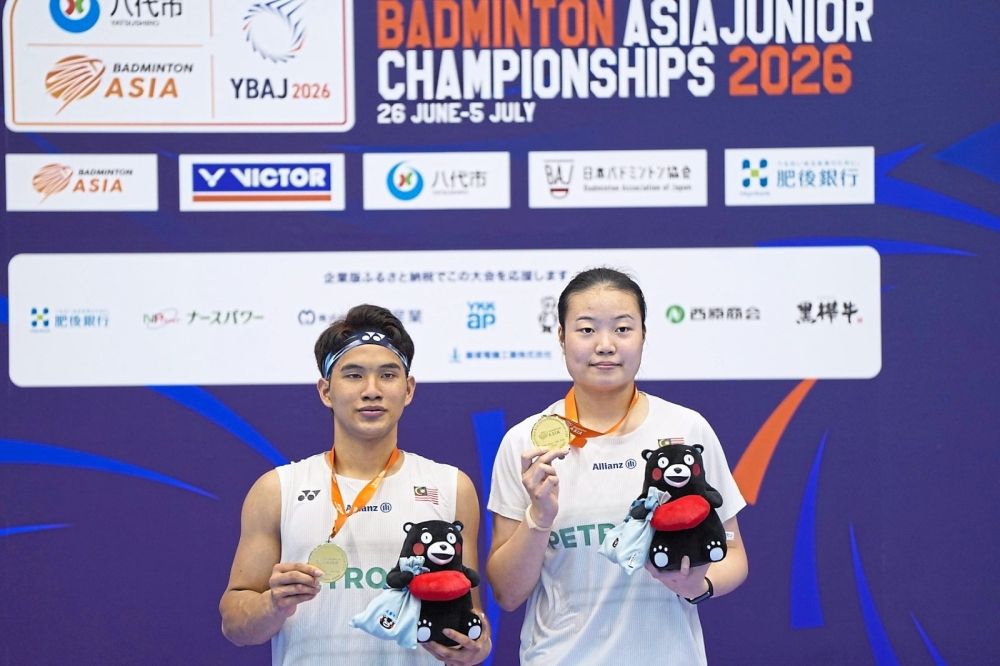
Ahmad Redzuan Zulwaqqarizal and Low Zi Yu have restored Malaysian badminton to the top of the junior mixed doubles podium at the Asian Junior Championships in Yatsushiro, Japan, sealing a breakthrough victory that ends nearly two decades of championship drought in the discipline. The Malaysian pair's 21-15, 22-20 win over China's Zheng Weigang and Li Menghan marks the first time since 2007 that a Malaysian combination has claimed the mixed doubles crown at this competition, with Tan Wee Kiong and Woon Khe Wei the last to achieve the feat on home soil in Kuala Lumpur.
The path to victory proved demanding, particularly during the second game where the momentum shifted dramatically in the closing stages. Redzuan and Zi Yu found themselves on the threshold of triumph, holding a commanding two-point advantage that appeared to herald a straightforward conclusion. Yet their Chinese opponents demonstrated the mental resilience typical of top junior shuttlers, clawing back to force the contest into a decisive third game. The final, which consumed 43 minutes of intense rallying, underscored the calibre of competition at Asia's premier junior championships and the pressure that accompanies championship finals even at grassroots level.
Low Zi Yu, reflecting on the psychological dimension that ultimately separated the finalists, pointed to composure as the decisive factor in the outcome. She emphasised that at the critical juncture of 20-20 in the final game, her partnership maintained sharper focus than their opponents, translating mental clarity into the precision required in high-stakes rallies. Beyond the technical execution, Zi Yu credited the backing of Malaysian teammates who had already exited their own events but remained courtside to provide vocal encouragement. This intangible support system, often overlooked in post-match analysis, appeared to furnish the psychological fuel needed when the championship hung in balance.
For Redzuan, the significance of this triumph extends well beyond the immediate achievement, carrying redemptive weight after three consecutive campaigns that yielded only bitter disappointment. The Terengganu-born player entered the 2023 edition in Yogyakarta with considerable ambition, competing in both boys' doubles and mixed doubles, yet encountered premature eliminations in both events. Rather than serve as motivation for improvement, those early exits were replicated in subsequent years. He returned to Yogyakarta in 2024 and Surakarta in 2025 with renewed hopes, only to suffer similar harsh early-round outcomes that tested his commitment to the sport. This narrative of persistence through repeated setbacks before breakthrough success resonates powerfully within elite sporting culture, where mental fortitude often determines whether an athlete emerges stronger or becomes discouraged.
Redzuan's post-victory remarks demonstrated measured perspective rather than unbridled celebration, suggesting a competitor who views this championship as a foundation upon which greater achievements must be built. He expressed satisfaction that his execution during the final reflected the technical work invested during training sessions, indicating that the championship victory validated his preparation methodology. However, he tempered his assessment by acknowledging that the current level represents merely an intermediary stage in his development, with the necessity to advance toward competing at higher competitive tiers. This calibrated mindset, neither dismissing the achievement nor treating it as the apex of ambition, frequently characterises elite junior athletes transitioning toward senior competition.
Parallel to her mixed doubles coronation, Zi Yu also claimed a bronze medal in the girls' doubles partnership with Genevie Lim, though this event concluded less triumphantly. The pairing encountered Japan's second-seeded combination of Aoi Banno and Yuzu Ueno in the semi-finals, suffering a three-game defeat with scorecard progression of 21-16, 17-21, 17-21. The loss, whilst disappointing, occurred against highly-ranked opposition and sent the Malaysian representatives home with medals in both events contested. Zi Yu's ability to operate effectively across two distinct pairings within the same tournament illuminates the demands placed upon modern junior badminton athletes, who frequently maintain multiple event commitments.
When addressing how she managed simultaneous involvement in mixed and girls' doubles without mutual interference, Zi Yu attributed her success to the exceptional capability of her partners. Both Redzuan in mixed doubles and Lim in girls' doubles demonstrated sufficient court intelligence and technical proficiency to operate with considerable independence, thereby liberating Zi Yu from the burden of compensating for weaker partners. This structural advantage allowed her to concentrate primarily on optimising her own performance rather than shouldering disproportionate responsibility for orchestrating points. Her willingness to provide verbal encouragement and occasional tactical guidance to Lim when unforced errors occurred exemplified the collaborative ethos within elite junior badminton, where partnerships function as true doubles rather than two individuals sharing a court.
The Malaysian victory arrives within a broader Asian junior badminton landscape increasingly dominated by Chinese and Japanese national programmes. Hong Tianyue of China secured the men's singles crown with a 21-18, 21-19 victory against Indonesia's Fardhan Joe, whilst the men's doubles trophy remained within Taiwan's contingent as Huang Tzu-yuan and Lin Sheng-ming overwhelmed compatriots Chen Ping-hsuan and Lee Wei-ting 21-10, 21-13. China's women's singles champion Yin Yiqing defeated stablemate Zhang Yixin 21-17, 21-15, and Japan's Aoi Banno and Yuzu Ueno added the women's doubles title by defeating fellow countrywoman Ria Haga and Rio Yamakita 21-13, 9-21, 23-21. This medal distribution underscores the structural advantages enjoyed by these three nations in junior player development and tournament access.
For Malaysian badminton, Redzuan and Zi Yu's accomplishment carries significance extending beyond championship medals, representing a breakthrough in mixed doubles at the junior level that can inspire younger cohorts and validate the domestic talent development pathway. The 19-year gap since Tan-Woon's triumph suggests that Malaysian mixed doubles depth at junior level has, for extended periods, lagged behind regional competitors. This triumph, should it catalyse systematic improvement in mixed doubles coaching and player identification, could eventually manifest in senior competition advances. However, isolated championship victories require institutional reinforcement through sustained investment in coaching expertise, training infrastructure, and competition access to translate individual breakthroughs into programmatic success.

