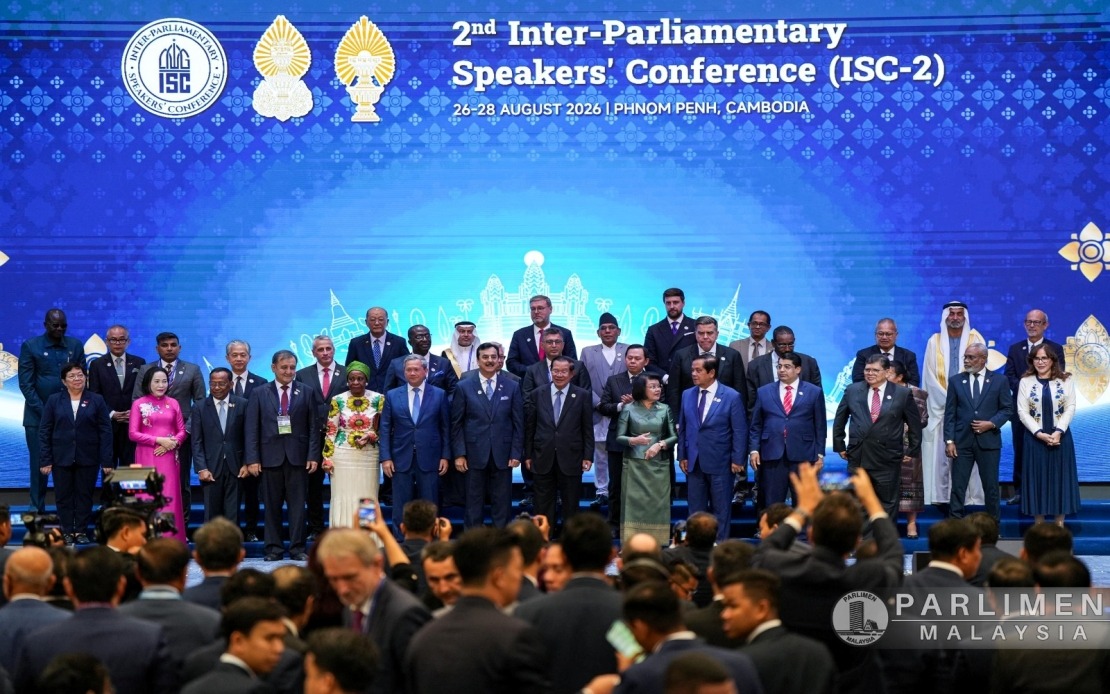
At the Second Inter-Parliamentary Speakers' Conference in Phnom Penh, Malaysia's Dewan Rakyat Speaker Tan Sri Dr Johari Abdul has made a compelling case for elevating the role of legislatures in addressing the world's most pressing challenges. Speaking to international counterparts gathered in the Cambodian capital from August 26 to 28, Johari contended that matters of global peace, international law and conflict resolution should not remain the exclusive domain of government executives, but must engage parliamentary bodies as equal partners in crafting solutions.
The conference, jointly hosted by Cambodia's National Assembly and Senate under the banner "Solidarity for Peace and Shared Prosperity: Strengthening International Law and Resolving Conflicts Peacefully," provided the stage for Johari to articulate how legislatures possess unique institutional advantages often overlooked in diplomatic circles. He emphasized that parliaments bring perspectives grounded in direct constituent engagement, offering insights that executive branches—often preoccupied with geopolitical maneuvering—may overlook. This structural difference, he suggested, creates a complementary dynamic whereby legislative bodies can temper executive decisions with broader, people-centred viewpoints.
Johari's intervention reflects growing recognition that contemporary global challenges demand coordinated responses transcending traditional boundaries between executive and legislative authority. The interconnected nature of modern crises—from regional conflicts to climate-induced displacement—requires institutions to pool their distinct competencies. Where governments navigate immediate diplomatic and security imperatives, parliaments represent popular concerns and longer-term societal interests. Integrating these perspectives strengthens institutional decision-making and enhances legitimacy by ensuring that ordinary citizens' welfare remains central to international affairs deliberations.
The human dimensions of unresolved conflicts animated much of Johari's argument. He highlighted how violence tears apart the fabric of communities through forced displacement, educational disruption and psychological trauma to families. These realities, he stressed, must inform diplomatic strategies that risk becoming abstract when handled exclusively by executive officials removed from ground-level consequences. Parliamentary bodies, accountable to constituents experiencing such devastation, can inject urgency and humanity into peace negotiations, ensuring that recovery and reconciliation mechanisms receive adequate attention.
Parliamentary diplomacy, Johari suggested, functions as a crucial backstop when formal government relations deteriorate. When official channels freeze due to geopolitical tensions, legislators can maintain dialogue across fractured nations, building incremental trust and preventing escalation into armed confrontation. This "track two" engagement preserves communication pathways, demonstrates that disagreement need not inevitably produce conflict, and reinforces the principle that shared humanity transcends political divisions. For regions prone to recurring tensions, such parallel forums prove invaluable for managing differences without sacrificing national dignity.
The Malaysian leader's advocacy carries particular weight given Southeast Asia's strategic position and ASEAN's foundational commitment to peaceful dispute resolution. He underscored how ASEAN's consultation-based framework and emphasis on dialogue provide the regional template for parliamentary engagement in international affairs. As geopolitical competition intensifies among major powers in Southeast Asian waters and territories, maintaining mechanisms for peaceful discourse becomes increasingly vital. Parliamentary bodies across member states can reinforce ASEAN's diplomatic culture by demonstrating that institutional pluralism—multiple voices from multiple branches of government—strengthens rather than weakens negotiating positions.
Johari positioned Malaysia as a champion of legal frameworks governing international conduct, anchoring his argument in respect for sovereignty, territorial integrity and peaceful dispute settlement mechanisms. These principles prove especially relevant as established international institutions face strains from rising powers questioning the post-World War II order. By advocating for legislative engagement grounded in international law, Malaysia signals commitment to rules-based approaches that protect smaller nations' interests in an increasingly contested global environment. Parliamentary advocacy for legal compliance provides a counterweight to executive pragmatism that might compromise principles for short-term advantage.
The sequential hosting of the Inter-Parliamentary Speakers' Conference illuminates shifting leadership patterns in global dialogue. Pakistan's hosting of the inaugural conference in 2025, Cambodia's current role, and Indonesia's upcoming turn as next year's host demonstrate how developing democracies assert greater voice in shaping international conversation. For Southeast Asia, Indonesia's hosting opportunity represents a chance to amplify the region's perspective on resolving conflicts and strengthening international law application. Malaysia's participation ensures regional concerns remain prominently featured in discussions that shape post-pandemic international relations architecture.
Johari's emphasis on parliamentary complementarity to executive action reflects mature democratic philosophy acknowledging that no single institution possesses complete wisdom on complex matters. Legislative bodies bring deliberative capacity, representative legitimacy and accumulated institutional memory that executive branches, necessarily focused on immediate problem-solving, may neglect. By integrating these elements, governments enhance decision quality while strengthening public confidence in international commitments. For Malaysian readers, understanding parliamentary diplomacy's potential offers perspective on how their elected representatives contribute beyond domestic lawmaking to regional and global stability efforts.
The speaker's intervention occurs amid escalating global fragmentation, from Middle Eastern entanglements to Indo-Pacific tensions to African conflicts. Each demonstrates how executive-only approaches struggle to build durable peace when they lack legislative legitimacy and public understanding. By championing parliamentary involvement, Johari advocates for institutional architecture that distributes responsibility for peace-building more broadly, acknowledging that sustainable international order rests ultimately on popular consent and representative legitimacy rather than elite executive agreements. This philosophical reorientation, if embraced across democracies, could fundamentally reshape how nations approach conflict prevention and resolution in coming decades.

