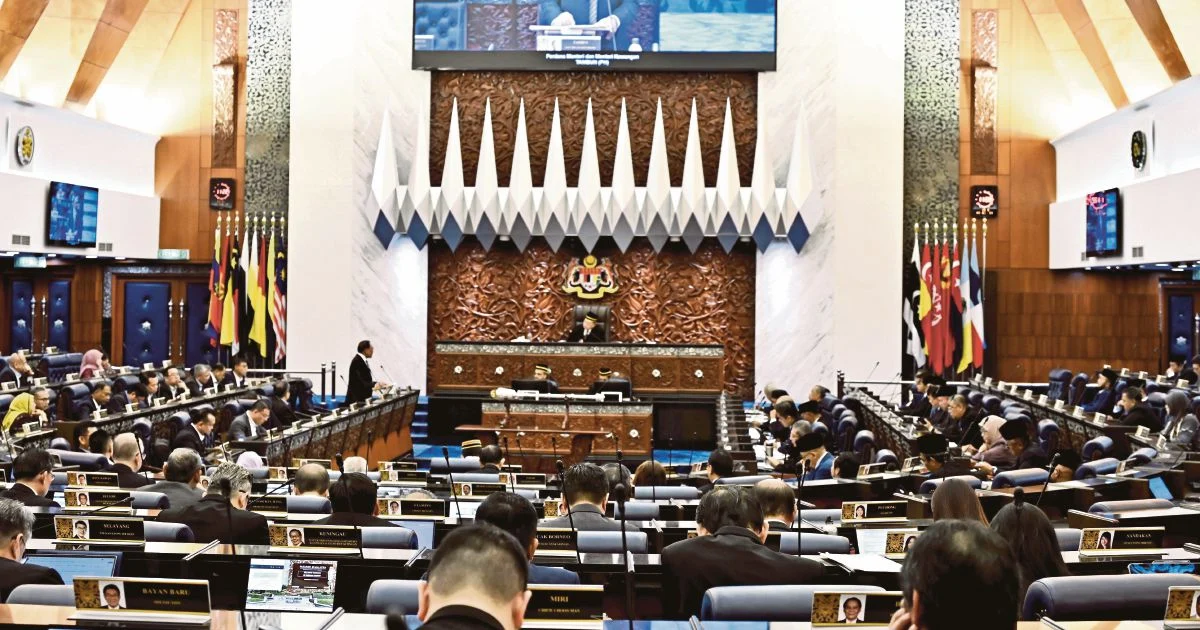
The opening hours of today's parliamentary session were marred by acrimonious exchanges between government and opposition benches, as lawmakers clashed over the recognition and standing of the opposition leader—a dispute that exposed deeper fractures within Malaysia's increasingly fragmented political landscape. The confrontation, which erupted less than an hour after proceedings commenced in the Dewan Rakyat, saw Takiyuddin and a government-aligned member engage in a sharp back-and-forth that underscored the volatile state of relations between rival coalitions and within them.
The immediate trigger for the outburst concerned disagreements about the opposition leader's formal status and recognition within Parliament, a matter that might appear procedural on the surface but carries significant weight in Malaysian political culture. The way parliament acknowledges and treats opposition leadership reflects underlying power dynamics and institutional respect—or the absence thereof. This particular dispute appears to have been particularly contentious because it touched on questions of legitimacy and standing that resonate deeply within Malaysia's system of parliamentary democracy.
Takiyuddin's involvement in the exchange is noteworthy given his prominent role within PAS and his visibility in parliamentary proceedings. As a seasoned legislator with strong connections within the ruling coalition's Islamist contingent, his willingness to engage in such confrontations signals that these tensions are not casual parliamentary theatre but reflect genuine concerns about how his party and its allies are being treated within the broader political ecosystem. His participation also suggests that the grievance runs deep enough within PAS to warrant direct intervention from senior figures.
The outbreak of hostilities within the first hour of sitting indicates that parliament remains a forum where genuine animosities are expressed, rather than a chamber where purely ceremonial debates take place. Malaysian lawmakers have long used parliamentary privilege to air substantive disagreements and score political points, but the speed with which tensions crystallised today suggests an underlying pressure that needed little provocation to surface. The current parliamentary term appears to be characterised by a particular brittleness in inter-party relations that can ignite quickly.
Beyond the immediate personalities involved, the exchange illuminates broader tensions within Malaysia's governing arrangements. The Perikatan Nasional coalition has incorporated PAS and Bersatu alongside other parties, yet coordination between these groups has not always been seamless. Questions about the relative standing and treatment of coalition partners, particularly in symbolic matters such as parliamentary recognition, become flashpoints precisely because they signal how stable or precarious the overall arrangement might be. When allied parties begin trading accusations publicly in parliament, it suggests that backroom mechanisms for managing disagreements have either broken down or proved inadequate.
The characterisation of one party as "bullying" another, which appears to underlie this exchange, speaks to a perceived imbalance in power or respect within the alliance structure. PAS, as a significant electoral force with considerable grassroots organisation, may feel that its contributions to the government are not being acknowledged appropriately or that larger partners are imposing decisions without adequate consultation. Conversely, other coalition members might view PAS as being overly assertive or demanding in ways they consider incompatible with coalition discipline. These interpretations rarely surface so explicitly in parliament, making today's outbreak particularly significant.
For Malaysian political observers, such confrontations carry implications that extend beyond the immediate parties involved. They suggest that the current governing coalition, despite its electoral mandate and parliamentary majority, continues to wrestle with fundamental questions about power-sharing and mutual respect among its constituent parts. Coalition stability depends not merely on arithmetic—having sufficient seats—but on maintaining sufficient goodwill and consensus on procedures and recognition to function effectively over time. When such foundational issues become live disputes, governments face pressure to manage internal conflicts more carefully.
The timing of this outbreak is also worth noting. Early in a new parliamentary term, such heated exchanges can establish unfortunate precedents for how members will interact over the months ahead. If parties begin assuming bad faith positions and framing disputes as matters of deliberate exclusion or bullying rather than bureaucratic misunderstanding, the temperature of parliamentary discourse rises and collaborative work becomes more difficult. Government business, which requires opposition cooperation on many procedural matters, can suffer when relationships deteriorate.
Takiyuddin's specific engagement in this dispute also reflects PAS's interests in ensuring its voice carries weight within the ruling coalition. As a senior PAS figure, his intervention was likely calculated to signal to his party's base and to coalition partners that PAS will not accept what it perceives as disrespectful treatment without pushback. This public assertion of red lines, while dramatic, serves an internal party function in demonstrating that leadership takes its members' concerns seriously and will defend party interests vigorously.
For Malaysians observing parliament from outside, today's exchange reinforces an uncomfortable reality about contemporary politics: that even governing coalitions built on substantial electoral support continue to be fraught with tensions and competing interests that regularly surface publicly. Rather than functioning as stable, unified teams, Malaysia's coalitions increasingly resemble coalition governments elsewhere that must constantly negotiate internal differences while presenting a united face to the electorate. The openness with which these tensions are now expressed suggests little appetite for the kind of careful consensus-building that previously kept such disputes behind closed doors.
The government's response to such outbursts will help determine whether this incident becomes a minor spat or signals deeper problems ahead. If coalition leadership moves swiftly to restore working relationships and address legitimate concerns about recognition and standing, today's heated exchange may be absorbed without long-term damage. However, if each party interprets events through an increasingly adversarial lens, such incidents may become more frequent and more corrosive to the coalition's cohesion.