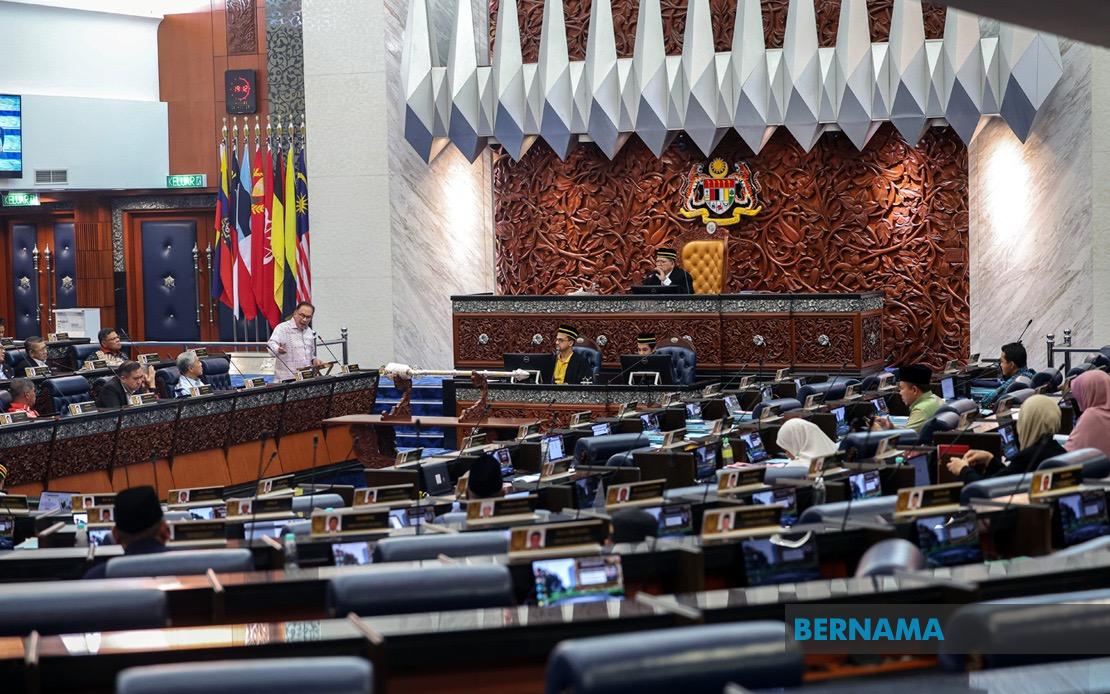
Parliament moved swiftly on July 15 to approve the transfer of RM14.5 billion in unspent proceeds from Malaysian Government Investment Issues (MGII) into the Development Fund, cementing the government's strategy for channelling borrowed funds toward long-term capital expenditure rather than routine operating costs. The motion secured passage through a majority voice vote following remarks from government and opposition lawmakers, signalling broad consensus on the mechanism for deploying these resources.
The move reflects Malaysia's constitutional and legal framework governing public finances, which restricts borrowing strictly to development expenditure while requiring operating expenses to be covered entirely through tax revenue and other government receipts. Deputy Finance Minister Liew Chin Tong explained that the Development Fund operates as a holding mechanism fed by transfers from multiple sources: the Consolidated Revenue Account capturing general government income, the Consolidated Loan Account channelling borrowing proceeds, loan repayments from earlier government lending, and various revenue streams tied to development activities. This structural separation enforces fiscal discipline by preventing borrowed funds from subsidising routine government operations.
The RM14.5 billion now approved for transfer represents the net proceeds after accounting for the intermediate use of MGII issuances between January and May 2026. During this five-month window, the government issued RM40 billion in gross MGII, yet RM25.5 billion of that sum was immediately recycled to refinance maturing earlier MGII obligations—a routine refinancing exercise that does not expand the government's net debt position. The remaining RM14.5 billion thus constitutes fresh borrowing directed toward development and deficit financing, underscoring how refinancing activities can obscure the actual scale of new government borrowing in monthly or quarterly reporting.
The broader context reveals an ambitious but declining borrowing programme. Liew disclosed that total MGII issuance for the full year 2026 is estimated at RM95 billion, deployed across three distinct purposes. The largest component, RM55 billion, addresses maturity schedules on earlier MGII issuances—debt that must be repaid or rolled over regardless of economic conditions. A second allocation of RM2 billion partially funds redemption of Malaysian Islamic Treasury Bills (MITB), short-term shariah-compliant instruments that represent another form of government debt cycle. The final RM38 billion carries the weight of actual new borrowing, financing a portion of the anticipated 2026 fiscal deficit that cannot be met through ordinary revenue.
For Malaysian and regional investors, the significance extends beyond accounting mechanics. Government securities and MGII issuances furnish critical investment vehicles for domestic institutional investors, particularly the Employees Provident Fund (EPF) and the Retirement Fund Incorporated (KWAP), whose portfolios underpin retirement security for millions of Malaysian workers. Liew pointedly addressed concerns about potential "crowding out"—the phenomenon where large government borrowing absorbs capital that might otherwise flow to private enterprise. He contended that government debt issuance actually provides essential investment pathways allowing institutions like the EPF to generate competitive returns while keeping capital domestic. The alternative scenario, where such investors seek returns abroad, would drain ringgit holdings and pressurize the currency.
This tension between fiscal sustainability and financial market function remains acute for Malaysia's policymakers. Liew noted that the government has progressively reduced annual new borrowing over recent years, suggesting awareness of debt accumulation risks. Yet the need to finance infrastructure modernisation, urban development, and periodic fiscal deficits necessitates continued market access. The parliament's approval today permits issuances through June and into December 2026, with a formal proposal for the latter half-year planned for the next parliamentary sitting. This staggered authorisation allows lawmakers periodic oversight while providing the Finance Ministry operational certainty.
The debate participants included Datuk Seri Ismail Abd Muttalib representing Maran under Perikatan Nasional, who sought clarification on MGII allocation across refinancing, MITB redemption, and deficit financing. His line of questioning reflects legitimate backbench interest in tracking how government borrowing translates into tangible public benefit rather than mere debt service. Datuk Zulkafperi Hanapi raised the crowding-out concern directly, probing whether massive government securities issuance might starve private sector investment of available capital and inhibit productive economic activity. These exchanges demonstrate that despite the comfortable passage of routine fiscal motions, Malaysian parliament retains capacity for substantive scrutiny.
Southeast Asian observers should note the broader implications. Malaysia's reliance on domestic borrowing—rather than external loans—insulates the country from currency and refinancing risks that have periodically destabilised regional peers. However, the accumulating domestic debt burden creates implicit claims on future government revenue and may gradually constrict fiscal space for unexpected shocks or new priorities. The ringgit's stability depends partly on investor confidence that borrowed resources translate into productive development generating future growth and tax revenue, rather than consumption or wasteful spending. The Development Fund structure aims to reinforce this credibility by segregating capital investment from routine expenditure.
Looking forward, the parliamentary approval of this RM14.5 billion transfer represents one step in a complex annual dance of borrowing, refinancing, and allocation that will shape Malaysia's fiscal trajectory for years. The government's stated intention to reduce borrowing year-on-year suggests recognition that current debt trajectories cannot continue indefinitely without constraint. Yet infrastructure investment needs in an era of technological transition, demographic ageing, and climate adaptation pressures argue against precipitous deficit reduction. The coming years will test whether policymakers can thread this needle—sustaining development investment while gradually improving the fiscal balance—without compromising either economic growth or financial stability that underpins regional confidence in the ringgit.

