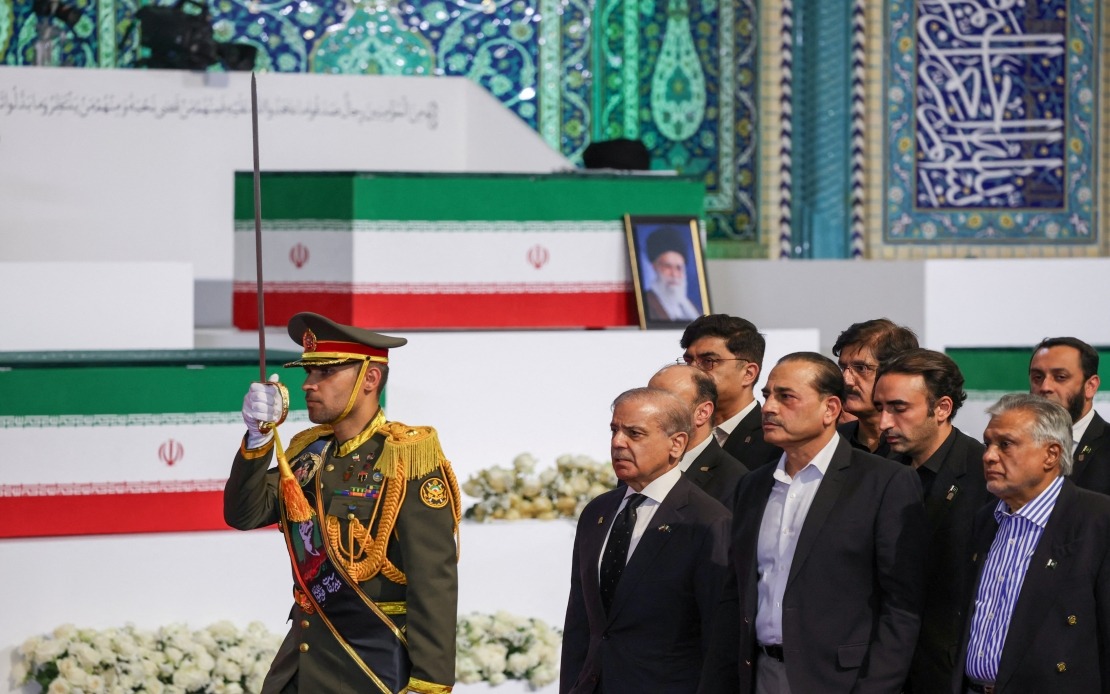
Pakistan's decision to send one of its most senior delegations to the funeral of Iran's Supreme Leader Ayatollah Ali Khamenei has elicited expressions of gratitude and praise from Iranian officials, underlining the strategic importance both nations place on their bilateral relationship despite regional tensions and occasional diplomatic friction. The funeral ceremony, held in Tehran on Friday, brought together high-level representatives from approximately 100 countries across multiple continents, reflecting the global significance of Iran's leadership transition following Khamenei's death earlier this year.
The Pakistan delegation proved notably substantial in both rank and size, surpassing comparable representations from other major powers. Prime Minister Shehbaz Sharif personally attended the ceremony, a symbolic gesture that conveyed Pakistan's respect for the deceased leader and its commitment to honouring long-standing ties with the Islamic Republic. Accompanying Sharif was a carefully curated roster of influential figures spanning multiple domains of Pakistani governance and politics, including Deputy Prime Minister and Foreign Minister Ishaq Dar, whose presence signalled the diplomatic weight Pakistan attached to the occasion. The inclusion of Chief of Army Staff Field Marshal Syed Asim Munir underscored the military's significance in Pakistan's Iran policy, while the representation of Pakistan People's Party chairman Bilawal Bhutto Zardari demonstrated that the attendance transcended party lines, reflecting a national consensus on the importance of the bilateral relationship.
Iranian Ambassador to Islamabad Reza Amiri Moghadam publicly acknowledged Pakistan's gesture through his social media post, describing the delegation as the most numerous and distinguished from any single nation present at the funeral. His remarks carried diplomatic weight beyond mere courtesy, serving as an official statement of appreciation from Tehran's political establishment. Moghadam emphasised that Pakistan's high-level participation reflected the "enduring friendship and brotherhood" binding the two Muslim-majority nations, language that resonated with the historical narrative both governments have long cultivated about their relationship. The ambassador's formal recognition suggests that Pakistan's attendance produced tangible diplomatic dividends, potentially strengthening bilateral channels at a critical moment when Iran faced internal transitions and international scrutiny.
Supreme Leader Khamenei's death on February 28 constituted a watershed moment for Iran's political system and regional influence. At 86 years old, he had steered Iran's course for over three decades, shaping the nation's foreign policy, nuclear programme, and resistance strategies against what Tehran viewed as Western aggression. His passing necessitated ceremonial acknowledgment from global powers, many of which maintained complex relationships with Iran rooted in historical grievances, sanctions regimes, and competing strategic interests. Pakistan's prominent attendance demonstrated that despite numerous challenges in Pakistani-Iranian relations—ranging from sectarian tensions to periodic border disputes—Islamabad valued the relationship sufficiently to demonstrate solidarity at a moment of significant consequence for Tehran.
The funeral logistics themselves reflected Iran's efforts to present a unified national image during the succession process. Public ceremonies commenced on Saturday, with the flag-draped coffin of Khamenei placed ceremonially alongside those of family members lost alongside him. The burial was scheduled for July 9 in Mashhad, Khamenei's birthplace and a city of profound religious significance in Shia Islam, ensuring that the final rites occurred in a location laden with symbolism and historical resonance for Iran's population. This choreographed sequence allowed the international community to participate in the official mourning period while affording Iran time to consolidate its transition to new leadership structures.
The attendance of Malaysia, Bangladesh, Saudi Arabia, Türkiye, Qatar, Oman, Egypt, Russia, Iraq, China, and India alongside Pakistan indicated that Iran's funeral invited a cross-section of regional and global stakeholders with varying degrees of alignment with Iranian interests. For Malaysian observers, the presence of regional peers at such a significant ceremony underscored how funeral attendance has evolved into a crucial diplomatic statement in contemporary international relations. When nations dispatch their highest-ranking officials to mark another country's loss, they signal respect, strategic interest, and a desire to maintain or strengthen bilateral channels. Pakistan's decision to participate at this elevated level thus represents a calculated investment in preserving and enhancing its relationship with Iran during a transitional period when Tehran's new leadership will be establishing its own diplomatic priorities and partnerships.
Ambasador Moghadam's characterisation of the gesture as "meaningful and historical" positioned Pakistan's attendance within a broader historical narrative of bilateral relations. The language employed—references to "shared values," "trials and triumphs of history," and "fraternal bonds"—reflected the diplomatic vernacular both nations employ when discussing their connection. This narrative framework serves multiple purposes: it validates Pakistan's attendance as consistent with longstanding bilateral bonds rather than a purely transactional political calculation, it provides reassurance to Pakistan's domestic audience that their government maintains strong international standing, and it signals to other regional actors that Pakistan-Iran relations remain strategically significant despite occasional public disagreements.
Prime Minister Sharif's personal tribute to Khamenei, describing his "wisdom, leadership and profound influence on Iran and the wider region," provided individual acknowledgment of the deceased's impact. Such remarks, while ceremonially appropriate, carry implications for Pakistan's future orientation toward Iran. By emphasising Khamenei's influence "on the wider region," Sharif implicitly recognised Iran's role in shaping South Asian and Middle Eastern geopolitics. For Pakistan, maintaining productive relations with Iran remains strategically essential given the two nations' shared borders, overlapping security concerns regarding terrorism and sectarian extremism, and mutual interests in stabilising Afghanistan. The funeral provided an opportunity for Pakistan to reinforce these connections at a moment when Iran's new leadership would be receptive to gestures of support and solidarity from neighbouring states.
The significance of Pakistan's delegation size and composition cannot be understated in understanding how nations deploy diplomatic resources to signal alignment and partnership. The inclusion of the Interior Minister alongside the Chief of Army Staff suggests that Pakistan wished to demonstrate its commitment across security, military, and civilian governance domains. The presence of the National Assembly Speaker indicated parliamentary-level engagement, while the Information Minister's attendance ensured that Pakistan's participation received domestic media coverage and public acknowledgment. This layered approach to delegation composition reflects sophisticated diplomatic planning, ensuring that no major institutional power centre in Pakistan could be perceived as absent from the ceremony, thereby maximising the gesture's domestic political value while simultaneously impressing upon Iran the breadth of Pakistan's institutional commitment.
Looking forward, the diplomatic dividend Pakistan appears to have secured through its funeral attendance may yield practical benefits in bilateral negotiations on trade, security cooperation, and regional stability initiatives. Iran's public appreciation of Pakistan's gesture, articulated through official channels, creates political space for both governments to deepen engagement on contentious issues where trust has historically been tested. For the broader region, Pakistan's prominent role at Khamenei's funeral signals that even amid Middle Eastern upheaval and transitional periods in major powers' leadership, smaller neighbours like Pakistan understand the value of investing in relationship maintenance and symbolic gestures of solidarity.

