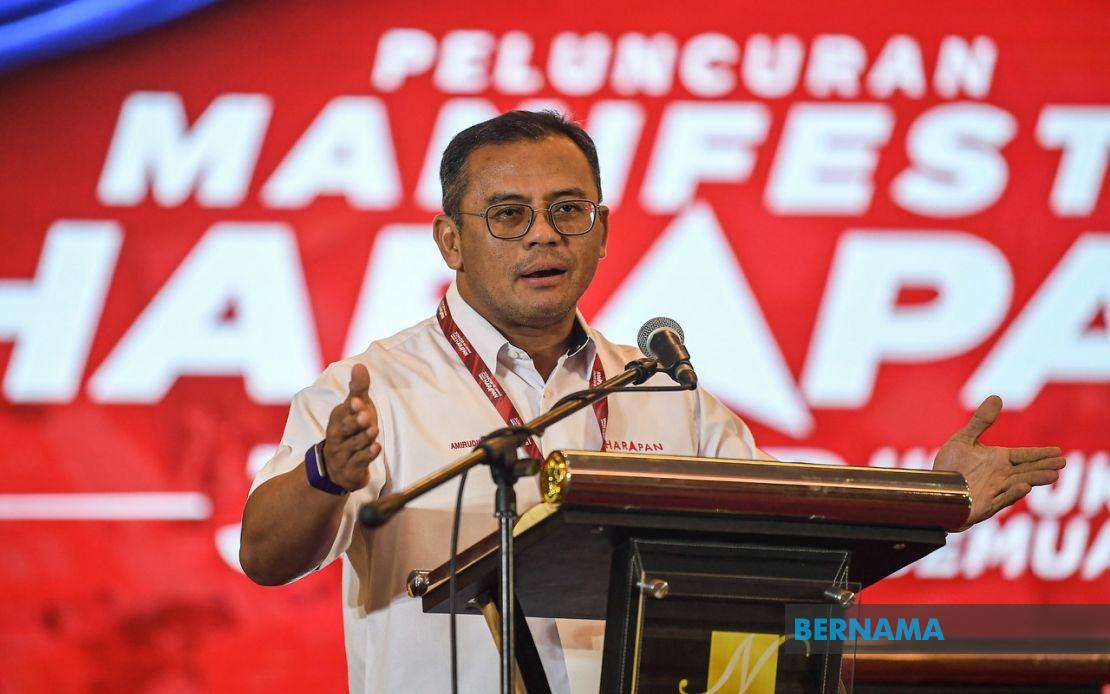
As Pakatan Harapan launches its campaign manifesto for the 16th Johor state election, the coalition is positioning its economic record as central to its electoral pitch. Senior party leader Datuk Seri Amirudin Shari, who chairs the PH Presidential Council and serves as Selangor Menteri Besar, has emphasised that federal and state governments under the coalition's stewardship have delivered measurable gains across major economic indicators, contrasting their performance against previous administrations and positioning PH as the custodian of national prosperity.
The coalition's economic narrative rests on several pillars that party strategists argue distinguish PH governance from competitors. The ringgit's appreciation to its strongest level in 16 years under the Anwar Ibrahim-led administration serves as a tangible symbol of economic stability and investor confidence. Amirudin highlighted this achievement alongside consistent gross domestic product expansion, framing these outcomes as evidence that PH's brand of administration can withstand global economic pressures while maintaining growth momentum. For Malaysian voters assessing which coalition can deliver improved living standards and economic opportunity, such macroeconomic stability carries significance as a precursor to job creation and business expansion.
The emphasis on state-level economic contributions reflects a calculated strategy to demonstrate that PH governance works across multiple administrative levels. Penang and Selangor, both PH-administered states, collectively account for nearly 40 percent of Malaysia's economic output according to Amirudin's characterisation. This concentration of economic activity in PH-controlled territories is presented not merely as statistical fact but as evidence of effective governance that attracts capital investment and nurtures entrepreneurship. The coalition appears intent on suggesting that where PH holds power, economic dynamism follows.
Selangor's economic expansion provides the most striking illustration of this argument. The state's economy reached RM432 billion in the Department of Statistics' 2023 valuation, subsequently growing by RM28 billion to RM460 billion in more recent assessments released just days before the manifesto launch. Amirudin's comparison directly to Johor is noteworthy—by arguing that Selangor's economy is twice the size of Johor's, he implicitly challenges voters in the incumbent coalition's stronghold to consider whether their state has underperformed under rival leadership. Such comparative framing is designed to plant doubt about alternative governance options.
The timing of this economic pitch in the Johor election campaign carries regional implications for Malaysian politics. Johor has traditionally been a Barisan Nasional stronghold, particularly during UMNO's period of dominance. By highlighting the economic credentials of PH-administered states and the federal government, the coalition is attempting to demonstrate that its governance model produces tangible returns that voters can measure through employment, business opportunities, and public infrastructure. The manifesto launch event becomes a venue not just for announcing policy proposals but for reframing the terms of electoral competition around measurable economic outcomes.
For Southeast Asian observers, the framing of economic performance as a central campaign message reflects broader regional patterns where growth delivery has become increasingly important to political legitimacy. Malaysian voters, like their counterparts across the region, face inflation, employment uncertainty, and questions about whether current administrations are improving or degrading their economic prospects. By leading with macroeconomic statistics and state-level development narratives, PH seeks to anchor voter perception to tangible performance metrics rather than to personality-driven or ideology-driven appeals.
The coalition's emphasis on investment attraction and GDP consistency also addresses a persistent concern about Malaysia's economic competitiveness in an increasingly fragmented global trading environment. The mention of the government's capacity to draw foreign and domestic capital investment signals to business constituencies and middle-class voters that PH can maintain Malaysia's position as an attractive destination for economic activity. This matters particularly in Johor, which has significant industrial zones, port operations, and cross-border economic ties to Singapore that depend on investor confidence and macroeconomic stability.
However, the coalition's economic messaging must navigate skepticism about whether headline growth statistics translate into improved circumstances for ordinary workers and small business operators. While Selangor's RM460 billion economy represents substantial expansion, the distribution of economic gains and accessibility of opportunities to residents across income brackets remain central concerns that aggregate statistics alone cannot address. Voters weighing competing manifestos will likely assess not just whether the economy grows, but whether growth reaches them.
The strategic choice to highlight Penang and Selangor as co-exemplars of PH governance reflects the coalition's recognition that it must present a coherent model of multi-state administration to voters. Rather than treating each state election in isolation, PH frames its state governments as part of an integrated system demonstrating how coalition governance produces prosperity. This approach attempts to overcome the traditional Malaysian pattern where state elections are fought on localized grievances and personalities, instead creating a larger narrative about PH's capacity to manage economic complexity across diverse state contexts.
Looking forward, the reception of this economic argument among Johor voters will likely influence how other state elections and the next federal election are contested. If economic messaging resonates and translates into electoral gains, expect other coalitions to intensify their own economic narratives. Conversely, if voters perceive a disconnect between growth statistics and their lived experience of economic stress, the salience of PH's messaging will diminish regardless of how impressive the numbers appear on paper.

