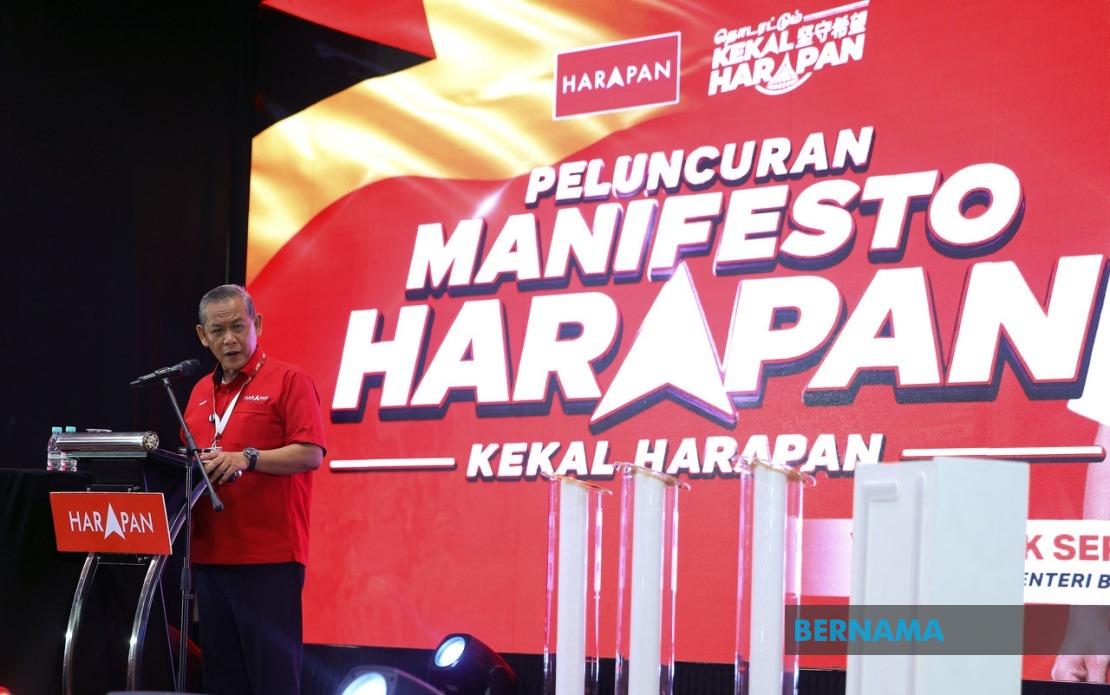
Pakatan Harapan formally presented its campaign blueprint for the forthcoming 16th Negeri Sembilan state election on July 20, anchoring its platform around the theme 'Negeri Sembilan Kekal Harapan' (Negeri Sembilan Stays With Harapan). The manifesto, unveiled by Negeri Sembilan PH chairman and Menteri Besar Datuk Seri Aminuddin Harun in Seremban, consolidates a decade of governance priorities into ten strategic pledges designed to frame the coalition's vision for the state's development trajectory over the coming electoral term.
At the heart of the manifesto lies a commitment to maintain governmental stability while advancing transparency and citizen-focused administration. This foundational pledge reflects PH's broader messaging that continuity and accountability represent essential prerequisites for sustained economic and social progress. For voters evaluating competing party platforms, such assurances carry particular weight in Negeri Sembilan, where the state has experienced political transitions that shaped public expectations regarding governance quality and institutional reliability.
Economic rejuvenation forms a central plank of the coalition's pitch to constituents. PH commits to cultivating a more competitive economic landscape capable of generating 30,000 high-income employment opportunities, a figure representing substantial job creation relative to the state's existing labour force. This employment target addresses persistent concerns among younger voters and displaced workers regarding income adequacy and career progression in an economy undergoing sectoral transformation. The specificity of the 30,000-job pledge suggests PH has identified particular growth sectors amenable to higher-wage positions, though the manifesto stops short of detailing which industries or regions would absorb this employment surge.
Housing affordability has emerged as a pressing concern across Malaysian states as property prices accelerate beyond wage growth. PH's commitment to construct 20,000 affordable units, coupled with a parallel pledge to resolve outstanding land-related disputes, signals recognition that housing accessibility remains a gateway issue influencing voter sentiment, particularly among first-time homebuyers and middle-income households. Resolving land matters simultaneously addresses a chronic source of friction between residents and state administration, suggesting PH perceives institutional efficiency on property questions as a differentiator in competitive electoral contests.
The manifesto emphasises strengthening the Skim Sejahtera Rakyat (SSR), or People's Wellbeing Scheme, indicating that PH views enhanced social protection mechanisms as integral to its electoral positioning. This welfare expansion reflects evolving voter expectations that state governments bear responsibility for mitigating economic vulnerability and supporting households experiencing income shocks. The SSR emphasis also demonstrates PH's awareness that social safety nets resonate particularly among lower-income demographics and retirees, constituencies whose engagement determines election outcomes in tightly contested multiracial states.
Educational access represents another cornerstone, with PH pledging to guarantee quality schooling across Negeri Sembilan. This commitment extends beyond mere resource allocation, implicitly addressing disparities in educational infrastructure between urban and rural zones and signalling PH's understanding that parents prioritise schooling quality when evaluating government performance. The universality language suggests an inclusive approach spanning all demographic groups rather than targeted assistance confined to specific communities.
Healthcare modernisation and accessibility appear alongside strategic infrastructure development in PH's promise slate. These complementary commitments recognise that public health systems and transport networks constitute foundational services whose deficiencies generate widespread frustration. By linking infrastructure and healthcare, PH connects physical connectivity with health outcomes, reflecting evidence that remote or poorly-served regions face compounded disadvantages when accessing medical facilities.
Youth empowerment, women's advancement, and family support initiatives collectively indicate PH's attempt to address cross-cutting social priorities. Rather than compartmentalising demographic groups, this framing positions youth, women, and families as interconnected constituencies whose progress depends on coordinated policy interventions. Such integration acknowledges that education, economic opportunity, and social protection serve these populations simultaneously and that fragmentary approaches prove insufficient.
Tourism and cultural heritage development constitutes a notably specific sectoral commitment, reflecting Negeri Sembilan's aspirations to leverage its historical significance and natural assets for economic gain. This pledge demonstrates PH's belief that cultural tourism represents a viable driver of sustainable growth compatible with environmental conservation, a position resonating with voters increasingly conscious of balancing development with ecological integrity. The heritage emphasis simultaneously appeals to communities invested in preserving local identity amid rapid modernisation.
Agricultural modernisation and food security strengthening together signal PH's attention to rural constituencies and national-level supply chain resilience. Agricultural enhancement moves beyond subsidy provision to encompass technological adoption and productivity improvement, suggesting a forward-looking rather than merely supportive approach to farming sectors. Food security commitments additionally reflect post-pandemic recognition that domestic production capacity constitutes a strategic priority transcending ordinary economic considerations.
Implementing the Felda Development Plan indicates PH's engagement with settled communities and land-based livelihoods. Federal Land Development Authority constituencies represent historically significant constituencies in Malaysian politics, and explicit recognition of Felda development priorities signals PH's commitment to addressing these communities' accumulated grievances and contemporary aspirations. This focus also demonstrates coalition-building awareness, as Felda settlers comprise a consequential voter bloc in multiple constituencies.
Interfaith unity promotion appears as a concluding commitment, reflecting Negeri Sembilan's multicommunal composition and the recognition that inclusive governance requires deliberate cultivation of social cohesion. Positioning religious and ethnic harmony as a government responsibility rather than merely a societal norm signals PH's commitment to active institutional engagement in fostering tolerance and preventing communal friction, positioning the coalition as stewards of pluralism rather than neutral observers.
Collectively, these ten commitments construct a comprehensive platform spanning economic, social, and institutional dimensions. The breadth suggests PH's assessment that voters expect governing coalitions to demonstrate competence across multiple policy domains simultaneously. Whether such ambitious pledge ranges enhance electoral appeal or invite scepticism regarding implementation capacity remains contingent on voter perceptions of PH's track record and competing parties' counter-propositions.

