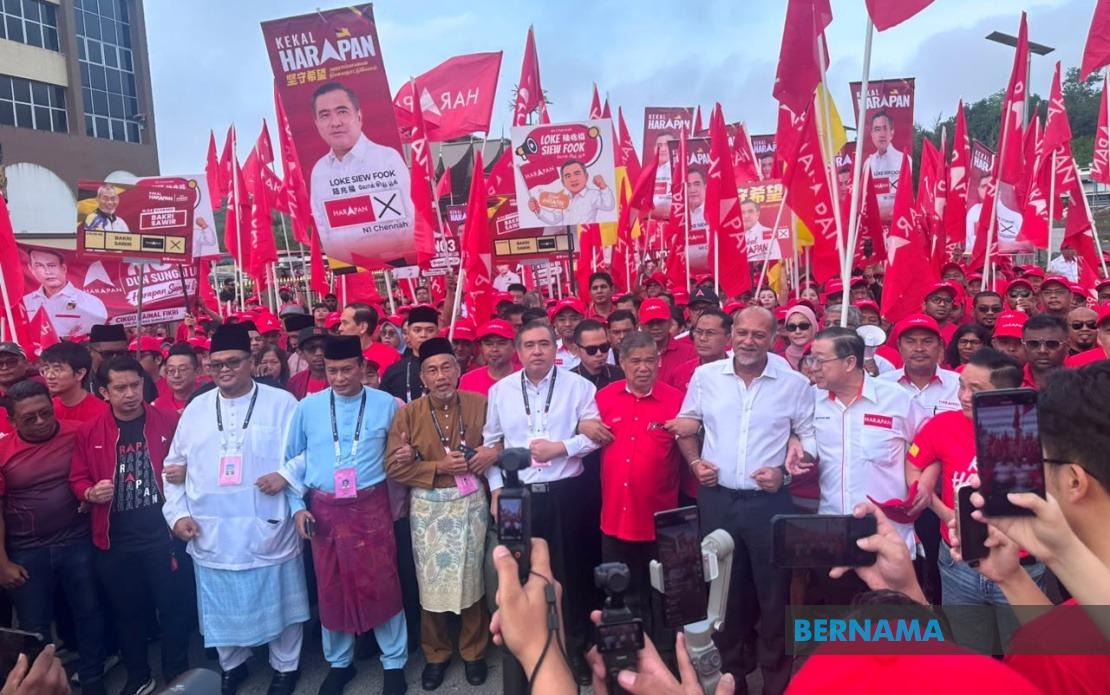
Negeri Sembilan witnessed a coordinated show of force from Pakatan Harapan's leadership ranks on July 18 as senior coalition figures fanned out across multiple nomination centres to accompany their candidates through the formal registration process for the state election scheduled for August 1. The high-profile turnout underscored the coalition's strategic focus on this crucial peninsular state, where PH currently holds a governing majority and faces pressure to retain its 2023 electoral gains.
Transport Minister Anthony Loke, who serves as DAP's secretary-general, personally filed his nomination papers for the Chennah seat in Jelebu, arriving at Dewan Besar Kuala Klawang before 8.30 am. His presence was reinforced by a roster of party heavyweights, including DAP chairman Gobind Singh Deo, veteran Lim Guan Eng in his advisory capacity, and Amanah president Mohamad Sabu. This clustering of senior figures in a single constituency reflected the symbolic importance of securing a prominent seat early in the nomination process, setting a confident tone for PH's campaign narrative.
In Jempol, the coalition deployed Deputy Communications Minister Teo Nie Ching, simultaneously serving as Wanita DAP chief, to back PH candidate Teo Kok Seong's bid for the Bahau seat. Kok Seong carries the incumbency advantage from the 14th General Election, positioning him as a defensive anchor in this district. Communications Minister Fahmi Fadzil arrived slightly later at the same nomination centre, expanding the leadership presence to support four additional candidates across the Serting, Palong, Jeram Padang and Bahau constituencies. Of these four, only Teo retained incumbent status; the other three—Yaacob Mahmood, Muhammad Zahin Zinal Abidin, and Manivanan Gowin—represented fresh attempts to penetrate new voter territory.
Menteri Besar Aminuddin Harun, who simultaneously holds the PH chairmanship for Negeri Sembilan, anchored the coalition's efforts in Port Dickson, filing his candidacy for the Linggi seat surrounded by DAP deputy secretary-general Hannah Yeoh, PKR secretary-general Fuziah Salleh, and Prime Minister Anwar Ibrahim's political secretary Farhan Fauzi. This particular gathering highlighted the connection between state-level and federal power structures, suggesting Putrajaya's direct investment in the Negeri Sembilan outcome. Three incumbent assemblymen—Yew Boon Lye from Chuah, Choo Ken Hwa from Lukut, and G Rajassekaran defending Sri Tanjung—also filed papers in Port Dickson, reinforcing the narrative that PH's existing representatives commanded sufficient confidence to seek re-election unopposed by internal challenges.
Entrepreneur and Cooperatives Development Minister Steven Sim orchestrated a separate mobilization at Wisma Majlis Bandaraya Seremban, accompanying six PH candidates and drawing attendance from figures including Selangor State Legislative Assembly Speaker Lau Weng San, Bukit Gelugor MP Ramkarpal Singh, and PKR vice-president R. Ramanan. The geographic diversity of these supporting players—drawing representatives from beyond Negeri Sembilan's borders—emphasized the coalition's view of this election as strategically significant beyond the state's immediate boundaries.
The electoral arithmetic underlying this organizational intensity reflects genuine stakes. Pakatan Harapan currently controls 17 of the 36 state assembly seats following the 2023 election, giving it a working but not overwhelming majority. Barisan Nasional holds 14 seats, while Perikatan Nasional's five representatives occupy the kingmaker position in theory, though PH's coalition partners have delivered it the comfortable governing edge. However, the composition of PH's parliamentary support across Malaysia has faced strain, making retention of every available foothold increasingly important for federal stability. Any significant reversal in Negeri Sembilan could embolden opposition narratives about waning support for the Anwar Ibrahim administration.
The nomination process itself—conducted on July 18 for an August 1 election with early voting on July 28—compressed the formal campaign window into a concentrated two-week period. This timeline meant that the opening day's mobilization of senior figures served double duty: simultaneously fulfilling the procedural requirement to file papers while launching the emotional and organizational momentum of the broader campaign. Early appearance by cabinet-rank figures signalled that headquarters expected competitive contests requiring maximum institutional investment.
Geographically, PH's candidate deployment across the state suggested a strategy to defend existing strongholds while probing for advancement in traditionally mixed or opposition-leaning constituencies. The presence of incumbents in several cases provided continuity messaging, while the fielding of newcomers in others indicated willingness to refresh the electoral proposition in voters' eyes. Notably absent from the nomination centre visits were any visible signs of internal discord within the coalition, despite persistent tensions between DAP and PKR over resource allocation and seat distribution in various state and federal contexts.
The Negeri Sembilan election carries implications extending beyond state governance. For PH, a strong showing would validate the coalition's ability to maintain electoral appeal despite national-level controversy and the ongoing political consolidation occurring elsewhere. For BN, the contest represents an opportunity to demonstrate renewed electoral competitiveness after years of decline, potentially energizing its grassroots operations for larger contests anticipated in coming years. For PN, the result would indicate whether its Negeri Sembilan foothold can be expanded or whether it remains confined to narrower regional zones of influence.
The Election Commission's announcement of August 1 as polling day and July 28 for early voting locked in an accelerated timetable that favoured incumbent coalitions able to mobilize established machinery quickly. PH's deployment of multiple federal ministers and state figures on nomination day demonstrated organizational readiness, though the actual electoral outcome would depend on whether this elite mobilization translated into grassroots enthusiasm and voter support across diverse communities within the state's districts.

