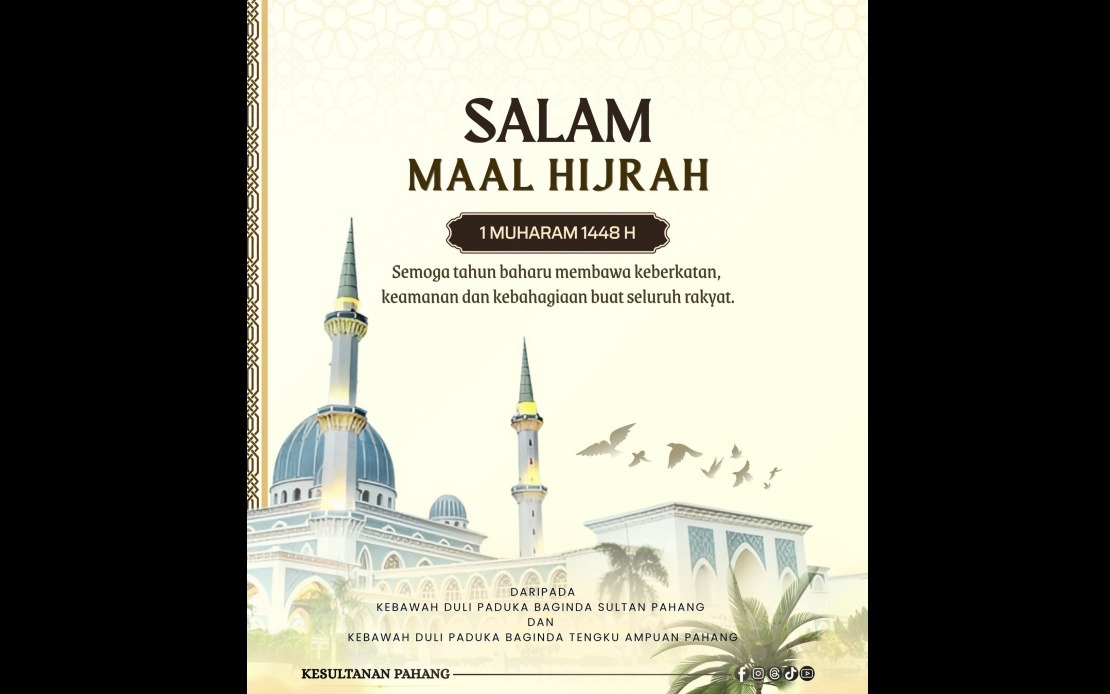
The Sultan of Pahang, Al-Sultan Abdullah Ri'ayatuddin Al-Mustafa Billah Shah, alongside the Tengku Ampuan of Pahang, Tunku Azizah Aminah Maimunah Iskandariah, has reached out to the Muslim community across the state with their traditional greetings marking Maal Hijrah 1448H, the Islamic new year. Through a message posted on the official Kesultanan Pahang Facebook page, the royal couple conveyed warm wishes for the arriving year to usher in prosperity, tranquillity and welfare for all residents of the state, regardless of faith.
The observance of Maal Hijrah holds particular significance in Malaysian culture, commemorating the Prophet Muhammad's migration from Mecca to Medina—an event that marks the beginning of the Islamic calendar. For many Muslims across the nation and the region, this occasion traditionally serves as a moment for spiritual reflection and personal renewal. The royal message from Pahang's leadership demonstrates the commitment of Malaysia's constitutional monarchy to acknowledge and support the religious observances of the Muslim majority while upholding the nation's pluralistic values.
Pahang Menteri Besar Datuk Seri Wan Rosdy Wan Ismail similarly addressed the state's Muslim population through his own social media statement, framing the new Islamic year as an opportunity for believers to reassess their spiritual commitments and intensify their dedication to faith-based principles. His remarks encouraged Muslims to view Maal Hijrah not merely as a calendar milestone but as a transformative moment for personal development and strengthened devotion to Islamic teachings.
In his message, Wan Rosdy drew explicit parallels between the Hijrah narrative and contemporary challenges facing society and governance. He urged residents to embrace the pioneering spirit embodied by Prophet Muhammad's journey, translating that historical example into modern action through deliberate self-improvement and community betterment. The Menteri Besar's framing suggests that religious observance in Pahang extends beyond ceremonial acknowledgment to encompass practical implications for state development and social cohesion.
The emphasis on renewal of resolutions carries particular resonance for Malaysian policymakers grappling with economic pressures, social polarization, and the need to rebuild public trust in institutions following years of political turbulence. Pahang, as one of Malaysia's larger states and a significant economic contributor, faces its own set of developmental priorities spanning infrastructure, education, and livelihood improvement for diverse communities. The invocation of Maal Hijrah values by state leadership appears designed to channel religious sentiment toward constructive civic engagement.
Wan Rosdy's specific mention of strengthening unity and instilling integrity represents a subtle but important messaging strategy. These values carry explicit reference to governance standards and inter-communal relations at a moment when Malaysia continues navigating complex questions about national identity and plural coexistence. The Menteri Besar's appeal for enhanced charitable activity similarly gestures toward Islamic principles of social welfare while implicitly encouraging voluntary community participation in addressing local needs.
The invocation of steadfastness and sacrifice in Wan Rosdy's statement acknowledges the historical and ongoing challenges that Pahang residents encounter, from economic restructuring to natural disasters. By anchoring contemporary resilience to Islamic principles of perseverance, the state leadership attempts to provide moral and spiritual frameworks through which ordinary citizens might interpret their own struggles and contributions to collective progress.
Social media platforms have become the primary vehicle through which Malaysian officials communicate with constituents about religious and cultural matters, reflecting broader shifts in how state institutions engage with the public. The choice to deliver Maal Hijrah greetings through Facebook represents an accessible, immediate communication channel that allows for broader reach than traditional announcement methods. This digital approach facilitates interaction and sharing, potentially amplifying the messages' resonance within communities.
For Malaysian readers and the broader Southeast Asian audience, these messages illuminate the intersection between religious observance and statecraft within a constitutional monarchy framework. The Sultan's personal participation in extending Maal Hijrah greetings underscores the continuing centrality of Islam to Malaysian identity and governance, while the emphasis on inclusive blessings for all people reflects the state's constitutional commitment to religious freedom and plural coexistence. The parallel statements from royal and executive branches demonstrate coordinated messaging on values that extend beyond narrow sectarian concerns to encompass broader national priorities of stability, integrity and collective welfare.