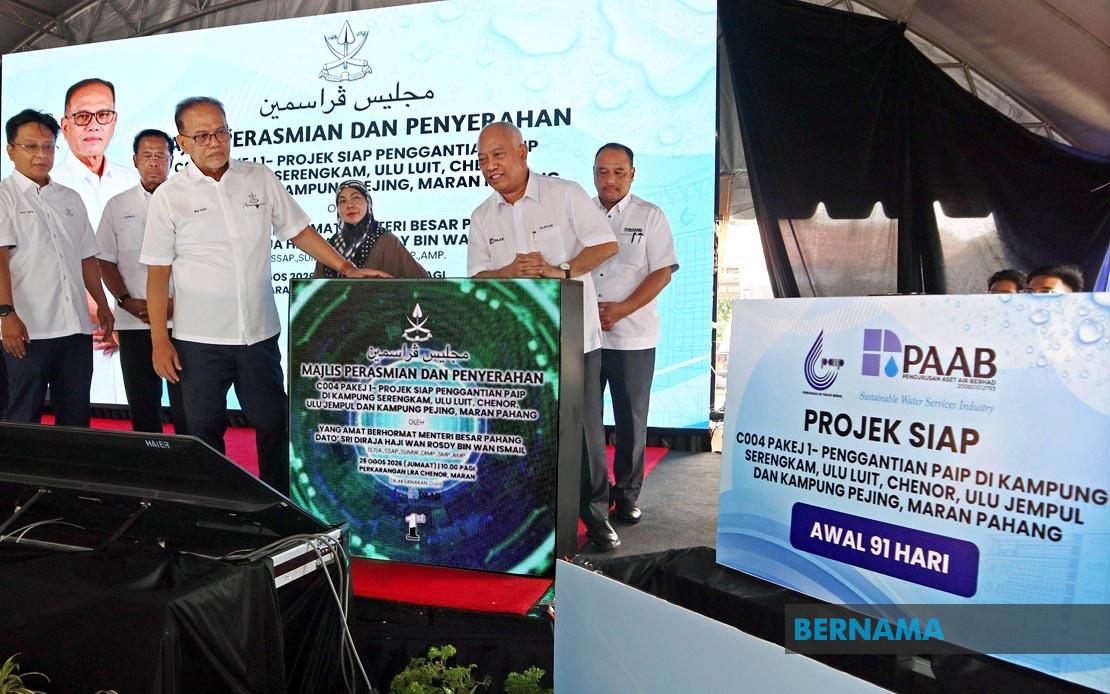
The Pahang government is undertaking a systematic review to devise sustainable remedies for the recurring problem of shallow river conditions affecting Sungai Pahang, most notably in the Maran district locality of Kampung Pesagi. Menteri Besar Datuk Seri Wan Rosdy Wan Ismail articulated this commitment while visiting the Chenor Water Treatment Plant in Maran on Wednesday, where he presided over the completion of a significant pipe infrastructure replacement project.
According to the Menteri Besar, state authorities are actively compiling detailed documentation from relevant government departments and agencies on the river's current hydrological status. This information gathering phase is essential before policymakers can evaluate and select the most appropriate interventions. The comprehensive nature of this assessment reflects recognition that river shallowing presents complex engineering and environmental challenges requiring careful analysis rather than hasty implementation.
Wan Rosdy outlined a tiered approach to addressing the issue, involving short-term interventions that can provide immediate relief to affected communities, medium-term measures designed to strengthen water flow and management systems, and long-term structural solutions that would provide enduring benefits. Once the district authorities complete their technical evaluation, these findings will be forwarded to the state executive council, where senior officials will scrutinise the proposals before determining the optimal path forward.
The Menteri Besar emphasised that tackling river shallowing demands urgency because the problem directly undermines livelihoods and economic activities of residents settling along the waterway's banks. Agricultural communities, fishing operations, and transport-dependent businesses all suffer when water levels decline. However, he stressed that any government intervention must rest on rigorous scientific study and hydrological modelling to ensure solutions are genuinely effective and do not create unintended consequences elsewhere along the river system.
Beyond the immediate river crisis, Pahang is advancing a broader infrastructure modernisation agenda. The state government has prioritised the pipe replacement programme designed to resolve persistent water supply deficiencies affecting multiple districts. This initiative has already achieved resolution rates exceeding ninety per cent in four districts, with Maran anticipated to reach similar performance benchmarks in the coming months. Such infrastructure investment directly improves public services and quality of life for ordinary residents.
A major economic catalyst under development is the Tenaga Nasional Berhad (TNB) power infrastructure project located in Kampung Awah. This initiative centres on constructing a 500-kilowatt Transmission Main Intake Substation with an estimated investment of approximately RM350 million and targeted completion by 2030. This facility would substantially strengthen electrical distribution capacity across Pahang and neighbouring East Coast states, creating an integrated energy network capable of supporting regional economic expansion.
The significance of the TNB substation extends beyond immediate operational benefits. By augmenting electricity infrastructure capacity and reliability, the project positions Pahang as an increasingly attractive investment destination for manufacturing, technology, and processing industries that require stable, high-capacity power supply. Enhanced energy infrastructure typically catalyses industrial clustering and attracts multinational corporations seeking reliable operational bases in Southeast Asia, generating employment opportunities across skill levels.
Wan Rosdy characterised infrastructure development and sustained investment implementation as foundational to economic advancement and prosperity. When basic systems such as water supply, electrical power, and river management function effectively, they create enabling conditions for business activity, entrepreneurship, and sector diversification. This represents orthodox development theory applied to Malaysian regional governance—that investing upstream in foundational infrastructure yields multiplier effects throughout the economy.
For readers across Malaysia and the broader Southeast Asian region, Pahang's experience illustrates how smaller states navigate chronic infrastructure challenges while simultaneously pursuing larger economic transformation. The state's parallel attention to immediate public service crises like water supply and river management, combined with longer-term strategic projects like the TNB substation, demonstrates a dual-track governance strategy increasingly necessary as demographic and economic pressures intensify across the region.
The Sungai Pahang shallowing phenomenon also reflects broader environmental management questions facing Malaysia's river systems. As upstream development, land-use change, and potentially altered rainfall patterns interact with existing infrastructure, many major rivers experience altered hydrological regimes. Pahang's methodical approach to studying root causes before implementing solutions could offer instructive lessons for other states confronting similar challenges with their own critical waterways and water resources.

