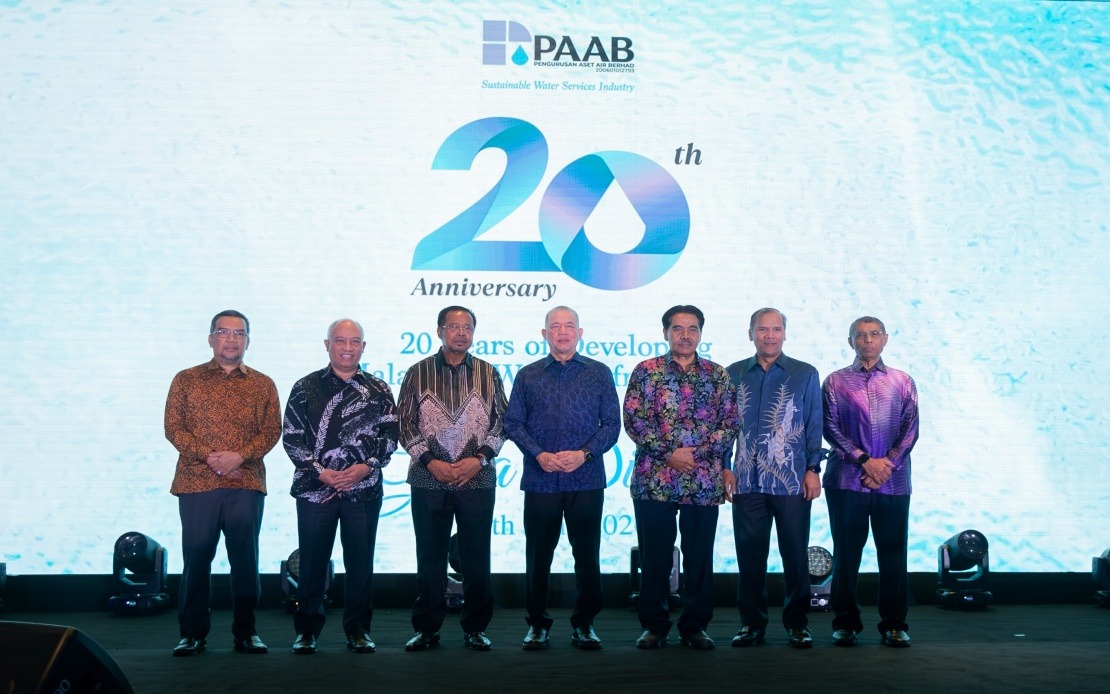
Pengurusan Aset Air Berhad (PAAB), the publicly owned water asset management company, reached a significant milestone this week as it commemorated two decades of reshaping Malaysia's water services landscape. Since its inception on May 5, 2006, PAAB has emerged as the central financial engine behind the nation's water sector transformation, directing substantial resources into modernising infrastructure and securing long-term water supply resilience. The organisation's 20th anniversary celebration, held at Menara Felda Platinum Park, underscored the scale and complexity of this ongoing restructuring effort, drawing high-level government participation and renewed policy focus.
The financial scope of PAAB's two-decade operation is substantial. The organisation has channelled RM23.04 billion towards refinancing and assuming water industry debts, while simultaneously investing RM23.84 billion in new infrastructure development. These figures combine to demonstrate a total capital deployment of RM46.88 billion—a commitment that positions PAAB as integral to Malaysia's broader public infrastructure modernisation programme. Beyond the headline numbers, this investment reflects a deliberate strategy to consolidate the fragmented water sector and establish institutional mechanisms capable of managing long-term service delivery obligations.
Tangible progress across the water network reflects PAAB's investment priorities. As of December 2025, ten states have formally adopted the National Water Services Industry Restructuring Plan, initiating coordinated infrastructure upgrades. Completed projects include 21 new water treatment plants with combined daily production capacity of 2,085 million litres, 42 storage facilities totalling 783 million litres of storage capacity, and 3,263 kilometres of pipeline replacement and expansion work distributed nationwide. These operational assets form the backbone of improved water security, though their deployment masks persistent challenges requiring immediate policy intervention.
Deputy Prime Minister Datuk Seri Fadillah Yusof, who also holds the Energy Transition and Water Transformation portfolio, used the occasion to redirect attention toward an uncomfortable truth: Malaysia's water system loses approximately 40 per cent of treated water through leakage and theft before reaching consumers. This non-revenue water (NRW) problem represents a critical vulnerability that infrastructure investment alone cannot resolve. Fadillah's remarks signalled frustration with timelines that defer aggressive action, emphasising that Malaysia cannot afford to wait until 2050 to address systemic losses affecting both households and strategic industrial investors.
The tension between long-term planning horizons and immediate operational challenges shaped Fadillah's intervention. While PAAB and regulatory bodies operate under a 44-year transformation roadmap extending to 2050, the Deputy Prime Minister stressed that the current scale of water losses demands urgent coordinated action across federal agencies and state governments. The concern reflects Malaysia's increasing reliance on stable water and energy supply to attract and retain foreign investment in data centres and other high-value sectors. Any disruption to water services poses direct economic risk, making the 40 per cent NRW figure not merely an operational embarrassment but a competitive liability.
PAAB's operational structure reflects the complexity of sector reorganisation. Chairman Datuk Seri Jaseni Maidinsa outlined the organisation's mandate within a phased implementation strategy spanning four decades. The Migration phase (2008–2020) focused on initial consolidation and asset transfer. The Stabilisation phase (2021–2030) targets system optimisation and efficiency gains. The Consolidation phase (2031–2040) aims to deepen integration and service quality improvements. Finally, the Full Cost Recovery phase (2041–2050) envisions a self-sustaining financial model where water pricing fully reflects underlying service delivery costs. This staged approach acknowledges that sectoral transformation requires extended timeframes for institutional adjustment, yet paradoxically collides with the imperative for immediate NRW reduction.
Capital allocation patterns reveal PAAB's spending priorities. Of the RM23.84 billion invested by December 2025, RM8.33 billion funded projects already completed and transferred to operating entities. A further RM1.84 billion supports projects currently under construction. The substantial RM13.67 billion allocation to projects in design and planning stages signals that PAAB's investment pipeline remains heavily weighted toward future years. This distribution suggests that many communities will experience infrastructure upgrades in subsequent phases, with implications for water security and service quality during the interim period.
The water sector restructuring initiative reflects Malaysia's attempt to transition from fragmented, politically-influenced management to institutionalised financial governance. PAAB's role as a holding company insulates operational entities from direct political pressure whilst maintaining public ownership and accountability frameworks. This model parallels approaches adopted elsewhere in developing Asia, where asset-holding companies attempt to depoliticise infrastructure finance. However, the persistent NRW problem suggests that institutional restructuring alone proves insufficient without simultaneous operational discipline and investment in non-revenue water reduction technologies.
Regional implications warrant consideration. Southeast Asian economies increasingly compete for investment in digital infrastructure and technology manufacturing, sectors with intensive water requirements. Malaysia's visible commitment to water security through PAAB's investments signals credibility to prospective foreign investors. However, the 40 per cent NRW rate directly undermines this message, suggesting that capital deployment into new infrastructure proceeds faster than optimisation of existing networks. Neighbouring countries operating with significantly lower NRW rates possess competitive advantage in attracting water-intensive industries.
The restructuring roadmap also reflects shifting responsibility allocation. By establishing PAAB as the central financing vehicle, the government compartmentalised infrastructure finance from immediate political budgeting, potentially enabling countercyclical investment patterns. However, this institutional separation potentially obscures the urgency of operational improvement. Deputy PM Fadillah's intervention highlighted this disconnect: the financial engineering of PAAB's establishment, whilst necessary, does not automatically translate into operational excellence or reduced system losses.
Looking forward, the alignment of PAAB's capital investment programme with NRW reduction targets remains unclear. The investment pipeline emphasizes production and storage capacity expansion, yet the most immediate return on investment likely emerges from systematic leak detection, pipe replacement, theft prevention, and metering technology. Whether PAAB's RM13.67 billion in planned projects adequately prioritises non-revenue water reduction remains a critical question for both water security and economic competitiveness.
The 20th anniversary milestone, while justifiably celebrating two decades of sectoral restructuring, simultaneously highlights persistent vulnerabilities. PAAB has successfully mobilised capital and established institutional mechanisms for long-term planning. Yet operational challenges—particularly the 40 per cent NRW rate—demonstrate that financial investment and structural reorganisation, whilst necessary, require complementary operational discipline and immediate corrective action. The path to sustainable, secure water supply depends equally on institutional innovation and rigorous execution across existing assets.

