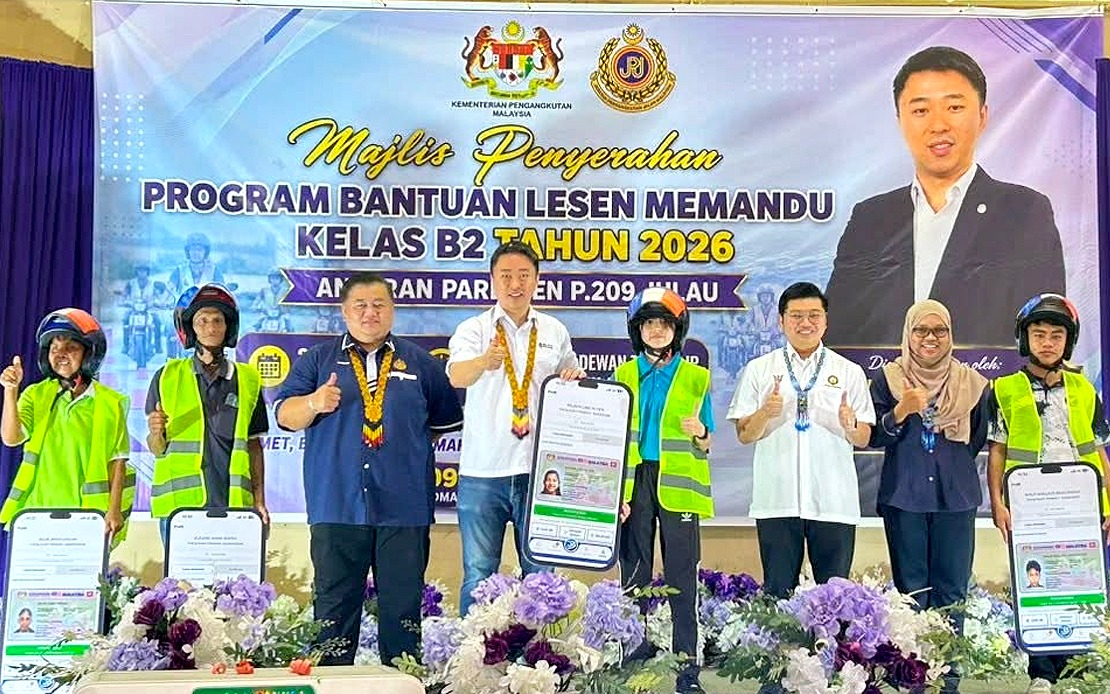
The Driving Licence Assistance Programme concluded on June 28 in Sarikei, marking a significant milestone for 885 rural residents of the Julau parliamentary constituency in Sarawak who gained legal riding credentials and access to government fuel subsidies. The initiative, delivered through the 2026 Class B2 Probationary Driving Licence scheme, addresses a longstanding barrier that has prevented smallholder farmers and rural workers from benefiting from petrol subsidies—a critical lifeline in a region where fuel costs directly impact household economics and agricultural viability.
For many participants, the lack of a valid licence had forced them to purchase fuel at full market rates, creating an invisible tax on rural incomes. Bajik Undum, a 57-year-old orchardist from Rumah Ajau in Ulu Kuntau, Pakan, exemplifies the programme's immediate impact. She previously spent substantially more on non-subsidised petrol to fuel the motorcycle she uses for daily orchard work and produce transport. The financial squeeze was acute; with contemporary fuel prices elevated across Malaysia, the differential between subsidised and market-rate petrol represents a meaningful proportion of operational costs for small-scale farmers operating on tight margins. Obtaining her Class B2 licence through the assistance scheme immediately qualified her for subsidised rates, providing tangible relief from daily transport expenses.
Kudang Jenggi, the oldest male beneficiary at 64, works as a bird's nest house caretaker in Bayong, Sarikei. Like many rural participants, his motorcycle serves as the essential connection to employment and family obligations. Beyond the financial advantage of subsidised fuel, he stressed the psychological and legal security of holding a valid licence. Passing through roadblocks no longer triggers anxiety; he operates within legal frameworks, reducing vulnerability to enforcement actions. This dimension—the legitimacy and dignity that formal documentation confers—often receives less attention than economic metrics but profoundly affects rural residents' sense of security and participation in state services.
Daniel Padong, 45, relies on his motorcycle to reach his oil palm smallholding daily. Rising petrol prices have compressed already-modest margins in palm cultivation, where input costs consume substantial portions of revenue. The licence programme offered him immediate cost mitigation through fuel subsidy eligibility, demonstrating how targeted interventions can support marginal agricultural enterprises. For smallholders across Southeast Asia competing in volatile commodity markets, reducing controllable expenses like transport becomes critical to survival.
The programme's design reflects understanding of rural Malaysia's transport realities. Unlike urban and peri-urban areas with diverse public transport options, rural constituencies depend fundamentally on private motorcycles for agricultural work, commercial activity, and access to services. Simultaneously, administrative barriers—including costs and awareness gaps surrounding licence acquisition—have left portions of rural populations operating informally. The Driving Licence Assistance Programme reduces these barriers, bringing residents into formal systems while they simultaneously access social safety nets like fuel subsidies.
Julau MP Datuk Larry Sng Wei Shien, who chairs the Malaysian Timber Industry Board, officiated the closing ceremony alongside Sarawak Road Transport Department director Norizan Jili. Their presence underscores governmental commitment to rural service delivery, though sustainability requires ongoing resource allocation to ensure future cohorts receive similar support. Sarawak, as a large state with dispersed rural populations and significant agricultural sectors, faces particular challenges in delivering programmes uniformly across constituencies.
The subsidy component warrants contextual examination. Malaysia's fuel subsidy system, particularly for motorcycles and rural users, represents a significant fiscal commitment designed to protect lower-income populations from commodity price volatility. However, beneficiaries must hold valid licences—a requirement that administratively excludes undocumented or informal riders. By reducing licence acquisition barriers, the programme expands the eligible population's access to this safety net, technically increasing subsidy expenditure while deepening its reach into genuinely vulnerable communities.
Rural transport infrastructure across Malaysia and Southeast Asia reflects persistent investment gaps. Licencing programmes represent one strand of rural development policy, alongside road maintenance, public transport provision, and safety regulation. The Julau initiative operates within this broader context, addressing demand-side constraints (rider credentials and subsidy access) rather than supply-side challenges like road quality or fuel distribution infrastructure. Comprehensive rural transport policy requires coordinated interventions across multiple domains.
The programme's gender dimension also merits attention. Bajik Undum, identified as the oldest female participant, represents agricultural workers often invisible in formal statistics. Women constitute substantial portions of rural agricultural workforces across Malaysia and Southeast Asia, yet policy discussions frequently overlook gender-differentiated transport patterns and mobility barriers. Programmes that deliberately include and track female participation contribute to more inclusive rural development understanding.
Looking forward, replicating this model across other constituencies—particularly those with significant agricultural populations—could extend benefits to thousands of rural residents currently disadvantaged by licence documentation gaps. Sustainability requires sustained funding for assistance programmes and coordination between state transport departments and parliamentary constituencies. Additionally, monitoring outcomes beyond immediate licence issuance—tracking actual subsidy uptake, cost savings realised, and economic impacts on smallholder livelihoods—would strengthen evidence foundations for future policy iterations.
The Julau programme represents practical recognition that rural development requires attending to administrative and financial friction points that accumulate disparately among lower-income populations. By simultaneously addressing licensing barriers and enabling subsidy access, it demonstrates how targeted interventions can reduce compound disadvantages facing agricultural workers and smallholders whose livelihoods depend on motorcycle transport.

