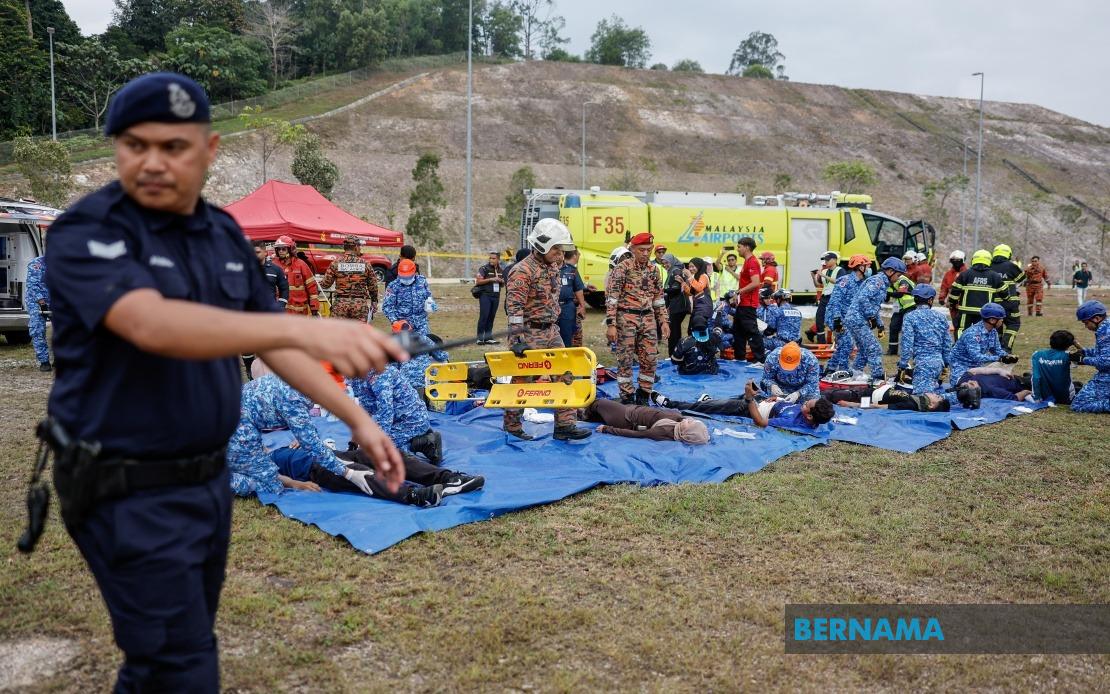
A comprehensive full-scale air disaster exercise dubbed Ex Urban Falcon 2026 brought together more than 20 enforcement and emergency response agencies in Shah Alam on July 16, marking the first coordinated test of Malaysia's ability to manage an aircraft accident occurring well beyond airport boundaries. The simulation, conducted at the Denai Alam Rest and Service Area along the Damansara-Shah Alam Elevated Expressway, replicated the crash of an ATR72 aircraft approximately six kilometres from Sultan Abdul Aziz Shah Airport in Subang, testing the country's emergency response infrastructure in an unconventional setting.
According to Muhammad Hidayat Ismail, general manager of Airport Fire and Rescue Services (AFRS), the drill represents a significant shift in Malaysia's approach to aviation safety preparedness. While previous exercises focused on incidents occurring within or near airport boundaries, this operation stretched response capabilities by placing the emergency scenario on highways intersected by toll plazas and narrow local roads. The distinction reflects growing recognition that not all aviation emergencies conform to predictable locations, and authorities must be equipped to manage crises in built-up suburban areas where infrastructure poses unique challenges.
The exercise was designed to validate Malaysia Airports Holdings Berhad's coordination mechanisms and test the broader operational framework outlined in the National Aeronautical Search and Rescue Manual. AFRS holds responsibility for rescue operations within an eight-kilometre radius of any airport's midpoint, establishing the legal and operational context for the drill. By simulating a crash outside this immediate zone, the exercise forced responding agencies to clarify roles and responsibilities when incidents occur at the boundary of conventional airport emergency protocols, highlighting potential gaps in inter-agency communication and resource deployment.
One of the most significant findings from the simulation was the operational friction created by Malaysia's road infrastructure. Response teams discovered that navigating to an off-airport crash site required traversing multiple toll plazas and local roads not designed for rapid emergency vehicle passage. This logistical reality stands in sharp contrast to the straightforward routing available during airport-based incidents, where dedicated emergency roads and predetermined access routes streamline response times. For rescue coordinators, the exercise underscored how suburban crashes demand not only faster personnel mobilisation but also traffic management cooperation from toll operators and local authorities.
Muhammad Hidayat noted a fundamental difference in victim survivability between airport and off-airport crashes, primarily driven by terrain factors. Aircraft landing at Sultan Abdul Aziz Shah Airport operate within a controlled environment designed to minimise impact severity, whereas suburban environments offer uneven ground, structures, and obstacles that dramatically increase casualty rates and injury severity. This distinction carries profound implications for how Malaysia calibrates its medical response, with off-airport scenarios requiring larger-scale deployment of trauma specialists, field hospitals, and extended care facilities compared to incidents occurring at or near airports.
The drill brought together approximately 450 personnel from critical public and private sector organisations, reflecting the complexity of coordinating aviation disasters in Malaysia's multi-agency environment. Malaysia Airports Holdings Berhad, the National Disaster Management Agency, the Selangor state government, and PROLINTAS—which operates the Damansara-Shah Alam Elevated Expressway—collaborated to create a realistic scenario that tested not just technical firefighting and rescue capabilities but administrative coordination under stress. This breadth of participation ensured that the exercise captured the real-world fragmentation of authority that characterises emergency response in Malaysia's federal system.
Disaster Victim Identification operations emerged as a particular focus area during the simulation. Muhammad Hidayat highlighted that off-airport crashes typically produce casualty counts that exceed survivable cases, creating unprecedented demands for the Royal Malaysia Police-led identification process. When hundreds of fatalities require identification in suburban settings far from dedicated morgue facilities, the entire forensic, administrative, and investigative apparatus faces strain. The exercise provided the first realistic test of how Malaysia's identification protocols scale when moved beyond airport facilities and into temporary civilian infrastructure.
Technologically, AFRS confirmed that Malaysia's aircraft firefighting capabilities meet stringent International Civil Aviation Organisation and Civil Aviation Authority of Malaysia standards. The fleet of specialised vehicles deployed during Ex Urban Falcon 2026 performed according to specification, though the exercise revealed that technical capability alone cannot compensate for logistical constraints imposed by geography and infrastructure. This finding suggests that future investments should prioritise pre-positioning additional resources in suburban corridors near major airports, rather than assuming that existing airport-based equipment can be rapidly relocated to distant crash sites.
Aircraft accidents occurring outside airport perimeters represent a statistically rare but catastrophically consequential scenario. By conducting Ex Urban Falcon 2026, Malaysia positioned itself ahead of many regional peers in proactively testing response mechanisms for this contingency. Most nations only conduct such exercises following actual incidents, inheriting institutional lessons through tragedy rather than anticipatory planning. Malaysia's approach demonstrates that policy makers in Kuala Lumpur recognise that aviation's rapid growth, the proliferation of flight paths over increasingly densely populated areas, and the expansion of airports toward suburban zones have collectively elevated the probability of off-airport incidents.
The findings and operational challenges identified during the exercise will be synthesised at a dedicated workshop scheduled for July 26 and 27. During this two-day session, participating agencies will collectively review performance data, identify bottlenecks, and develop concrete improvement measures addressing the gaps exposed in real time. This structured debrief process separates serious emergency management from ad hoc response, embedding lessons into institutional practice rather than allowing them to dissipate after the exercise concludes.
For Malaysian aviation stakeholders and neighbouring Southeast Asian nations monitoring Malaysia's preparedness, Ex Urban Falcon 2026 signals institutional maturity in disaster management thinking. The exercise demonstrates that Malaysia's authorities understand the distinction between managing controlled crises within airport boundaries and responding to uncontrolled catastrophes in civilian areas. This recognition carries implications for regional aviation networks, as major Southeast Asian hubs increasingly operate overlapping flight corridors and shared airspace. If Malaysia strengthens its off-airport response capacity, it simultaneously elevates the safety baseline for regional aviation more broadly, benefiting citizens across multiple nations who depend on these air routes.
Muhammad Hidayat emphasised that the sustained commitment demonstrated by all participating agencies reinforces public confidence in Malaysia's aviation safety framework. Such confidence rests not merely on aircraft design standards or pilot training, but on the existence of credible, tested emergency response systems that citizens can trust. By publishing evidence that emergency protocols have been validated through comprehensive simulation involving hundreds of trained personnel, Malaysian authorities send a signal to the flying public that aviation is not merely safe in isolation, but that systematic preparation exists to manage the worst-case scenarios when safety systems fail.
The exercise ultimately reflects a maturation in how Malaysia approaches risk management in complex, interconnected systems. Rather than assuming that past incident patterns will continue indefinitely, planners have acknowledged that rapid urban expansion, intensifying air traffic, and changing flight patterns may produce future emergencies unlike those previously experienced. By stress-testing systems proactively through Ex Urban Falcon 2026, Malaysia invests in preventing surprise rather than merely reacting to it, a distinction that separates sophisticated disaster management from institutional complacency.

