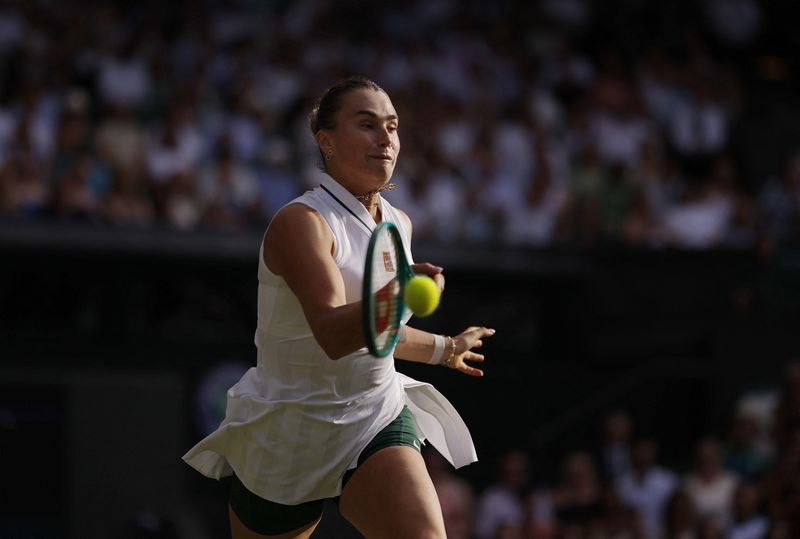
Naomi Osaka's return to competitive tennis following her 2024 comeback has produced one of the tournament's most significant results, as the Japanese star dismantled top-seeded Aryna Sabalenka 6-2 7-6(2) on Centre Court in Sunday's Day Seven showdown at Wimbledon. The fourth-round victory catapults the 14th seed into uncharted territory at the grasscourt championship while simultaneously transforming the women's tournament landscape, with the elimination of the tournament's three highest-ranked players now guaranteed.
For Sabalenka, the result represents a painful departure from a competition where she had reached the semi-finals in three consecutive years, arriving this year with realistic aspirations of claiming her first Wimbledon title. The Belarusian powerhouse was visibly overwhelmed during the opening set, which lasted just 32 minutes as Osaka's aggressive returning game systematically dismantled her service rhythm. The top seed's aggressive baseline play, which has proven so devastating across hardcourt surfaces, found no purchase on the grass, leaving her prone to frequent errors and forcing her to raise her game in frustration.
The second set offered more competitive resistance from Sabalenka, though Osaka's composure never wavered. In a particularly defining moment, the Japanese player claimed a tiebreak victory that snapped Sabalenka's remarkable streak of 21 consecutive tiebreak victories across Grand Slam tournaments. That statistical milestone underscores just how clinical Osaka's performance was against an opponent unaccustomed to such baseline vulnerability. When Sabalenka subsequently missed a match point in the tiebreak, her frustration boiled over into an explosive moment where she struck a ball far into the London sky, a visceral release of disappointment that underscored her inability to manage the tactical challenge Osaka presented.
Osaka's advancement assumes particular significance given the broader context of this year's women's draw collapse. Defending champion Iga Swiatek exited in the third round on Saturday, followed swiftly by second seed Elena Rybakina's departure on the same day. With Sabalenka now eliminated, the pathway to the Wimbledon title has been dramatically opened, creating opportunities for unseeded or lower-ranked competitors that rarely materialise at Grand Slam tournaments. This unprecedented scenario injects considerable unpredictability into the final rounds, fundamentally reshaping betting odds and strategic considerations for remaining contenders.
For Osaka herself, this victory assumes dimensions that extend well beyond tournament advancement. Having returned to professional tennis in 2024 following the birth of her daughter Shai, she had been steadily rebuilding her ranking and competitive rhythm without achieving the marquee victories that would signal a genuine return to form. This win against the world's leading player, achieved on one of tennis's most hallowed courts, represents the most substantial scalp of her renaissance campaign. Her post-match comments reflected both the emotional weight and genuine enjoyment she derived from the contest, with the player explicitly noting that she had not experienced such court satisfaction in considerable time.
The historical context between these two players adds another layer to this upset. Both Osaka and Sabalenka have constructed their Grand Slam legacies predominantly on hardcourt surfaces, with each claiming four major titles on faster courts where their power-based games flourish. Remarkably, despite their parallel trajectories and similar age ranges—born merely seven months apart—they had never faced each other at a Grand Slam tournament since their first meeting eight years ago, when Osaka prevailed en route to the United States Open title. This Sunday encounter represented their first Slam meeting in nearly a decade, suggesting that the competitive landscape of women's tennis has undergone substantial transformation since their last major championship collision.
Osaka's tactical performance demonstrated a sophisticated understanding of how to neutralise Sabalenka's strengths on grass. Rather than attempting to trade power from the baseline, Osaka focused on aggressive return-of-serve positioning that prevented Sabalenka from establishing the rhythm her game requires. Her own service games proved remarkably stable throughout, denying the top seed the opportunities that might have shifted momentum. This strategic clarity, combined with the evident joy Osaka displayed in executing her gameplan, suggests that her mental approach to competitive tennis has matured considerably during her time away from the professional circuit.
For Malaysian and Southeast Asian tennis enthusiasts, Osaka's trajectory carries particular resonance as a high-profile Asian player rebuilding a career after personal considerations. Her commitment to continuing professional competition while maintaining her family priorities challenges traditional narratives about athlete longevity and sacrifice. Furthermore, her willingness to engage with fashion and cultural expression through her court walk-on outfits—incorporating Japanese-inspired designs—demonstrates how contemporary tennis athletes negotiate identity and authenticity within the sport's conservative traditions.
Sabalenka's post-match conduct and comments revealed the psychological toll of the upset, as the 28-year-old arrived at her press conference visibly drained and expressed her immediate intention to retreat from competitive considerations temporarily. Her comment about preferring to drink and forget about tennis suggested not merely disappointment but genuine shock at how thoroughly she had been outplayed by a player she had beaten three consecutive times previously. This reversal in their head-to-head record, combined with the manner of the defeat, likely ensures that both players will approach any future encounters with considerably more mutual respect.
Osaka now advances to face Czech 10th seed Karolina Muchova in the quarter-finals, continuing a run that just days ago seemed unlikely given the extraordinarily talented competition ranged against her. The quarter-final draw has been fundamentally recalibrated by the departures of three top seeds, potentially offering an unexpected pathway toward the championship that few anticipated before this week's rapid eliminations. For Osaka, each successive victory now carries exponentially greater significance, as extended tournament runs would further validate her return from maternity leave and potentially reposition her among women's tennis elite.

