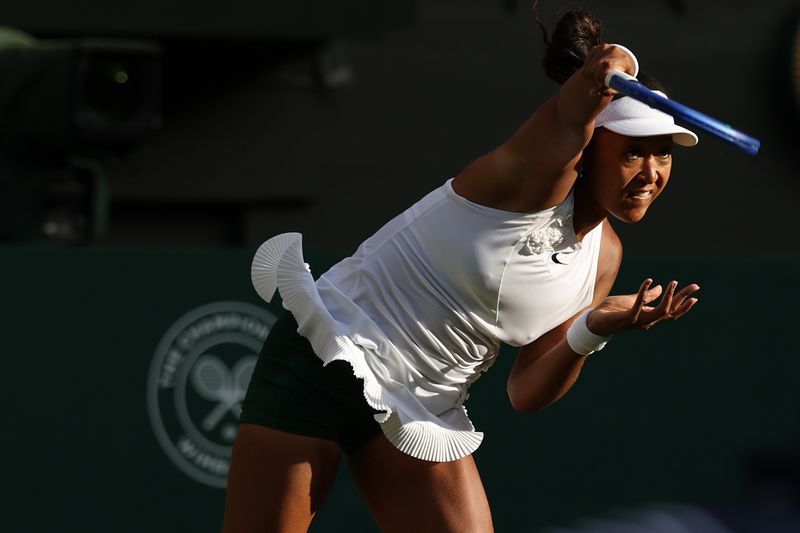
Naomi Osaka's commanding 6-2 7-6(2) victory over top seed Aryna Sabalenka at Wimbledon this week marked a decisive turning point in the women's tournament, as the Japanese 14th seed dismantled one of the competition's strongest remaining contenders with the calibre of tennis that once earned her four Grand Slam crowns. Playing with composure and precision on Centre Court, Osaka progressed to her first quarter-final at the All England Club, punctuating an already extraordinary seven days during which the tournament's hierarchy has been systematically dismantled.
The trajectory of this year's Wimbledon women's draw has become increasingly turbulent for the sport's established elite. Defending champion Iga Swiatek and 2022 winner Elena Rybakina both departed in the third round, while Osaka's demolition of Sabalenka means the competition has now lost its three highest-seeded contenders. The collision between Osaka and Sabalenka carried particular significance given their shared pedigree: both are 28-year-olds boasting four Grand Slam titles apiece, yet those triumphs have materialised exclusively on hard courts, rendering this grass-court encounter a genuine clash of styles and temperament.
Their head-to-head record heading into the match had tilted decidedly in Sabalenka's favour. Following Osaka's defeat of the Belarusian competitor during her run to the 2018 U.S. Open championship, nearly eight years elapsed before the pair encountered each other again on the professional circuit. When they finally reconvened, Sabalenka seized control of their rivalry, accumulating three consecutive victories earlier this season alone. Yet Osaka's resurgence in 2024 following her return from maternity leave has gathered momentum, and on Monday she demonstrated that prior defeats held no psychological weight as she dismantled her opponent with sustained power and precision that left Sabalenka visibly frustrated throughout their encounter.
While anticipation surrounding the Sabalenka-Osaka showdown had been palpable, the actual spectacle failed to ignite the fireworks many observers had envisaged. Rather than an extended contest between two hardcourt specialists adapting to grass, Osaka imposed her game relentlessly from the opening service games, establishing such commanding control that Sabalenka never recovered her equilibrium. The Japanese competitor's display represents her most impressive victory since commencing her comeback to professional tennis twelve months ago, establishing her as a genuine threat to the entire remaining field. When asked about her accomplishment, Osaka reflected on the emotional significance of reversing three consecutive losses: "I lost to her like three times in a row, so that really sucked."
Osaka's entrance to Centre Court for the match turned heads for sartorial reasons distinct from her dominant performance. The competitor wore a kimono-style walk-on outfit celebrating her admiration for a character from Quentin Tarantino's film Kill Bill. When later questioned about her fashion statement, she indicated that strategic considerations regarding her impending match had prompted a deliberately understated presentation. Her measured response revealed a player increasingly prioritising tennis execution over extracurricular spectacle: "I actually really wanted to focus on the match. So that was me being very tame. I kind of want to focus on my tennis now, so I might dial back a little bit."
The elimination of Krejcikova by fellow Czech player Karolina Muchova in the fourth round compounds the upheaval rippling through the women's bracket. This cascade of upsets guarantees that Wimbledon will crown a maiden women's champion for the ninth consecutive year, a striking pattern that underscores both the depth of talent permeating women's tennis and the particular challenge grass presents to traditionally dominant competitors. Osaka will next encounter Muchova, who dismantled the reigning 2024 champion 7-5 5-7 6-3 in a tightly contested fourth-round battle that demanded three sets to resolve.
While the women's draw has experienced seismic disruption, the men's competition has proceeded along more conventional trajectories. Novak Djokovic advanced to his seventeenth Wimbledon quarter-final through a laboured 7-6(6) 6-3 3-6 6-3 victory against Russian qualifier Roman Safiullin that the 39-year-old characterised as aesthetically displeasing. The Serbian champion's performance lacked the rhythmic fluidity that typically distinguishes his grass-court play, and he subsequently acknowledged his discomfort throughout the encounter. "To be honest, I haven't felt really great on the court, so I was relieved to get out of it and get a win," Djokovic reflected. "Satisfaction and enjoyment weren't part of today's win."
Despite the ungainly nature of his passage through, Djokovic's advancement carries profound significance for the tournament's final stages. The victory elevated him past Swiss legend Roger Federer's men's record of 105 Wimbledon match victories, establishing a new benchmark that underscores his extraordinary longevity at the sport's highest competitive level. The Serbian's continued progression has positioned him to potentially encounter defending champion Jannik Sinner in the semi-finals, contingent upon Djokovic disposing of Canadian third seed Felix Auger-Aliassime in the quarter-finals.
Auger-Aliassime secured his own quarter-final berth through an exhausting four-hour 26-minute marathon against Spain's final representative Alejandro Davidovich Fokina. The engrossing 6-7(4) 7-6(6) 6-3 6-7(2) 6-1 contest concluded with an acrimonious exchange of words at the net, illustrating the emotional toll extended baseline battles inflict upon competitors. Poland's Hubert Hurkacz experienced particularly cruel misfortune in his fifth-set encounter with German veteran Jan-Lennard Struff, who at 36 years of age is experiencing his maiden Grand Slam quarter-final appearance following Hurkacz's forced retirement.
The American contingent in the women's draw has demonstrated unexpected resilience, with five representatives advancing to the round of sixteen—the highest figure since 2002. Among them, fourth seed Jessica Pegula demonstrated superior match management in dispatching 18-year-old sensation Iva Jovic 4-6 6-3 6-1 on Court One, equalling her best previous Wimbledon result. Pegula's experience-driven dominance suggests the American could encounter another compatriot in subsequent rounds, should Coco Gauff navigate past Swiss competitor Belinda Bencic. The unexpected depth of American representation augments the unpredictability that has come to characterise this year's championship, where conventional seeding has repeatedly yielded to genuine competition.

