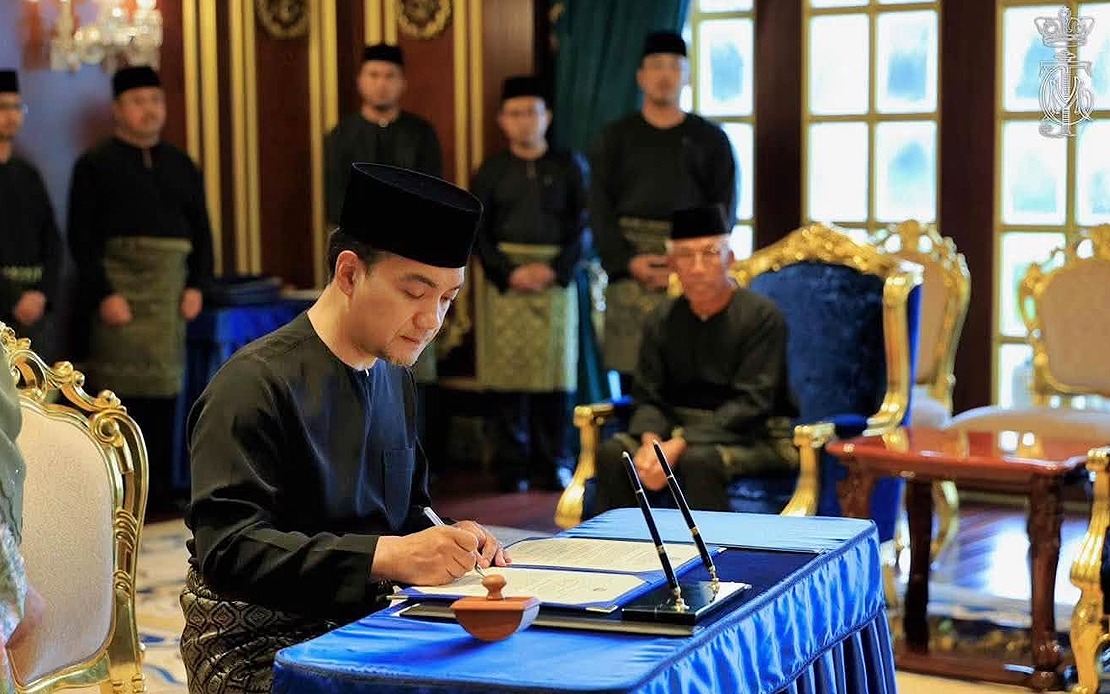
Datuk Onn Hafiz Ghazi begins his second term as Johor Menteri Besar with a reinforced electoral mandate and the weight of Malaysia's most prominent political pedigree behind him. The 48-year-old leader took his oath of office before the Regent of Johor, Tunku Mahkota Ismail, at Istana Bukit Serene following Barisan Nasional's resounding performance in the state election, securing 48 of the 56 available state seats. This represents a significant improvement on the coalition's 2022 performance, when it captured 40 seats, giving Onn Hafiz a stronger foundation from which to advance his governance agenda across the southern peninsula's largest economy.
The expanded parliamentary majority arrives at a critical juncture for Johor's economic positioning within Southeast Asia. With a government now commanding nearly 86 percent of state assembly seats, Onn Hafiz faces minimal legislative obstruction in advancing the "Maju Johor 2030" blueprint, the state's comprehensive long-term development strategy focused on economic diversification and attracting foreign and domestic investment. The enhanced majority signals voter confidence in continuity, particularly important given Johor's role as a crucial economic bridge between Malaysia and Singapore, as well as its significance as a gateway to the broader Southeast Asian market.
Onn Hafiz's ascendancy represents the continuation of one of Malaysia's most influential political dynasties. As the great-grandson of Datuk Onn Jaafar, the visionary founder of UMNO who served as Johor's seventh Menteri Besar, and as the grandson of Tun Hussein Onn, Malaysia's third Prime Minister, Onn Hafiz embodies a lineage that has shaped both the state and the nation for generations. This familial connection to foundational figures in Malaysian governance provides him with institutional knowledge and political networks that most regional leaders cannot access, though it also invites scrutiny regarding meritocracy and political succession in Malaysian governance structures.
Despite his aristocratic political background, Onn Hafiz has deliberately cultivated a corporate professional identity that distinguishes his administrative approach from traditional patronage-based politics. Born on March 2, 1978, he studied at Malaysia's Royal Military College before obtaining a bachelor's degree in accounting from the University of Hertfordshire in the United Kingdom. This educational trajectory positioned him for a significant career in international business, where he worked as an auditor and management consultant at PricewaterhouseCoopers between 2001 and 2004, subsequently transitioning into senior corporate roles including directorships and executive positions between 2005 and 2013. His experience at Chin Well Holdings Berhad and as chief executive officer of KMB Sdn Bhd embedded in him an operational focus on efficiency, profitability measurement, and systematic organizational management that contrasts with the more intuitive political leadership sometimes observed in Southeast Asian state administrations.
Onn Hafiz's transition from corporate management to electoral politics followed a methodical path through party structures. He joined UMNO Youth's executive council, serving as chief of the Sembrong UMNO Youth division from 2012 to 2018, while simultaneously working as political secretary to the Defence Minister. This dual engagement allowed him to accumulate both grassroots party experience and exposure to federal-level policymaking. His 2018 election victory as the Layang-Layang assemblyman, followed by his appointment as chairman of the Johor Tourism, Youth and Sports Committee, gradually positioned him within the state administration. His subsequent 2022 election victory in the Machap state seat ultimately culminated in his March 2022 appointment as Johor's 19th Menteri Besar, succeeding Datuk Hasni Mohammad.
Within institutional UMNO structures, Onn Hafiz has consolidated considerable influence over party mechanisms governing Johor. Since 2023, he has chaired the Johor UMNO Liaison Committee, the body coordinating all UMNO divisions within the state, while simultaneously serving as chief of the Simpang Renggam UMNO division. These dual positions ensure his direct command over party machinery at both state and divisional levels, critical for maintaining internal party discipline and advancing preferred candidates in future elections. His earlier service as deputy chief of Simpang Renggam from 2018 to 2023 provided a foundation for this consolidation of internal party authority.
The "Maju Johor 2030" framework represents Onn Hafiz's articulated vision for state development and reflects the managerial approach embedded from his corporate background. Rather than emphasizing symbolic projects or large-scale infrastructure announcements typical of Malaysian state governance, this blueprint prioritizes sustained economic expansion, diversified investment attraction across technology and manufacturing sectors, and systematic human capital development. The agenda aligns Johor's economic trajectory with the advanced development profiles of neighboring Singapore and emerging economic zones elsewhere in the region, positioning the state as a competitive destination within Southeast Asian manufacturing and service provision networks.
Onn Hafiz's family background as a father of four does not substantially feature in his political messaging or public administration philosophy, distinguishing his profile from several other Malaysian political figures who emphasize family-oriented governance approaches. This restraint in personalizing state governance reflects his corporate training, where professional competence rather than familial connection traditionally forms the basis for organizational advancement and public accountability. Whether this orientation can be sustained across a full second term, particularly as Johor faces persistent challenges including aging infrastructure in critical zones, skills gaps in emerging technology sectors, and demographic pressures in urban centers, will significantly shape public assessment of his leadership during this mandate period.
The electoral context surrounding Onn Hafiz's expanded majority extends beyond Johor's borders and carries implications for Malaysian federalism more broadly. Johor, as the economically largest state and historically a Barisan Nasional stronghold, has represented relative political stability compared to other Malaysian states experiencing multi-party competition and frequent government changes. His reinforced mandate reflects voter preference for continuity in a state where economic performance and administrative consistency have been prioritized over ideological differentiation between competing coalitions. This pattern, if sustained across upcoming federal and other state elections, may indicate a broader Malaysian electorate preference for predictable governance during periods of economic adjustment and regional strategic realignment.
Looking forward, Onn Hafiz's second term will be measured against his "Maju Johor 2030" implementation trajectory, the tangible economic outcomes for ordinary Johoreans across diverse economic sectors, and his ability to translate corporate management principles into effective public governance at state scale. The substantial assembly majority he now commands provides extensive legislative capacity, yet simultaneously raises accountability expectations. For Malaysian and Southeast Asian observers, his tenure offers a significant case study in whether business-trained technocratic leadership can deliver superior governance outcomes compared to traditionally oriented political administration, a question increasingly relevant across the region as states compete for investment and talent in evolving economic landscapes.

