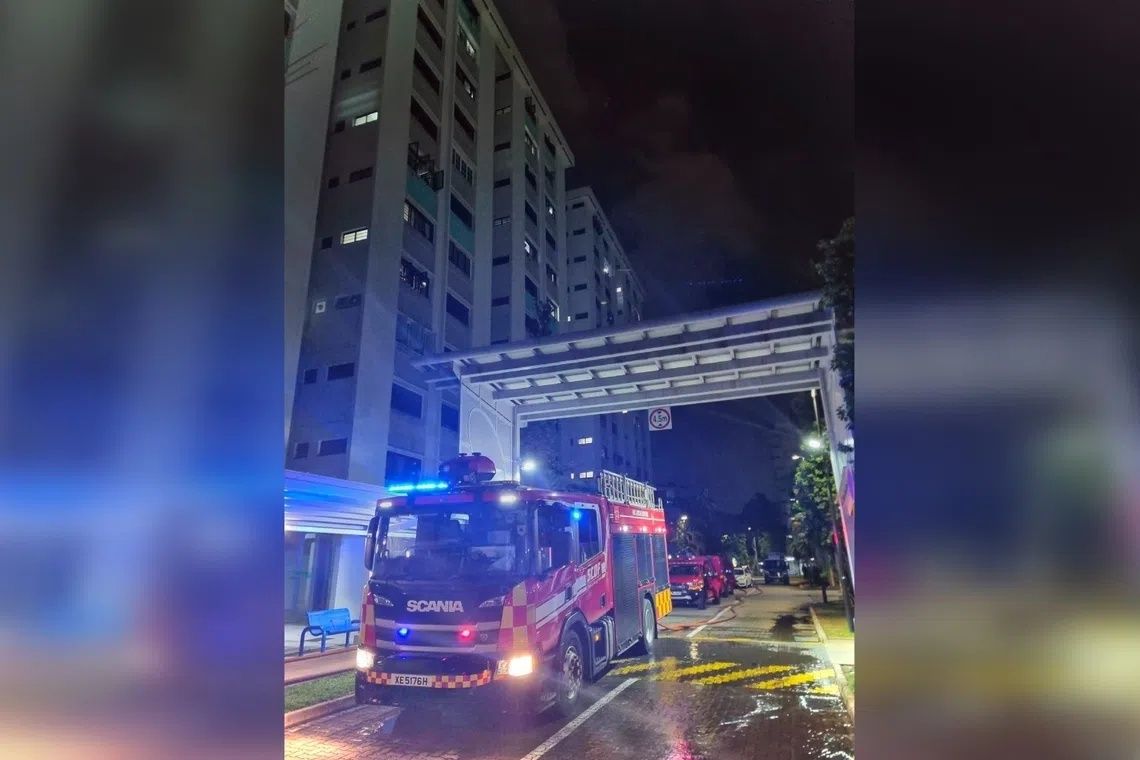
A resident of an eighth-floor Housing and Development Board flat in Clementi died following a fire that erupted late on Friday, July 31, marking another tragedy in Singapore's ongoing struggle with residential fire incidents. The Singapore Civil Defence Force was notified of the blaze at Block 309 Clementi Avenue 4 shortly before 11.10pm, arriving to find flames consuming the living room of the affected unit. Firefighters forced entry into the apartment and deployed two water jets to suppress the fire, which had engulfed furnishings and other combustible materials in the main living area.
The casualty—a person believed to have resided alone in the unit—was discovered unconscious in the kitchen during the firefighting operation and rushed to Ng Teng Fong General Hospital. Despite receiving emergency medical treatment, the individual was pronounced dead upon arrival. Holland-Bukit Timah GRC Member of Parliament Sim Ann, who serves as the second minister for both Foreign Affairs and Home Affairs, confirmed the fatality through a social media statement the following morning, expressing sorrow at the loss and pledging support to affected residents.
The rescue effort came at a cost to emergency personnel, with two firefighters sustaining burn-related injuries while combating the blaze. Both were transported to Singapore General Hospital for treatment, though one was subsequently discharged and is recovering at home. The incident underscores the physical dangers firefighters regularly face in close-quarter rescue operations within densely occupied residential buildings, where rapid response and entry procedures can expose them to severe thermal injuries.
As a precautionary measure, police and civil defence personnel evacuated approximately 40 residents from the affected building block. The evacuation was conducted systematically to ensure the safety of neighbouring residents while firefighting operations continued. By 1.30am on August 1, most evacuees had been cleared to return to their homes, demonstrating the relatively contained nature of the incident despite the tragedy within the affected unit. MP Sim praised the coordinated efforts of the SCDF, police force, residents' network volunteers, the People's Association, and town council staff in managing the emergency response and supporting the displaced residents.
Damage assessment conducted following the fire revealed that destruction beyond the origin unit remained limited, with common areas and adjoining residential spaces largely spared. Restoration work on shared property commenced promptly, reflecting the town council's commitment to swift recovery. Residents whose homes and personal belongings sustained fire-related damage have been assured of assistance programmes, signalling the authorities' intention to provide comprehensive support during their rebuilding process. Such measures are particularly critical in Singapore's high-density public housing context, where fire incidents can rapidly cascade across multiple units if not contained effectively.
The cause of the fire remains under investigation by the relevant authorities, with firefighting personnel and investigators working to determine the ignition source and contributing factors. Understanding the origin of the fire holds significance not only for this specific incident but for broader fire prevention strategies across Singapore's extensive HDB estate. Preliminary findings may inform residents and town councils about potential hazards requiring mitigation, whether related to electrical systems, cooking equipment, or other common residential fire sources.
This fatality contributes to a troubling upward trajectory in Singapore's fire-related harm statistics. According to the SCDF's annual data released in February, fire-related injuries have risen from 80 cases in 2024 to 94 in 2025, representing an 17.5 per cent increase year-on-year. Whilst fire fatalities showed a marginal improvement—declining from seven deaths in 2024 to six in 2025—the overall increase in injuries suggests that more people are being exposed to fire hazards or that fires themselves are spreading more extensively before control. The total number of fire incidents across Singapore climbed 3 per cent, from 1,990 in 2024 to 2,050 in 2025, indicating a persistent challenge for fire prevention and emergency response capabilities.
For Malaysian observers and policymakers, the Clementi incident serves as a sobering reminder of residential fire risks inherent in high-density urban housing environments. Many Malaysian cities, particularly in the Klang Valley and Kuala Lumpur, operate comparable multi-storey apartment blocks and public housing schemes where similar scenarios could unfold. The concentration of residents, shared electrical infrastructure, and rapid flame propagation in confined spaces present universal urban fire challenges transcending national boundaries. Singapore's disciplined response—rapid emergency mobilisation, coordinated multi-agency communication, and swift recovery planning—offers instructive lessons for Malaysian fire services and local authorities managing similar housing typologies.
The incident also highlights the considerable risk exposure borne by firefighters in rescue operations. Burn injuries sustained during this single incident affected two professionals, underscoring why comprehensive training, advanced protective equipment, and ongoing health monitoring remain essential investments for fire departments across Southeast Asia. The psychological dimension of responding to fatal incidents also deserves attention, as emergency personnel regularly encounter traumatic scenes that can affect long-term wellbeing. Supporting firefighter resilience through counselling services and peer support networks represents an often-overlooked component of effective emergency management infrastructure that Malaysian authorities might examine more closely.
Looking forward, the Clementi fire reinforces the importance of fire safety culture within residential communities. Public education campaigns emphasising smoke detector maintenance, evacuation planning, electrical safety, and reporting of hazardous conditions remain underutilised tools in most jurisdictions. Singapore's relatively low fatality count relative to its fire incident volume suggests that evacuation protocols and early warning systems function effectively, yet the rising injury figures indicate room for enhanced prevention measures. Malaysian towns could benefit from systematically evaluating comparable data and implementing targeted interventions in high-incident areas before tragedies necessitate reactive responses.

